 Greetings Friends and neighbors,
I hope you have had an opportunity to safely enjoy the weather this week. With some open spaces and parks re-opening, it can be challenging to maintain physical distance from others. Thanks to your dedication, Oregon has been successful at limiting the spread of COVID-19 and making certain our vital medical resources are not overburdened.
Parks Opening and returning to limited daytime service:
- Tryon Creek in Portland
- Willamette Mission north of Keizer
- Mongold boat ramp at Detroit Lake
- State Capitol State Park in Salem
- The Cove Palisades boat ramp at Lake Billy Chinook near Culver
- Prineville Reservoir boat ramp near Prineville
- Joseph Stewart boat ramp on Lost Creek Lake near Shady Cove
- Pilot Butte to pedestrians (no vehicles) in Bend
Limited day-use will slowly return to other state parks starting this week and is dependent on the readiness of the community to welcome visitors, as well as staff, supply and equipment availability. As our state makes this transition parks may re-close or open without a lot of warning. If you plan to visit a state park it is advised that you check oregonstateparks.org or call 800-551-6949 in advance. Again, please physically distance from other visitors, wear your mask and practice appropriate hygiene.
County Re-Opening
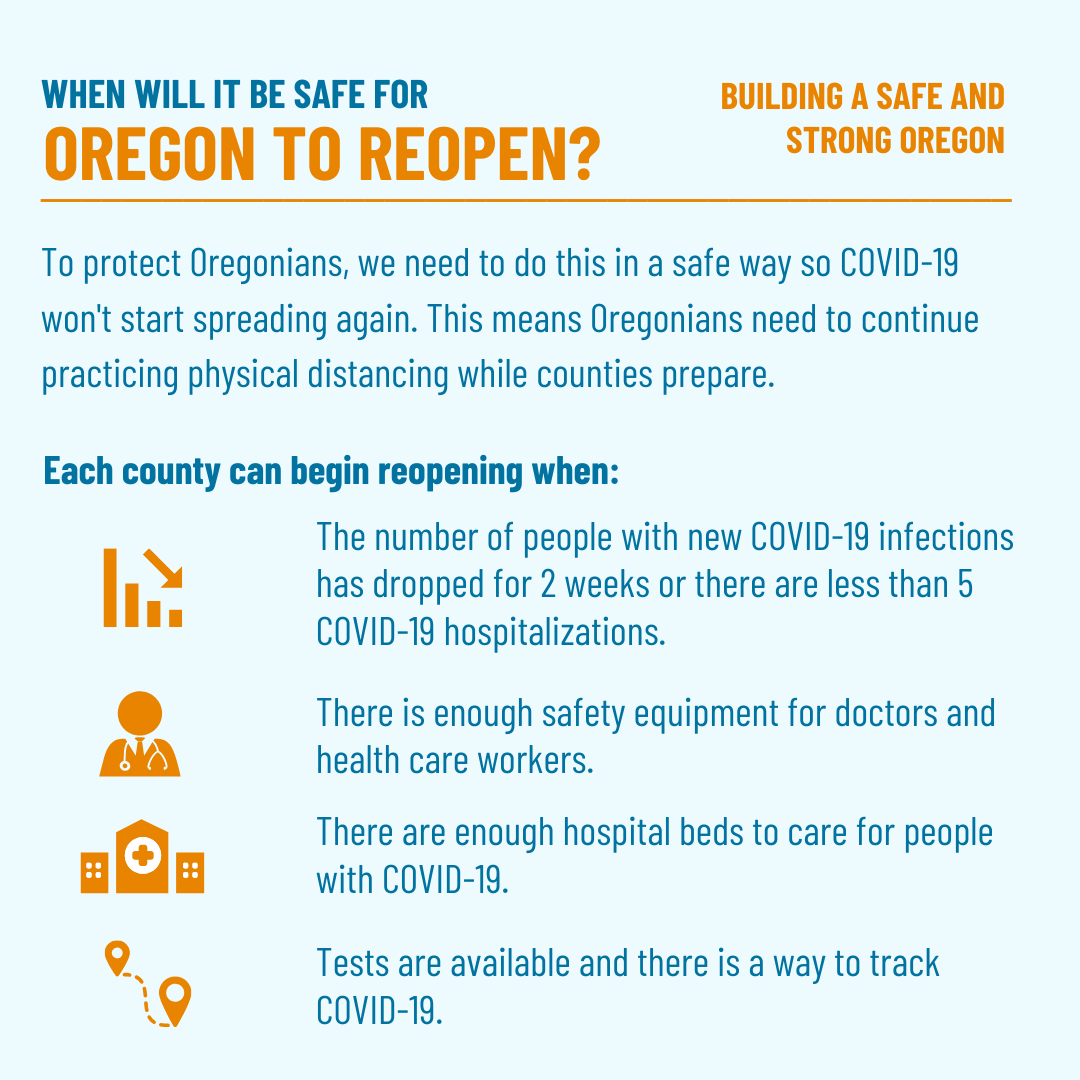
In our reopening plan, each county has the opportunity to apply to enter Phase 1 after meeting certain pre-requisites. The county will need to:
- Show a decline in COVID-19 or have fewer than 5 hospitalizations,
- Have sufficient COVID-19 testing and contact tracing capability,
- Establish plans for the isolation and quarantine of new cases,
- Have the hospital capacity to handle any surge in COVID-19 cases
- And have enough personal protective equipment for health care workers.
When a county enters Phase I it can begin the limited reopening of certain sectors under specific safety guidelines:
- Restaurants and bars for sit-down service.
- Personal care and services businesses, including barbers and salons.
- In-person gatherings of up to 25 people.
Counties must be in Phase I successfully for at least 21 days before they are elgible to consider entering Phase II. If counties begin to see significant increases in COVID-19 cases or community spread, the Oregon Health Authority will collaborate with the county and local governments to decide on appropriate action, including possibly going back to stay-home status. I recommend viewing the presentation on reopening. You can also watch Governor Brown’s press conference here.
Again, thank you for doing your part. Each of us has a role to play during this crisis. I know this has posed a challenge. It’s important we continue to practice these distancing measures. Each of our continued efforts will be key to Oregon’s reopening. We’re in this together. Keep up the great work.
Oregon’s Reopening Framework
The information below is a compilation of resources from Regional Solutions in the Office of Governor Kate Brown. The info is related to employment, commerce and economic development issues surrounding COVID-19. There are numerous online resources for those seeking health-related information, including daily COVID-19 updates from the Oregon Health Authority at https://govstatus.egov.com/OR-OHA-COVID-19.
The state’s reopening framework presentation is now available in Spanish.
The Western Governors’ Association will host a webinar on COVID-19 Economic Impacts and Mitigation on Main Street (Part III) from noon to 1:30 p.m. on Friday, May 15. This webinar will highlight challenges facing Main Street businesses in rural communities resulting from COVID-19 and provide perspectives from business owners and lenders. Register here.
The Oregon Community Foundation has announced $1 million in grant funding to support communities and economies in the Pacific Northwest through the Accelerate Northwest Fund. Learn more.
Business Oregon and the Oregon Innovation Council announced the Enhanced Innovation Grant Program that will fund up to five proposals from innovation-based companies. The program has $250,000 available and will fund individual grants up to $50,000. Proposals are due May 20. Learn more.
USDA will host a webinar at 10 a.m. on Thursday, May 14 for farmers, ranchers and producers interested in applying for direct payments through the Coronavirus Food Assistance Program. Register here.

Constituent News
The IRS needs your information by Thursday, May 14th,if they are seeking to have your stimulus check direct-deposited. Please visit the Get My Payment tool for more information.
-
Work Systems is hosting M/W/F webinars to help you navigate:
- Unemployment Insurance including updates on expanded eligibility, increased payments for workers laid off due to COVID-19, and expected timelines for receiving benefits. This information will be presented by staff from the Oregon Employment Department.
- Information related to business closures and layoffs.
- Information on the best way to reach the Oregon Employment Department to file or check on an Unemployment Insurance claim.
- Health insurance options. This information will be presented by staff from the Oregon Health Insurance Marketplace.
- Available options for aid if you have been laid off or furloughed.
- Other resources available to support you through this situation.
-
Oregon Health Authority announced that it has distributed 12 additional Abbott ID NOW rapid testing instruments to various healthcare providers around the state. OHA distributed the first three of a federal shipment of 15 in April but was unable to send the remaining 12 until now because of a lack of test supplies. Now the state has received enough test supplies to distribute all 15 machines and continue to supply them going forward. The 12 Abbott ID NOW instrument and test kits include:
- Asher Community Health Center (Wheeler County)
- Bay Area Hospital (Coos County)
- Blue Mountain Hospital (Grant County)
- Grande Ronde Hospital (Union County)
- Mercy Medical Center (Douglas County)
- Mirasol Family Health Center (Umatilla County)
- Northwest Human Services (Marion County)
- Salud Medical Center (Marion County)
- Sky Lakes Medical Center (Klamath County)
- Wallowa Memorial Hospital (Wallowa County)
- West Valley Hospital (Polk County)
- Woodburn Ambulance (Marion County)
-
The Governor’s COVID-19 site has been updated to include info on all of the counties which applied to enter Phase 1. There will be a press conference on Thursday (time TBD) going over approved-counties, etc.
-
OPB did a run-down of the agency budget proposals (including links) following the Governor’s ask for a 17% reduction plan.
- NIMH has a lot of great share-ready resources for Mental Health Awareness Month, please considering downloading and including in your social media.
- Politico covered Pelosi’s $3 trillion relief plan.
- DeVos and the Department of Ed released Title IX guidance last week. Advocacy groups are critical of the guidance as not being sensitive to survivors or trauma informed care as well as the timing – given higher-ed institutions are struggling to navigate the public health crisis.
- Salon and spa workers have a variety of views on re-opening and are struggling to balance financial needs and safety implications.
 FBB Update: House Introduces Next COVID Bill; Receives Chilly Reception From Across the Capitol
Ray Bucheger FBB Federal Relations, Affiliated with Lindsay Hart, LLP; http://FBBFederalRelations.com
House Democrats introduced the next COVID-19 response bill yesterday. The $3 trillion, 1,815-page bill, which was dubbed the HEROES Act, could be taken up in the House as soon as Friday. While a summary of the bill is below, note the following:
- This bill was not negotiated with Congressional Republicans or the Trump administration. It is largely viewed as an opening offer designed to try to force Congressional Republicans and the Trump administration to the negotiating table.
- The White House is generally calling for a go-slow approach with the next bill – this is driven by the President, who worries that another round of funding will slow the process of re-opening the economy.
- Senate leaders haven’t committed to taking up another COVID bill – GOP leadership says it is important to evaluate the use of funds allocated in the $2.2 trillion CARES Act before enacting another round of funding.
With that all being said, here is a high level summary of the HEROES Act.
- $500 billion for state governments.
- $375 billion for local governments.
- $175 billion for testing and other health-related expenses.
- $75 billion in housing assistance.
- $25 billion for the U.S. Postal Service.
- $20 billion for tribal relief.
- $20 billion for relief for territories.
- $10 billion for small businesses (no increase in PPP; another $10B for SBA's Economic Injury Disaster Loan program)
- $3.6 billion for election security and preparation.
- $1.5 billion to address broadband issues.
Note that while the HEROES Act has virtually no Republican support, there are certain aspects of this bill that do have bipartisan support and could make it into any final bill. Also, there are a number of things not included in this bill, but that also have bipartisan support, and are still being developed.
Funding for Ports
One item that remains a work in progress is funding for ports to make up for lost revenue and cover fixed costs. While the COVID-19 pandemic has not affected all ports the same way, many ports are hurting – this is why FBB Federal Relations is continuing to work with the American Association of Port Authorities (AAPA), the Pacific Northwest Waterways Association (PNWA), the National Waterways Conference (NWC), the Florida Ports Council (FPC) and the American Great Lakes Ports Association to develop legislation and encourage Congress to set-aside funding for ports in the next COVID-19 bill.
To that end, we have worked with Senators Wyden and Merkley and Representatives DeFazio and Schrader to get the attached letters to House and Senate leadership – in total, 19 Senators and 85 members of the House of Representatives have called for funding for ports.
Paycheck Protection Program
While the HEROES Act would not provide new funding for the Paycheck Protection Program (PPP), the bill includes several changes to the program, including.
- Carveouts for nonprofits (25% of existing money) and small businesses with fewer than 10 employees (25% of existing money), as well as a set-aside for community financial institutions (lesser of 25% of existing money or $10 billion).
- Mandates that any returned amounts due to the cancellation of previously approved loans be redistributed through loans to small businesses with 10 or fewer employees.
- Prevents SBA from limiting the portion of the loans that can be spent on non-payroll costs if borrowers want the loans forgiven (currently, the Treasury Department requires that 75% of the loan be used to cover payroll in order to have the loan forgiven).
- Establishes a minimum maturity on PPP loans of 5 years to enable borrowers to amortize loans over a longer period of time, which lowers monthly payments.
- The bill would give borrowers 24 weeks to spend loan funds, an increase from the current eight weeks.
The bill includes a number of other changes to PPP – shoot me an email or give me a call if you have questions about these changes.
Anticipated Timeline (Based on Current Data)
Even with the House poised to take up and pass the HEROES Act, it will likely be another month or more before a final package is signed into law (if at all). As noted above, Senate Republicans are taking a go-slow approach, and the President would prefer to support workers, businesses and state and local government by re-opening the economy.
Also note there are other issues that will impact whether Congressional leaders are able to come together on a final package (and when), including the fact that Republicans are generally pushing for liability protection for healthcare providers and businesses, whereas Democrats generally oppose such provisions. Meanwhile, the President has said he will not support any bill that doesn’t include a payroll tax cut (although we have heard from a few members of Congress – gotta love Zoom calls! – that very few people outside the White House are calling for such a tax cut.
We are watching this process closely, and are staying in touch with members of Congress and staff – Republican and Democrat – from around the country and in the House and Senate. We will update you as events warrant.
|