|
July 11, 2019
Dear Neighbors and Friends:
A little over a week has now passed since the end of the “remarkable” 2019 legislative session, and it’s time for me to do a look-back on the session, particularly its final two weeks.
I use quotation marks around the adjective because of the complexity of my feelings about it. In many ways it was indeed a remarkably effective session in terms of addressing issues that we’ve been working on for a number of years. There were many accomplishments, including a number that I helped lead on: Clean Diesel, Universal Health Care (designing a Medicare for All and a public option plan for Oregon), National Popular Vote, Paid Postage, Juvenile Justice Reform, and a variety of immigration and environmental improvements. There were other big priorities, such as stable school funding paid family and medical leave, and various housing initiatives. Here is a list that I put together for the town hall that I did last week, together with Reps Barbara Smith Warner and Alissa Keny-Guyer. It includes some of the major legislation passed (or not passed) during this this session that were of particular interest to Barbara, Alissa, and me. Overall, it speaks to the fruits of years of hard work on a number of fronts.
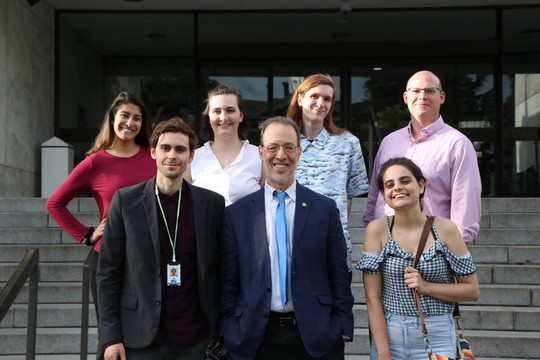
And, I had a great team supporting me in the office this year, led by my legislative aides Logan Gilles and Emily Henderson. Here's "Team Dembrow 2019," including our stellar interns Radhika Shah (Oregon State University), Matthew Hampton (Portland Community College), Igory Leontiy (Portland State University) and Grace DeLee (Willamette University).
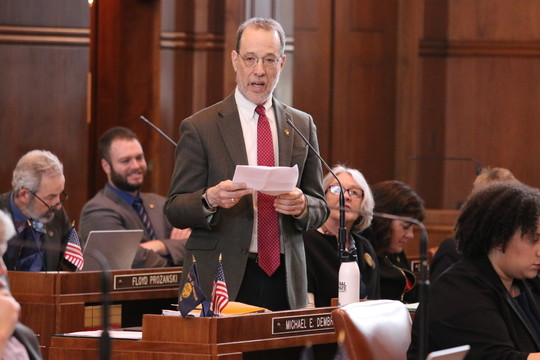
Still, for now, all of these glimmers of light remain obscured by the gloom of those last weeks. It was remarkably disappointing in the failure of our climate action legislation, difficult in terms of personal and political relationships, and sobering as we witnessed the shattering of long-held norms and expectations.
HB 2020B, the Clean Energy Jobs bill that would have created the Oregon Climate Action Program, was at long last ready to go—after years of work, hundreds of hours of public hearings and debate, thousands of pages of public testimony. We had made the necessary design decisions that balanced out the needs of environmentalists and industry, urban and rural. National observers such as David Roberts (among the most respected of writers on climate issues) were printing complimentary assessments of the proposed program. We had secured the support of the utilities, the construction trade unions, the tribes, large forest landowners, and all the major environmental organizations, and Oregon Business and Industries had taken a neutral position on the bill. We had the votes to pass it in both chambers.
And then, for a variety of reasons—political, ideological, irresponsible lobbying, inadequate communication, misleading communication, timing, bad faith, and, ultimately, threats of violence and the involvement of dark, anti-government elements—the effort stalled and nearly took with it the entire remainder of the session.
In this newsletter, I’ll provide a kaleidoscope of impressions of the last month, try to give you some explanation and context for what happened behind the scenes—and yes, if you’ll indulge me, try to address some of the misinformation that was pervasive in the final weeks of the session.
I’m spreading this report over a couple of newsletters because there’s too much for one. In this one I’ll discuss the loss of Senator Jackie Winters, shed light on the two Republican walkouts, and try to rectify some of the misinformation about HB 2020’s impact on rural Oregon.
In next week’s newsletter I’ll explain why the legislation needed (and still needs) an “emergency clause,” will give you a sense of next steps on climate action, will tell you more about the just-passed Clean Diesel bill, and will give you the details on our upcoming August 12 repeat constituent outing to Senator Hansell’s district in Central/Eastern Oregon.
And, yes, I’ve got interim work groups already in the offing. Stay tuned for those!
This session was particularly heartrending because of the loss of an inspiring, long-term public servant with whom many of us had a long-standing personal and professional relationship: Senator Jackie Winters of Salem. Jackie was an anomaly in many ways, an African-American Republican leader in a Blue state. She grew up in Vanport and other parts of North and Northeast Portland, and she never forgot her roots. She served as state ombudsman under Governor Vic Atiyeh, and believed firmly in the role of government in protecting the interests of the least among us.

We were on different sides on many issues, but Jackie and I bonded quickly when she learned about my many years of teaching at PCC-Cascade. We shared a passion for second chances and the transformative power of education. We worked together to get “Ban the Box” legislation passed in the Senate in 2016, in order to make it easier for people exiting prison to reenter and be successful in our communities. We jointly formed the Task Force on Reentry in Housing and Employment and drafted and passed a number of bills removing barriers to reentry.
In her final years, Jackie was particularly committed to reversing the effects of the mass incarceration movement of the 1990s, in particular the consequences of Ballot Measure 11, which imposed mandatory minimum sentences and largely removed judicial discretion in sentencing. One of the session’s great accomplishments, SB 1008, the Juvenile Justice Reform legislation—which required a 2/3 vote of each chamber to pass—could never have passed without her commitment and her personal charisma. Her last appearance on the floor of the Senate was to cast her aye vote on that bill, and the House vote came just days before her passing.
A few days after her passing, I happened to be at the Oregon State Correctional Institution for a graduation ceremony for several inmates receiving their bachelor’s degrees from the University of Oregon. It was uplifting and inspiring, and a welcome relief from the craziness at the Capitol. I was eager to tell the guys in the university program, whom I had met in previous visits, about the successful passage of SB 1008. I learned to my astonishment that they had been able to watch every hearing and each of the floor votes. They fully understood the role that Jackie had played, and they asked me to express their deep appreciation and sympathy to my colleagues and to Jackie’s family. It was extremely moving.
Ironically, it was exactly a week before “the walkout” that we celebrated Jackie Winters’ life on the Senate floor. It was a moment of bipartisan appreciation of the power of public service, with many tears and deep reflection. In hindsight, it was a moment of calm, of peace before the storm, faith and even optimism before the breakdown of an institution.
I can’t help but believe that if Jackie Winters had had her full health this session and still been with us, a path to avoid this walkout would have been found.
|
Some of my legislative colleagues in other states have told me that the first thing they did when they heard about the Oregon Republican walkout was to check on their own quorum requirements. It had never been an issue for them because their states only require a simple majority for a quorum.
In fact, that’s the norm for nearly every other state. As you can see from this chart from the National Conference of State Legislatures, 46 out of the 50 states require a simple majority of the body to be present in order for business to be done. (That, by the way, is also the standard in Oregon for committee work, which is why committees were able to carry on their work even in the absence of Republicans.) It’s something that has been in our constitution since statehood, something that we borrowed from Indiana (which Oregon used as its model for its constitution).
In and of itself, denial of a quorum can be a delaying tactic used in order to make a point or to slow things down, but no more than that. Eventually, those who leave will come back and the session will continue. That’s what we saw happen when the Democrats left for a week in 2001 in protest of what they believed to be an illegal attempt by the Republican majority to circumvent redistricting laws. It’s what we saw happen in May when the Republicans left for a week in order to slow down passage of the school funding proposal.
However, when the state constitution was amended in 2010 to give us annual sessions, it put into Section 10 of the Constitution a set number of days (160) that the odd-year session could last. Prior to this change, there was no limit on the length of a session, so there was no way for a minority of members to run out the clock on the session. Now there is, and it’s a weapon that the Senate Republicans chose to use.
During the walkout, Republicans argued that this is a tool that the Constitution envisions and even expects the minority party to use. That is simply untrue. In fact, the Constitution provides the Legislature with the means to compel absent members to return, and thereby clearly expects that members will fulfill their oaths of office and allow the work of the representative body to be done. The Oregonian printed a perceptive opinion piece to this effect by former Oregon Speaker Pro Tem, Republican Lane Shetterley, that makes this point very clearly.
Though most of the Republicans eventually returned, we came dangerously close to an eventual shutdown of state government. Even when it was clear that the Climate Action bill was not going to move forward, Republican senators were under pressure from the more extreme elements of their base to stay away. Is this now a weapon that we will see used by one party or the other again and again? We need to think hard about that possibility, and how we can keep government working for Oregonians.
As a chief proponent of the Climate Action bill, it obviously pains me to see all of that hard work fall victim to this last-ditch tactic. But really, my concerns go beyond one single bill.
Look, in this session and in past sessions, we have passed bills that I really don’t like, that I feel are detrimental to my constituents and to all Oregonians. We have certainly failed to pass bills that I know are needed by the residents of this state. My job as an elected representative is to do my best to get the votes needed either to pass or to reject legislation. If changes need to be made to secure the necessary votes or to make the bill that I don’t like more palatable, it’s my job to do that work. At some point, the vote needs to happen and the rules of our democratic republic prevail. If the results are less than satisfactory, I come back the next session and try again to pass that good bill or rescind/improve that bad law.
That’s how a representative democracy, with representatives duly elected by a majority of their constituents, is supposed to work. The wishes of the minority must be respected and where possible incorporated via a careful, deliberative process. But at the end of the day, the vote must be taken and the outcome respected. When we start to depart from that norm, we enter very dangerous territory.
We heard from our Republican colleagues that the main reason they had to go back on their word that they would not deny a quorum again was that it was the only way they could block HB 2020, which would be “a disaster” for the rural districts that they represent. They declared it to be an attack by Salem and Multnomah County against the livelihood and values of rural Oregon. This was certainly the coordinated message coming out of the Senate Republican Office and oppositional industry lobbyists, but how true was it?
In fact, one of the hallmarks of HB 2020 is the extent to which it focuses on alleviating the impacts of climate change on rural Oregonians, particularly those of lower income. It also requires that a disproportionately higher amount of investments in jobs and refunds to mitigate the impact of the program be made in rural Oregon. We knew that in the current political environment it is virtually impossible for Republican legislators to support robust climate action, but that didn’t mean we were not committed to looking out for the interests of their constituents.
Here's a list of some of the ways in which HB 2020 would in fact have benefited rural Oregon.
You’ll see that there are many, including refunds that will completely offset any increases in gas prices due to this program for low- and middle-income residents. But have we been able to communicate and explain these benefits in a way that will resonate with those who are skeptical about this kind of climate action and who are hearing only negativity about it? So far, no.
These objections and concerns are real and must be addressed in partnership with those affected. The “urban-rural divide” is a real thing, and it’s stoked by a number of forces, a number of realities that are economic, demographic, cultural—and political. Understanding and seeking ways to heal that divide while breathing new life into our rural economies remains one of our biggest challenges as a state. It will be key to our moving forward with climate action.
The first time the Republican senators denied a quorum, it was in early May and the goal then was to block or secure major changes to HB 3427, the Student Success Act, the long-awaited, historic investment in stable school funding that would be secured by changes in corporate taxation. Oregon Business and Industries, the state’s major business lobbying group, had announced that it would not oppose the bill during the session or if there were a subsequent ballot fight. Passage of the bill required a super-majority for passage, but the votes appeared to be there. So, in a last-ditch effort to keep that from happening, all the Republicans but one (Senator Tim Knopp from Bend) chose to stay away and deny a quorum. Committee work was able to continue (the quorum requirement for our committees is the simple majority that is the norm in most states), but no bills could be considered on the Senate floor.
The impasse lasted for four days. It came to an end as a result of negotiations between the Governor, Senate President Peter Courtney, and Senate minority leader Herman Baertschiger.
The ultimate “deal” was extremely controversial at the time and remains so today. It traded a couple of key Democratic priorities (gun safety and enhanced vaccination requirements) for a pledge not only that the Republicans would return, but that “Senate Republicans will not walk out again during the 2019 Regular Legislative Session, ending on June 30, 2019.”
Obviously, the Senate Republican caucus reneged on that agreement when they chose to leave on June 20 and remained out until June 29.
The minority leader conceded that they were violating the agreement, but felt that it was justifiable to do so given their need to kill the Climate Action bill. In addition, he argued, the Democrats had not fulfilled another, lesser-known part of the deal, an agreement to “get a reset” on HB 2020.
What exactly was intended in this reset? There were two elements. First, for a time, there was an insistence on a new bill number for the Climate Action bill. Believe it or not, this does happen occasionally: when a bill concept becomes so controversial that its bill number is weighted down with that controversy, the concept may get tucked into another bill or receive a brand new bill number in order to give it a fresh start. The original bill is then declared dead and we move on.
Ultimately, it was decided by both parties that this step was not necessary in this case, and that demand was dropped.
The second element was an expectation that Senator Cliff Bentz, Republican Co-Vice-Chair of the Joint Committee on Carbon Reduction, would be included in the deliberative process as the final details of HB 2020 were decided. That in fact did occur in a series of meetings, and some of his priorities were ultimately incorporated into the final set of substantive amendments (HB 2020-98) amended.
Is that to say that those changes turned HB 2020 into a bill that Senator Bentz would support? Definitely not. Senator Bentz wanted and continues to want fundamental changes to the program that we were not able to adopt. I believe that those changes would make the Oregon Climate Action Program ineffective and would cost us key support from advocates on all parts of the spectrum—environmental, public health, social justice, business, and industry. But given those differences, we made an ongoing attempt to accommodate his priorities and those of his constituency where we could.
Nevertheless, this supposed failure to “reset” became another “justification” for the walkout.
For more details about this part of the story, I’d encourage you to look at Nigel Jaquiss’s thorough reporting on this issue for the Willamette Week.
Our annual "town hall on two wheels" is back again for its eleventh edition! We are still in the planning phase, but go ahead and mark your calendar and plan to join us for the ride on Saturday, September 14th. It's always a great time and I'm excited to once again partner with my Reps. Barbara Smith Warner and Alissa Keny-Guyer.
 Senator Michael Dembrow
District 23
email: Sen.MichaelDembrow@oregonlegislature.gov
web: www.senatordembrow.com
phone: 503-986-1723
mail: 900 Court St NE, S-407, Salem, OR, 97301
| 

