Message from Executive Director Ben Cannon
Fall is always a busy time on Oregon campuses, and I want to start with a reminder from our Office of Student Access and Completion (OSAC) that October also marks the opening of financial aid application season for new and continuing students. The Free Application for Federal Student Aid (FAFSA), the Oregon Student Aid Application (ORSAA) and the Oregon Promise grant application have all recently opened, and in November we will also open the OSAC scholarship applications. Please encourage students to explore their options and apply at OregonStudentAid.gov.
At the HECC, the coming months will be an important time in the development of the House Bill 4124 Higher Education Revitalization study, which is a major focus of the HECC this year leading up to a legislative deadline in April. Thank you to the many people across the higher education enterprise who have been engaging the HECC and our consultants in this important work. I want to extend special thanks this month to the leaders who joined us for a very insightful regional panel in Klamath Falls on higher education and workforce pathways, to the students who are taking time to join us for a newly-convened student voices group this winter, and to hundreds of Oregonians who have spent time sharing their thoughts through the public survey recently launched by our consultant, EY-Parthenon. If you have not shared your input on this effort already, please consider taking time to fill out the HB 4124 study survey, which is open through December 4.
Our Commission's October public meetings were hosted this month at the bustling campus of Chemeketa Community College in Salem, where we heard highlights about the college's unique programs and strengths in President Jessica Howard's welcome presentation. I was also able to join commissioners in touring the campus and learned about the breadth of services at a newly opened Student Resource Hub, which brings several essential services together to support student basic needs, including a Benefits Navigator position, a food pantry, clothing closet, and Student Emergency Relief Fund services. We visited the Math Hub, which provides drop-in academic support, testing services, calculator and textbook resources, and a collaborative study environment, and the Dental Assisting Program, just one of many examples of pathways to credentials in a high-demand field. The visit emphasized for me the way that interconnected resources—basic needs resources, academic supports, campus community hubs, and meaningful career pathways—can support student needs holistically, helping them to succeed and thrive. We thank Chemeketa partners for graciously hosting us.
This month's newsletter highlights many ways we at the HECC have been working in partnership with campuses and education communities to help equip Oregon to better serve learners for years to come. The State of Oregon through the HECC recently received two significant federal grants that will help expand supports for basic needs, workforce pathways, affordable textbooks and open educational resources. As we work to take action on goals we established in our strategic plan, we are continuing our focus on student belonging, and invite participation in a research and community engagement effort to help us identify ways to improve students' sense of belonging, which is so important to student success. And finally, we recently convened hundreds of partners for professional development at two signature fall conferences focused on college and career preparedness and adult learners. We appreciate all who participated.
Thank you, as always, for reading our newsletter and for your engagement.
House Bill 4124 Engagement Broadens with a Student Voices Panel, Technical Work Groups, a Regional Meeting in Klamath Falls, and More
The HECC continues to collaborate with partners across the state to inform the House Bill 4124 Higher Education Revitalization Study. The HECC’s consultants are working to incorporate as many representative voices and perspectives as possible into the study process to inform the recommendations, which will be finalized by April 1, 2027, and we are thankful to all who have engaged with us on this work already.
After completing an initial analysis for the study, and submitting a preliminary report to the Oregon Legislature in September, the current focus of the work is on: expanded partner and public input; deliberations about hypotheses, challenges and opportunities for the system; and considering ideas to inform recommendations. EY-Parthenon continues to lead research and development as the HECC's primary research consultant for this study, and Oregon Consensus is continuing to provide third-party facilitation throughout the legislatively-driven process.
The Higher Education Coordinating Commission receives updates on the process of this HB 4124 study at its full monthly public meetings, and has also set aside a series of special public meetings devoted specifically to this study. Public testimony is welcomed at the full Commission meetings, and input is also welcomed through the newly launched HB 4124 Study Public Survey (learn more below).
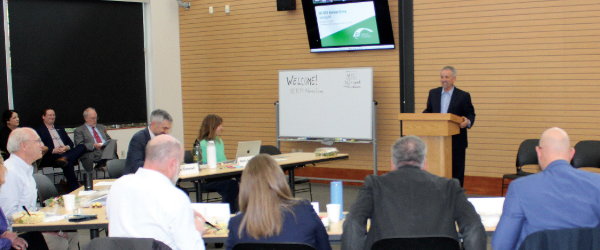
The HB 4124 Advisory Group, a representative group of key partners, is the center of partner deliberations on the development on the study, and this group is informing HECC agency staff who report to the Commission. As part of a series of place-based sessions across Oregon, the House Bill 4124 Advisory Group met in Klamath Falls in October for a full and informative day of regional insight and discussions, welcoming perspectives from Oregon Tech and Klamath Community College leadership, public officials, workforce and economic development partners, foundation and community leaders, and K-12 education leaders.
In addition, with fall term commencing and many more people back on campuses, we have broadened the engagement processes underway, which now include: a newly convened student voices panel, five technical work groups, focus groups with faculty and staff, a legislative roundtable, an academic and fiscal leadership table, and the recently launched public survey. The student voices panel, convened for the first time in October, will meet several times through the winter months and provide insights and recommendations to the Advisory Group. This panel is comprised of approximately 18 currently-enrolled students in Oregon community colleges and public universities who bring a diverse array of student experiences, including undergraduate and graduate students, adult learners, transfer students, online learners, students working full-time, first-generation students, and students from both rural and urban regions in Oregon. In convening this panel, Oregon Consensus focused their recruitment on both traditional and non-traditional students from across a mix of universities and community colleges, learners from underrepresented groups, and students with diverse lived experiences, to ensure that input is heard from a broad range of student perspectives.
|
Photo: Klamath Community College (KCC) President Roberto Gutierrez welcoming the HB 4124 advisory group to a regional meeting in Klamath Falls. Courtesy of KCC, Gerry O'Brien, Communications Director.
Share Your Input on Opportunities and Priorities in Oregon Higher Education
The HECC's lead consultant for the House Bill 4124 Higher Education Revitalization Study, EY-Parthenon, has launched the House Bill 4124 Study Public Survey. We encourage you to participate and to help us share this survey widely in Oregon! The survey will be open through December 4, 2026.
EY-Parthenon is seeking input from students, faculty, staff, employers, legislators, community members, and other interested parties as part of the HB 4124 study of Oregon’s public postsecondary education system. This short survey asks you to respond to four questions related to the 4124 study, as well as your connection/affiliation with the higher education system. Your feedback will help identify challenges, opportunities, and priorities for Oregon’s public postsecondary education system and will be considered alongside other research and engagement methods as recommendations are developed for the future of public higher education in Oregon.
As described in the companion article above, in addition to the survey, numerous additional processes of engagement, analysis, and collaboration are underway as HECC works toward the higher education revitalization study called for by HB 4124.
As the lead consultant supporting the HECC on the HB 4124 study, EY-Parthenon serves as an independent, evidence-based technical advisor. To learn more about the study’s background and process, visit the HECC HB 4124 implementation web page, where you can also find a link to the survey. Please help us share this survey opportunity with students and communities. Anyone who is interested in public postsecondary education in Oregon is welcome to participate. You may share this article with others, or share the HECC social media posts on the survey on LinkedIN, X, or Facebook. Thank you for sharing your perspective!
|
Connecting, Collaborating, and Advancing Adult Education: Oregon Adult Basic Skills Conference Highlights
On October 16, 2026, the HECC convened hundreds of partners for the annual Adult Basic Skills (ABS) Conference: From Learning to Earning: Empowering Adult Learners for Economic Success. The conference attracted over 250 registrants from across the state, bringing together adult education professionals, community college leaders, and partners for a day of learning, collaboration, and professional development. The virtual format provided accessible, no-cost professional development opportunities for educators and administrators statewide, removing geographic and financial barriers to participation.
This year’s conference focused on the critical role adult basic skills programs play as a gateway to economic mobility. Throughout the day, attendees engaged in sessions focused on strengthening adult education practices, connecting learners to college and career pathways, and addressing the evolving needs of Oregon's adult learners. A highlight of the conference was a panel featuring Oregon community college presidents discussing the critical role ABS programs play in expanding educational opportunities, supporting workforce pathways, and serving diverse communities.
Kathryn Hanna, an instructor at Mt. Hood Community College, said, “The conference was wonderfully interactive and informative. The IET Educator Networking & Support session gave me valuable insights and connections with IET instructors focused on student success, and the Instructional Routines to Support Student Progress and Persistence session showed me an engaging way to get learners to explain their reasoning through reflective learning.”
Shannon Schuette, instructor at Eastern Oregon Correctional Institution, stated, “I left feeling renewed and reminded that education is about more than learning—it is about hope, opportunity, and showing people they matter.”
The HECC extends its appreciation to the presenters, planning partners, and attendees who contributed to this year's event.
Fostering College and Career Readiness: ASPIRE Fall Conference Highlights
On October 2, 2026, more than 130 career and college practitioners from across Oregon gathered at Oregon State University-Cascades in Bend for the 2026 ASPIRE Fall Conference. The event offered a full day of professional development, networking, and inspiration for those supporting students on their postsecondary journeys.
This year’s conference featured 30 breakout sessions covering a wide range of topics, including financial aid, postsecondary pathway exploration, and supporting underrepresented students. There were multiple sessions on working with students, including Reimagining Career and College Readiness for Neurodivergent Students, Beyond the Backpack – improving outcomes for students experiencing homelessness, and a panel of students, hosted by the Oregon Department of Human Services’ Child Welfare Division, that featured youth with lived experience in foster care who shared their journeys through postsecondary education.
One ASPIRE Coordinator said, “Making connections with professionals in the field of education and higher education is invaluable to me as well as getting the most updated information about career and college readiness topics.”
The ASPIRE Fall Conference continues to be a cornerstone event for Oregon’s career and college readiness community. The HECC extends thanks to everyone who helped make this year’s event a success.
Next Step in Our Work on Belonging: Complete a Brief Online Community Exercise
As we continue our work driven by the HECC Strategic Plan to identify actions that can make a difference in supporting belonging in higher education, we invite you to complete a brief online exercise.
This spring, the HECC and Oregon’s Kitchen Table heard from 1,100 Oregonians about what helps create a sense of belonging for learners in college and training programs. Now, we invite our partners to join us for the next step in our work to foster students’ sense of belonging in postsecondary institutions.
OKT and Izora Arts & Sciences have developed a set of factors that affect students' sense of belonging. You can read about the factors in OKT’s preliminary summary report about what people shared here.
What’s happening now: We need your help this fall to make connections between the factors using a community exercise (https://tinyurl.com/belong-exercise) This online exercise asks you to make connections between factors. First, we'll ask you a few questions about yourself. Then, we'll ask you a minimum of five matching questions. It will take about 10 minutes. You can answer more matching questions if you would like! This next step will help us identify the factors with the highest potential to influence students' sense of belonging statewide so HECC and partners can decide on what actions to take. Thank you for continuing to be part of this important work with us! You can participate in the exercise here (https://tinyurl.com/belong-exercise) through December 11, 2026.
For more information, contact Sarah Giles (sagiles@pdx.edu) at OKT or Anthony Medina (Anthony.D.MEDINA@hecc.oregon.gov) at the HECC.
Grant Will Bolster Oregon’s Work to Help Community College Students Afford Basic Needs and Prepare for the Workforce
The HECC recently announced in a press release that it has been awarded a $4.1 million Basic Needs for Postsecondary Students Program grant from the U.S. Department of Education. This significant four‑year investment, running through 2030, will expand Oregon’s capacity to address basic needs insecurity—such as food and housing insecurity—among community college students. Oregon’s grant project will help increase access to public benefits for Oregon community college students statewide as they progress toward workforce‑relevant credentials.
At a time when rising costs and unmet basic needs continue to threaten students’ ability to persist and complete their education, the project aims to implement sustainable, statewide strategies that connect students with essential supports, reduce barriers to completion, and promote long‑term economic mobility.
The HECC was one of only three recipients nationally for the Basic Needs for Postsecondary Students Program grant for 2026, which was awarded from the U.S. Department of Labor on behalf of the U.S. Department of Education. The HECC’s Office of Community Colleges and Workforce Development will administer the funds and subcontract with Portland Community College to coordinate the project among the state’s two-year public institutions and partners, building on Oregon’s ongoing statewide initiatives underway, including benefit navigators, career pathways, and more.
The need for systemic basic needs support is clear. According to a 2025 survey from The Hope Center for Student Basic Needs, 79 percent of students across the nation who had stopped out—or were considering stopping out—cited basic needs insecurity as a driving factor, including financial strain, mental health challenges, and barriers such as transportation and childcare. Learn more about the grant here.
With Grant Funding, Oregon Will Expand Development of Affordable Textbooks for High-Demand College Courses at Public Institutions
In a recent press release, the HECC announced that Oregon has been awarded an approximately $1.7 million grant from the U.S. Department of Education Open Textbooks Pilot Program to support Open Textbooks, also known as Open Educational Resources (OER). The funds will be used over the next three years to support open textbooks in high-enrollment courses at Oregon colleges and universities. These resources help improve affordability for higher education by offering free or low-cost textbooks and other course materials as an alternative to high-cost educational materials that are a barrier for many students.
The grant will support the development of high-quality, accessible OER, including textbooks and course materials, for four high-enrollment general education Communications courses. The project is expected to eliminate required textbook costs in these courses, saving students in these courses an average of $59 per student, and $219,000 total during the grant period. Post-grant savings are projected to be over $2 million per year. The curriculum will be available to be adopted as-is or it can be adapted to meet an instructor’s needs.
The grant builds on more than a decade of state work in this area. Since 2015, the State of Oregon has supported efforts to promote the development and use of high-quality, no-cost, and low-cost textbooks and course materials at Oregon public colleges and universities. Oregon was one of four entities across the nation that received an Open Textbooks Pilot Program grant, awarded by the U.S. Department of Labor on behalf of the U.S. Department of Education. The project is administered by the HECC and the agency sub-grants with Linn-Benton Community College, which houses a statewide program, Open Oregon Educational Resources, that leads this collaborative work with Oregon institutions. Learn more below.
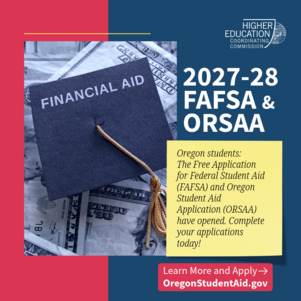
The 2027-28 FAFSA and ORSAA are Now Open
Please encourage students to complete the key financial aid application for next academic year as early as possible. We are pleased to announce that both the Free Application for Federal Student Aid (FAFSA) and the Oregon Student Aid Application (ORSAA) are now open for students applying for aid for 2027-28. Learn more about both forms on the HECC Office of Student Access and Completion (OSAC) website FAFSA ORSAA page.
To be eligible for most types of financial aid, students must complete the FAFSA or ORSAA. These applications compile financial information and other details about students and families, which the U.S. Department of Education and the State of Oregon use to determine financial need and eligibility for various financial aid opportunities.
The ORSAA is an alternative to the FAFSA for undocumented Oregon students, including students who have Deferred Action for Childhood Arrivals (DACA) status or Temporary Protected Status (TPS). As part of our ongoing commitment to protecting student privacy, the HECC has upgraded the ORSAA application, which is now housed on our internally-hosted agency network. Returning users will notice a new look and feel, and will need to set up new login credentials. OSAC also recently announced a change in who is eligible to complete the ORSAA, with a new option for students from mixed status families. See the OSAC FAFSA ORSAA page for details to help inform student decisions on which form to use.
|
The Oregon Promise Application is Now Open
We are pleased to share that the Oregon Promise Grant application has launched for the next round of new high school and GED® test graduates to apply. All students who graduate between July 1, 2026 and June 30, 2027 can apply for Oregon Promise. Students must also submit the FAFSA or ORSAA by their applicable deadline, based on their graduation date.
Winter Term 2026-27 Oregon Promise: In addition, OSAC is still taking applicants for one student group for Winter Term 2026-27. The priority group of students who need to submit at this time are high school students who graduate between July 1, 2026 and November 30, 2026. For these students, the deadline to submit both the Oregon Promise application and the 2026-2027 FAFSA/ORSAA has been extended to November 16, 2026.
|