Message from Executive Director Ben Cannon
The development of a statewide budget recommendation for higher education and training is always of high public interest, especially as some Oregon colleges and universities struggle with funding shortfalls, and Oregon continues to rank low (37th nationally) in higher education funding per student.
After several months of deliberation, public input, and analysis, our Commission at its August meeting approved the HECC’s Agency Request Budget (see details in the article below). The ARB is an early step in the state's budget-making process, and the agency was required this year to follow state guidelines—driven by the statewide budget constraints—which limit agency requests for new funding. While understanding the state’s constraints, several Commissioners spoke at the meeting about the insufficiency of a current service level budget. Chair Hamann also presented a letter expressing concerns and acknowledging the Prosperity Council’s recent recommendation for an infusion of higher education funding to help meet the state’s economic development goals.
Separately, the Oregon Legislature, through House Bill 4124, has charged HECC with a significant study on the state’s higher education system. Higher education is at an inflection point as it faces numerous challenges, and we are exploring ways to help ensure that the Oregon system is strong and sustainable for many years to come.
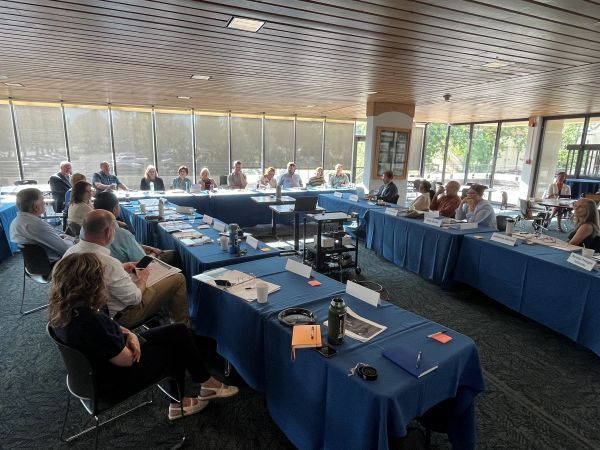
I am pleased to share an update in this newsletter on the collaborative engagement process we are leading to develop the HB 4124 Higher Education Revitalization study. I just returned from a couple days of meaningful conversation and engagement in La Grande, where the recently formed HB 4124 Advisory Group and HECC's consultants met with Eastern Oregon regional partners to help deepen understanding of the regional contexts for the Revitalization Study. We heard insights from a dynamic regional panel that shared important perspectives from workforce, education, and community leaders. Our Commission has also discussed this work during recent public meetings, and we look forward to engaging more Oregonians during the months to come.
In other Commission news, I want to note that at our last Commission meeting, Chair Hamann announced that Commissioner Arnel Fajardo has concluded his service on the Commission. We are very thankful for Mr. Fajardo’s contributions and his deep commitment to higher education. His service to Oregon will now continue in a new capacity, as Mr. Fajardo has been appointed to the board of trustees for the Oregon Institute of Technology.
Finally, I am excited to report that the HECC has finalized the Workforce Pell policy for Oregon, and we will soon be launching a process to consider new programs to qualify for this new benefit. We will share more on this in future updates. We are also happy to share in this newsletter about other programs serving Oregonians, including new work on expanding registered apprenticeship pathways and the impressive work of Benefit Navigators to connect students with benefits and services they need to succeed.
Thanks, as always, for your engagement.
Engagement and Analysis is Underway for the House Bill 4124 Higher Education Revitalization Study
Numerous processes of engagement, analysis, and collaboration are underway as HECC works toward the higher education revitalization study called for by HB 4124 (2026). This legislation directs the HECC to study the condition of Oregon’s postsecondary education system and develop recommendations for a viable and improved institutional framework for public higher education in Oregon by April 2027.
To ensure a transparent, inclusive, and collaborative process for the study, the HECC engaged the support of Oregon Consensus to conduct an initial assessment that has guided the process that is now underway. One key component of this collaborative process is the establishment of a House Bill 4124 Advisory Group representing public institutions, faculty, staff, unions, philanthropy, workforce, K–12, and underrepresented communities. The HECC appreciates the participation of the Advisory Group members who will bring important deliberation on this project from multiple perspectives, and advise staff who report to the Commission.
Following a competitive bid process, HECC is now working with EY-Parthenon as the lead consulting firm for the study called for in House Bill 4124, and the firm is beginning the first phase of their work. EY-Parthenon’s role is to serve as an independent, evidence-based technical advisor to HECC leadership through this legislatively-driven process. EY-Parthenon’s approach to the project contains three phases, including: 1) a first phase focused on foundation-building, including a preliminary assessment of the post-secondary conditions in the system related to the missions of each sector, demographic and financial trends, and alignment with workforce needs; 2) a second phase focused on developing options; and 3) a third phase focused on translating options into recommendations as well as a written report. EY-Parthenon will appear regularly before the Advisory Group and engage in forums, conversations, and interviews with higher education, workforce, and industry leaders. Oregon Consensus has also been retained to provide third-party facilitation, documentation, convening, and other process support.
The Advisory Group has held three meetings this summer, with a preliminary focus on framing the project and engaging with partners at a regional meeting held in August in La Grande. The August convening marked the beginning of the Advisory Group’s place-based sessions across Oregon, which are also scheduled for Klamath Falls, Ashland, Monmouth, and Portland. In addition to the advisory group convenings, HECC is also leading regular briefings with legislators and other partner groups.
More information is available on HECC's HB 4124 implementation web page and in recent materials presented to the Commission at its August 13 public meeting.
*Photo: regional partners and HB 4124 Advisory Group members convening in Eastern Oregon
|
Commission Approves Agency Request Budget (ARB), an Early Step in the State’s Budgeting Process
After reviewing information and developing recommendations over the course of numerous public meetings, and after receiving considerable public input from April through June, the Commission reviewed and approved the final 2027-29 Agency Request Budget (ARB) funding levels at its August 13, 2026 public meeting. The HECC's ARB for each biennium includes recommended funding levels for the operation of Oregon's community college and public university support funds, student financial aid, workforce programs, capital construction, debt service, and HECC agency support.
The ARB is an early step in the state's multi-phased biennial budget-making process. The ARB is considered in the preparation of the Governor’s Recommended Budget (GRB), which must be balanced to projected revenues, and which serves as a starting point for the Legislature’s development of the Legislatively Approved Budget (LAB).
The HECC’s ARB adheres to budget instructions developed by the Governor and Chief Financial Office (CFO), which limits most requests for new resources this budget cycle, unless they are paid for with reductions from within the agency’s budget. Pursuant to guidelines, most recommendations on funding this year were at the Current Service Level, a calculation designed to adjust to inflation and maintain service at the status quo. The ARB funds total $4.7 billion for 2027-2029, and an unaudited summary of the amounts was approved for each funding category. The CSL amounts for the three largest funds in the ARB are as follows:
- Public University Support Fund, $1.15 Billion
- Community College Support Fund, $972 Million
- Oregon Opportunity Grant, $360 Million
For the community colleges and universities, there are also some additional fund categories outside of these primary operating funds and these are not included in the total above.
While the Commission voted to advance the ARB that meets the state guidelines, there was considerable discussion at the Commission meeting and input from numerous partners describing the insufficiency of CSL in relation to the higher education system's needs. Given that the HECC Commission is charged by statute with addressing the strategic needs of the state in higher education, HECC Commission Chair Hamann expressed in a letter to the Governor his concern about these funding levels.
The Commission approved submission of the HECC’s 2027-29 ARB funding levels as presented and authorized staff to finalize and submit the narrative portions of the ARB. At its June meeting, the Commission reviewed a draft narrative regarding the long-term funding needs of the system, which will be included in the final ARB narrative document that the agency submits as context for this year’s budget request.
August Legislative Updates:
New Interim House Committee on Higher Education
The Speaker of the Oregon House of Representatives recently announced the creation of an Interim House Committee on Higher Education, and HECC anticipates that this interim committee will likely carry over into the 2027 legislative session. The interim committee will be chaired by Representative Lisa Fragala, who was a member of the previous iteration of the higher education committee. Rep. Fragala is a former member of the Lane Community College Board of Directors and was a community partnerships coordinator for Pacific University.
HECC is scheduled to present to the new higher education committee in September on Workforce Pell initial implementation in Oregon and the House Bill 4124 Higher Education Revitalization Study process and background. We will keep our legislative session webpage updated with more information about these presentations.
Update on Legislative Concepts Underway: Transfer Concept
HECC staff have been engaging with key partners in recent months to refine the legislative concepts that the agency will pursue in the 2027 legislative session. At the August 13, 2026, HECC meeting, staff provided an update to the Commission about a legislative concept related to student transfer. The concept seeks to add flexibility to required HECC roles related to Major Transfer Map development and Transfer Council membership, improve general education credit transfer processes, and better align AP/IB exams with statewide transfer tools. The HECC will continue to present on 2027 legislative concepts underway at future public HECC meetings. Previous updates can be found in Commission public meeting materials presented in April, May, and June of this year.
Oregon to Expand Registered Apprenticeship Pathways in Healthcare, Information Technology, and Manufacturing
In an August 17 press release, the HECC announced that Oregon will invest approximately $1.7 million in federal funding to expand Registered Apprenticeship Programs (RAPs) aimed at strengthening the state’s apprenticeship system and addressing urgent workforce shortages in healthcare, and emerging needs in information technology (IT) and manufacturing. This initiative addresses critical workforce shortages, especially in rural and frontier communities, by increasing access to paid, high-quality training pathways.
To accelerate solutions, Oregon will use the grant funds awarded by the United States Department of Labor (DOL) through the State Apprenticeship Expansion Formula 4 (SAEF4) to address workforce shortages in healthcare, and emerging needs in IT and manufacturing. The funds will support healthcare apprentices in high-demand occupations. Funding will prioritize education, clinical supervision, wraparound services such as transportation and childcare, mentor development, and employer onboarding, particularly for rural providers and community-based organizations. In addition to healthcare expansion, Oregon will invest these grant funds to pilot registered apprenticeship models in information technology and manufacturing. These pilots will help build future training pathways in sectors where registered apprenticeship opportunities are currently limited.
Approximately $491,000 in grant funds will be sub-awarded through a competitive Request for Applications (RFA) that will be available to healthcare employers and providers, as well as industry and training partners in IT and manufacturing. In addition, the federal grant provides approximately $1.2 million to bolster funding for the state apprenticeship system through the Bureau of Labor and Industries and HECC to accelerate program approvals, streamline processes, strengthen sponsor readiness, and increase transparency. A statewide behavioral health resource hub will be developed to help Oregonians understand behavioral health career pathways, including apprenticeship opportunities. Read our full release below.
Thank You to All Who Shared Insights on Belonging in Postsecondary Education... What's Next?
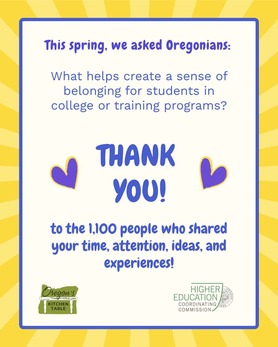
In HECC’s strategic plan, we have prioritized a goal of belonging focused on elevating learner voices and supporting inclusivity and belonging in postsecondary education settings. This past spring, HECC partnered with Oregon’s Kitchen Table to invite Oregonians across the state to share what helps create a sense of belonging for them and learners in their community, with a focus on students and learners.
We are pleased to share that approximately 1,100 people participated in giving input! All of these voices are so important in helping us find ways to foster a sense of belonging for Oregon learners at all of our postsecondary learning institutions. We are grateful for your time and attention!
In the coming months, OKT will share a preliminary summary report about what people shared along with a set of factors that influence student belonging. Drawing on this input, OKT and partner Izora Arts & Sciences plan to work with partners this fall to determine factors that have the greatest potential to influence students’ sense of belonging statewide. The final findings will be released in early 2027.
For more information, contact Sarah Giles (sagiles@pdx.edu) at OKT or Anthony Medina (Anthony.D.MEDINA@hecc.oregon.gov) at HECC.
|
Benefit Navigators Provided Direct Support to 30,180 Students in 2025-26
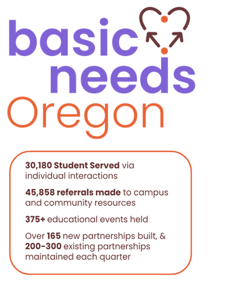
Benefit Navigators at Oregon’s public community colleges and universities help students apply for resources that reduce basic needs insecurity. We are pleased to report that over the past year (2025-26), benefit navigators provided direct support to 30,180 students, nearly doubling the average number of students served each month compared to the previous year. They also more than doubled the number of referrals to campus and community supports, providing 45,858 referrals in total.
The Benefit Navigator legislation (ORS 350.262), passed in 2021, requires Oregon’s public postsecondary institutions to employ benefit navigators to assist students in determining eligibility for and applying to public benefit programs that help them stay enrolled and succeed. The HECC, through its Office of Community Colleges and Workforce Development (CCWD), administers funding for the program, manages institutional agreements, and provides technical assistance and policy guidance.
Basic Needs Oregon is the name adopted by the statewide community of practice of Benefit Navigators, providing a forum for navigators to share best practices, resources, and strategies for supporting students. Navigators meet directly with students to identify needs, explore available supports, and determine pathways to access resources.
While direct student support remains the foundation of benefits navigation across the state, navigators also reached an additional 20,770 students by hosting more than 375 educational events. These efforts highlight the ongoing and growing need for basic needs support in Oregon’s colleges and universities.
*This article is based on “Pathways Pulse: Highlights from the Field,” Portland Community College’s Pathways to Opportunity program.
|
Workforce Pell Implementation in Oregon
The HECC is developing processes for implementation of the Workforce Pell Grant in Oregon: partners can learn more on our web page at Workforce Pell Implementation in Oregon. Workforce Pell—established through Congress’s passage of H.R. 1 in 2025—expands Pell Grant eligibility to support learners enrolled in short-term, career-focused training programs that meet defined standards and lead to industry-recognized credentials. The HECC has been designated by the Oregon Governor to administer Workforce Pell program policy and approval processes for Oregon. The final Oregon Workforce Pell Policy is now available on our web page. In addition, institutions and partners can review the list of eligible occupations—by local workforce region and statewide—as they consider proposing new instructional programs for Workforce Pell in Oregon.
Developmental Education Redesign Process Advances
For over a decade, Oregon’s community colleges have been working together to address the significant gaps in student outcomes for students who begin in developmental education math and writing courses.
In 2024, the Legislature required HECC to convene a workgroup to study evidence-based corequisite student support models. Corequisite support means students enroll directly into college-level math and English courses and concurrently receive academic support in a paired college-level course in the same academic term. The workgroup recommended implementing corequisite student support models across Oregon’s community colleges, and staff provided an update to the commission about progress toward this goal at the August 13 HECC meeting.
The target date for implementation of corequisite education is July 1, 2027, and the steps in the upcoming process are summarized in the presentation. The next step of the process will be a presentation on potential changes to the Community College Support Fund (CCSF) tentatively scheduled for discussion for the October public HECC meeting.
Recent HECC Reports to the Oregon Legislature
Competency Based Education Report
The HECC has submitted to the Oregon Legislature its annual report on Competency Based Education. Competency Based Education (CBE) is a system of instruction, grading, assessment, and reporting where success is defined based on students demonstrating mastery of specific skills. CBE can help shorten the path to a credential, especially for adult learners, who bring significant prior knowledge and experience to the postsecondary classroom.
Implementation of CBE at Oregon's postsecondary institutions has so far been limited, with one main exception: Emergency Medical Services (EMS) education, which remains Oregon's most developed model for competency based education. In early 2025, the Oregon Health Authority formally adopted a competency-based assessment model for EMS education in rule.
The report examines progress within the EMS field, as well as ongoing efforts to better align CBE with other statewide strategies like credit for prior learning and dual enrollment.
Sexual Misconduct Reporting
The HECC has submitted to the Oregon Legislature its annual report on Sexual Misconduct Reporting. The HECC annually collects information on Oregon colleges' and universities' compliance with provisions of the law aimed at supporting students and employees who have been affected by sexual misconduct (ORS 350.335-346 and OAR 715-030).
Although most higher education institutions demonstrated substantial progress toward meeting the requirements of the law during the 2025-26 academic year, some encountered challenges. These included limited resources to comply with the law's provisions, differing levels of administrative capacity, and, in some regions, limited availability from local victim advocacy organizations to partner with higher education institutions to deliver required support services.
|