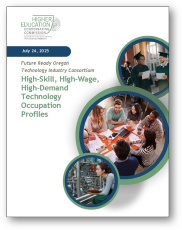
Industry Consortia Release New Occupation Profiles and Wage Data
Profiles Summarize High-Skill, High-Wage, High-Demand Jobs in Oregon’s Healthcare, Manufacturing and Technology Sectors
We are pleased to announce the release of new occupation profiles and wage data for high-skill, high-wage, high-demand jobs in Oregon’s healthcare, manufacturing, and technology sectors. The HECC’s Industry Consortia have completed the process of informing and approving the profiles, which are now available on our website.
Prepared by HECC staff in collaboration with the Oregon Employment Department, the profiles fulfill the wage transparency expectations of HECC’s Industry Consortia detailed in House Bill 3306 (2023). They will be updated biennially.
Each set of profiles shares typical education and training requirements, average entry-level hourly and annual wages, industries where Oregonians are employed in these occupations, and regional employment and wage data from across the state. The content is designed for policymakers and program administrators, including education, training, and workforce service providers and counselors who directly support students and job seekers. The Industry Consortia will use the information to help identify strategic priorities and advance sector-specific workforce and talent development strategies, which include:
- understanding talent supply and workforce demand for high-skill, high-wage, high-demand occupations in each sector;
- identifying the related education, training, and career pathways that are available in Oregon; and
- sharing wage information to increase transparency for people who are training for these occupations.
|

Future Ready Oregon Grantees and Partners in Eastern Oregon Share Regional Strategies for Workforce Development in the Tech Sector
This summer, the Technology Industry Consortium convened in Pendleton for its third-quarter public meeting, featuring presentations by local employers, Future Ready Oregon grantees, and their partners, including Blue Mountain Community College, the Confederated Tribes of the Umatilla Indian Reservation, and Eastern Oregon University’s Greater Oregon STEM Hub. Presenters shared strategies for building on the strengths of rural communities to develop Eastern Oregon’s tech workforce. They addressed topics ranging from training for data center careers, to teaching AI in the context of agricultural applications, to connecting students with hands-on training to become licensed drone/Unmanned Aircraft System (UAS) operators. The meeting concluded with a tour of the Pendleton UAS Range. Watch the meeting recording for more information.
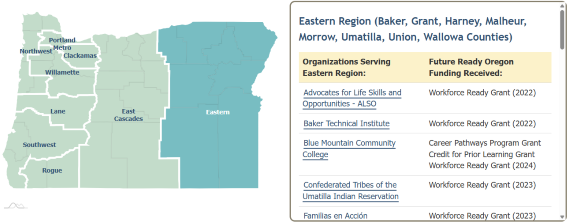
In this issue, we are pleased to share a few of the many examples of Future Ready Oregon grant-funded projects that support workforce development across Eastern Oregon. The following articles feature projects that use tech to prepare rural learners, workers, and job seekers to fill in-demand jobs throughout Eastern Oregon. Keep reading to learn more, and check out our map to see the full list of organizations that have received Future Ready Oregon funding through the HECC to serve this region.
|
CTUIR Leverages Partnerships, Workforce Ready Grant for Drone Operator Training
The Confederated Tribes of the Umatilla Indian Reservation (CTUIR) has leveraged regional partnerships and a 2023 Workforce Ready Grant from the HECC for its Unmanned Aerial Systems (UAS/drone) training program.
Named the CTUIR Drone Project, it supports student success at every step through hands-on training, wraparound support and services as well as paid work experience. Key partners include the CTUIR’s administrative service provider Cayuse Native Solutions in collaboration with Blue Mountain Community College (BMCC) and drone training provider DelMar Aerospace.
“The CTUIR Drone Project has exceeded our expectations. It has positively impacted the lives of several tribal community members, including myself as a graduate of the program,” Greg Penney, CTUIR member and drone project facilitator, said. “Community members should take advantage of this opportunity to enter the UAS industry that is projected to grow 58 percent in the next five years. They will complete the program with hands-on experience, a FAA Unmanned Commercial Pilot’s License and their very own personal drone.”
Students have access to two training options in the program. They can enroll in BMCC’s UAS Professional Pilot program, using simulators and real drones in 11-week evening courses, or they can complete a set of fast-paced trainings (an 80-hour Ground School and 80-hour Live Flight School) with DelMar Aerospace at its Pendleton Airport training facility.
Both options help prepare students for the Federal Aviation Administration (FAA) Part 107 Unmanned Pilot’s exam to earn their drone operator’s licenses. Workforce Ready Grant funding supports the CTUIR and Cayuse Native Solutions in covering training costs and exam registration, providing weekly $465 academic and $1,000 internship stipends as well as offering additional support for needs such as transportation and tutoring.
And the training program doesn’t stop when students earn their licenses because they are then eligible for a three-month internship, learning on the job from experienced drone operators while earning a stipend made possible through the Workforce Ready Grant.
As trained, licensed and experienced drone operators, they get to select a drone to keep and use in pursuing future drone work or in taking additional classes to prepare for sector-specific applications, such as using drones to gather agricultural data.
Since launching the program in 2024, which is open to tribal and community members, CTUIR has enrolled 55 participants. Forty-three of the 55 are CTUIR members with another eight being members of other tribes, while four are non-tribal. Twenty-eight participants have passed the DelMar Aerospace/BMCC Ground School, and 12 participants have passed the FAA Part 107 Exam – receiving their personal $1,600 drones. Six participants have acquired employment in the UAS industry with one becoming an instructor with DelMar Aerospace.
Visit Cayuse Native Solutions’ drone workforce page for details. Read a related press release here.

GO STEM Uses Workforce Ready Grant to Teach AI through Agriculture
Last fall, the HECC awarded a Future Ready Oregon Workforce Ready Grant to Eastern Oregon University’s Greater Oregon Science Technology Engineering and Math Hub (GO STEM) to advance workforce readiness. The funding supports GO STEM in teaching data science and the applications of artificial intelligence (AI) to agriculture, while also supporting educators and community members in understanding the history and broader implications of this technology. Less than a year after receiving the grant, GO STEM is already making great strides. This summer’s programming connected with more than 300 K-12 and university students, teachers, administrators, and community members, offering a behind-the-scenes look at how AI influences their daily life, farming decisions, and the broader economy.
GO STEM’s Workforce Ready Grant project serves rural Eastern Oregon by aligning with the region’s agricultural strengths while preparing the local workforce for a rapidly changing technological landscape. As part of this effort, an existing course has been modified through Eastern Oregon University’s Agriculture Entrepreneurship bachelor’s program. With 26 students enrolled for the fall 2025 term, the course will focus on large-scale irrigation management with data science and AI, addressing a critical workforce need in Eastern Oregon.
|

Student reflections reveal both enthusiasm and caution about AI’s role in agriculture and their lives. Their voices show that young people are engaging critically with both the opportunities and the ethical implications of emerging technologies. For example, some students called AI “a useful tool, however overused,” or noted that “AI can be helpful” but raised concerns about its impact on artists. One student expressed concern his job would be replaced by “huge drones spraying and seeding everything, [and where] tractors run on their own,” while another worried that farming may become “a lot less natural.”
Through this work, GO STEM is building trust, sparking discussion, and preparing Eastern Oregon’s next generation of agricultural leaders to navigate a world where AI will be central to both farm management and community decision-making. One student question captured the spirit of the conversations: “What’s next? Where do we go from here?”
Read more about this project in EOU’s press release. (Photographs courtesy of GO STEM.)
|
Eastern Oregon Workforce Board Expands Access to Employment Resources
Workforce Benefits Navigator Grant Supports New Check-In System and Expungement Clinics
Eastern Oregon Workforce Board (EOWB), with support from Future Ready Oregon Workforce Benefits Navigator funding from the HECC, has been working to remove barriers and strengthen connections to resources for job seekers, workers, and community members across the region. New data collection tools and Clean Slate Expungement Clinics are two recent Workforce Benefits Navigator initiatives that highlight EOWB’s use of data-driven strategies and barrier-reducing services to support workforce development.
Through new data collection systems recently installed at WorkSource Oregon (WSO) centers across Eastern Oregon, EOWB is learning more about how individuals are engaging with WSO services and, in turn, enhancing their customer service strategies. Between January and March 2025, all of the region’s WSO centers transitioned to the “Waitwhile” check-in system, which has since logged 22,577 visits—with 60 percent from returning customers. By collecting data on services requested, such as unemployment insurance support, and identifying peak hours and high-traffic WSO centers (the Hermiston center alone has received 6,768 visits), EOWB is better able to meet customer needs. This data is also helping EOWB improve access across rural communities, where the distances community members have to travel can present a major barrier.
This data is directly informing EOWB’s implementation of the new Oregon Career Information System (CIS) to make it easier for people to access career planning resources and wraparound supports. The system will support case workers in making referrals, and will include a public-facing web portal so individuals can also find services on their own. Once launched this winter, the tool will enable EOWB to better identify referral needs, outcomes, response times, and partner engagement, helping ensure that no one falls through the cracks.
In addition to system improvements, EOWB has been expanding outreach through “Clean Slate” expungement clinics. The first clinic was held in Pendleton and served 62 people by helping remove eligible criminal and eviction records, opening doors to employment, housing, and education. The next clinic will take place in partnership with a community resource fair in Baker City on November 14, continuing this critical work to reduce barriers and provide second-chance opportunities for Oregonians.
With new tools, data, and community partnerships, EOWB is improving access to workforce services using a data-driven approach. To learn more, visit eowb.org.
Mark Your Calendars: Upcoming Industry Consortia Meetings
Join us for the Consortia’s final quarterly public meetings of 2025 and subscribe to HECC’s Industry Consortia public meeting notices for the latest updates on meeting materials, times, and locations.
- Tuesday, October 14: Manufacturing Consortium (Chemeketa Center for Business and Industry in Salem)
- Wednesday, November 5: Technology Consortium (Oregon Institute of Technology - Portland-Metro Campus in Wilsonville)
These meetings will be held in person with the option to listen online. All quarterly meetings are open to the public to attend. Look out for a tentative schedule of the Consortia’s 2026 quarterly public meetings in a future newsletter issue!
|