Message from Executive Director Ben Cannon
Happy fall, and the start to a new academic year! This month's newsletter features numerous ways to convene, participate, and learn from each other. For HECC, engaging with communities across the state is more important than ever as we work to strengthen higher education and workforce training opportunities for all.
At events attended by HECC staff in Oregon this summer, considerable attention was paid to fostering economic growth and workforce on-ramps, data-driven strategies, strengthening rural education, and addressing public perceptions of postsecondary education.
In addition to those themes, postsecondary education plays a critical role in fostering a healthy democracy and civic engagement, and I was pleased to participate in a panel that explored how states can support this work at a meeting of directors of state higher education agencies from around the country.
It is a uniquely pressure-filled time for higher education and workforce development. The State of Oregon’s current budget is out of balance and anticipates serious reductions in federal revenue in coming years, both resulting from the recent federal budget reconciliation bill. HECC, like other state agencies, is responding to a recent directive on budget reductions; numerous Oregon institutions are in hard conversations with campus communities about budget deficits; and the changing federal funding and policy landscape takes considerable focus. (You can always find our most recent agency updates on the federal landscape here).
While we respond to these issues, it is important to remember that the biggest, and most enduring, story of postsecondary education and workforce training continues to be a story of transformation and life-changing opportunity. We remain steadfast in our mission to drive opportunity and open doors for Oregonians. In addition to our implementation of ongoing investments and programs, we are consolidating other efforts into initiatives inspired by our new strategic plan, which you will hear more about in coming months. I am optimistic about what we can accomplish together this year, and thank you, as always, for staying engaged.
Take a Short Survey, and Help Shape Oregon's Vision for College Credit in High School
The Higher Education Coordinating Commission and Oregon Department of Education invite your input in a short survey as we work to draft a statewide vision for college credit in high school in Oregon.
Courses that offer college credit in high school can lead to great things for students: industry certifications, credit towards college degrees, and career and college experiences that help students “launch” after high school. Not only do these experiences save money for Oregon families, they also let high school students get a supported head start on planning for their future.
A statewide vision will guide future state policy work, and the survey will help ensure the vision includes voices from all of Oregon’s diverse communities. We want to hear from students, teachers/instructors/faculty, dual credit coordinators and other administrators, counselors/advisors, staff, parents or guardians, community members, and workforce partners. The HECC and ODE are working to gather input from a wide range of Oregonians, including our rural communities and multilingual communities.
The state vision is the first step of a project that will improve opportunities and outcomes for Oregon students by aligning state policies and priorities, making these opportunities easier for schools to offer and for students to access. Please take the survey and share with your networks!
The survey will be open through October 20, and results will be used to create a draft of a state vision. We will also host listening sessions to get feedback on the draft, when available. We will announce those dates in future HECC communications, so stay tuned!
Industry Consortia Release New Occupation and Wage Profiles
Profiles Summarize High-Skill, High-Wage, High-Demand Jobs in Oregon’s Healthcare, Manufacturing and Technology Sectors
We are pleased to announce the release of new occupation and wage profiles for high-skill, high-wage, high-demand jobs in Oregon’s healthcare, manufacturing, and technology sectors. The HECC’s Industry Consortia have completed the process of informing and approving the profiles, which are now available on our website.
Prepared by HECC staff in collaboration with the Oregon Employment Department, the profiles fulfill the wage transparency expectations of HECC’s Industry Consortia detailed in House Bill 3306 (2023). They will be updated biennially.
Each set of profiles shares typical education and training requirements, typical entry-level hourly and annual wages, industries where Oregonians are employed in these occupations, and regional employment and wage data from across the state. The content is designed for policymakers and program administrators, including education, training, and workforce service providers and counselors who directly support students and job-seekers. The Industry Consortia will use the information to help identify strategic priorities and advance sector-specific workforce and talent development strategies, which include:
- Understanding talent supply and workforce demand for high-skill, high-wage, high-demand occupations in each sector;
- Identifying the related education, training, and career pathways that are available in Oregon; and
- Sharing wage information to increase transparency for people who are training for these occupations.
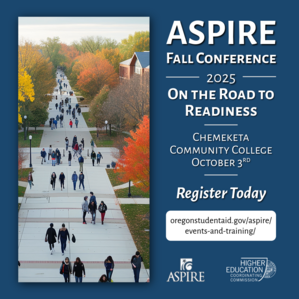
Join us in Salem on October 3 for "On the Road to Readiness," the 2025 ASPIRE Fall Conference
Join us on October 3, 2025 for the ASPIRE Fall Conference, On the Road to Readiness, at Chemeketa Community College’s main campus in Salem, Oregon. This year’s conference will feature a dynamic lineup of workshops addressing challenges and opportunities in the field of Career and College Readiness. Registration is open here.
The ASPIRE program helps educate Oregon students to become career and college ready. ASPIRE offers education, resources, and mentoring opportunities for all students. Student supports include 1:1 and group mentoring, activities and events that focus on career exploration, career and college research, admissions applications, scholarships, and financial aid. Visit the ASPIRE web page for more details on the college and career planning resources offered by the ASPIRE program.
In addition to our Fall Conference and monthly ASPIRE Connections meetings, we have other ways to support your professional development, including regular mentor trainings, webinars, and videos posted to our YouTube page.
|

Join us Online on October 28 for "Growing and Enriching Foundations," the 2025 Oregon Adult Basic Skills Conference
Join us on October 28, 2025, for the Oregon Adult Basic Skills Conference—a virtual event focused on Growing and Enriching Foundations in adult education. This free, one-day online conference offers practical tools, innovative strategies, and inclusive practices to better serve adult learners across GED®, Adult Basic Education, English for Speakers of Other Languages, and corrections programs.
Our theme, “Growing and Enriching Foundations,” emphasizes a commitment to cultivating innovative, inclusive, and effective educational practices that empower learners and educators alike. The conference focuses on growing and enriching foundational practices and preparing learners for both postsecondary education and career success.
Register here and visit the conference website for more details.
|
Commission Elects Greg Hamann as Chair, Emily Simnitt as Vice Chair, and the Governor Nominates New Commissioners
We are pleased to announce that at a June 12 public meeting, Greg Hamann and Emily Simnitt were unanimously elected chair and vice chair of the Higher Education Coordinating Commission.
Chair Hamann has served on the Commission since 2021, including service as vice chair since January 2024. Dr. Greg Hamann is the former president of Linn-Benton Community College and has served as an advocate for postsecondary education in Oregon and nationally.
Vice Chair Simnitt has served on the Commission since 2022. Dr. Emily Simnitt teaches writing, scientific and technical writing, community literacy, and digital humanities, and directs the Writing, Public Speaking, and Critical Reasoning program at the University of Oregon. In addition to serving as HECC vice chair, Dr. Simnitt will also serve as chair of the HECC Funding and Achievement Subcommittee.
In addition, Governor Kotek has nominated three new HECC commissioners: whose appointment is pending confirmation by the Oregon Senate: Michael Dembrow, Devon Lawson, and Erick Njue. Governor Kotek also nominated Commissioner Greg Hamann and Commissioner Arnel Fajardo for reappointment to their 4-year terms. Former Oregon State Senator Michael Dembrow is nominated to serve in an At Large seat, Devon Lawson is nominated to serve in the community college student seat, and Erick Njue is nominated to serve in the graduate student seat. We will share more about the appointees after the Senate considers their nominations.
The HECC is grateful for the dedicated public service of Rachel Biscoe, who completed her term in the community college student seat where she served since October 2023. HECC is also thankful for the dedicated service of Motutama Sipelii, who completed his term in the graduate student commissioner seat where he served since May 2022.
Former Commission Chair Sandy Rowe is Recognized for her Years of Leadership
Former Commission Chair Sandy Rowe was honored for her leadership at the August 14 HECC meeting, which was her final as a commissioner after eight years of service on the commission, including two years as chair. Ms. Rowe, who is a former Oregonian newspaper editor and journalist with extensive community leadership experience, was commended by fellow commissioners at the August public meeting for her student-focused vision, intelligence, diplomacy, and her inspiring leadership of the HECC.
Executive Director Ben Cannon spoke about his confidence in Sandy Rowe's leadership since she was first appointed, bringing "a journalist’s independence, integrity, orientation toward facts, [and] reasoned analysis." He thanked Ms. Rowe for inspiring him and others through her "relentless determination to improve" the systems for which we are responsible. Ms. Rowe was praised by incoming Chair Hamann for her "incredible tenacious passion for this work." Among additional reflections by members of the Commission, Vice Chair Simnitt expressed gratitude for Ms. Rowe's focus on "how to continually and always think about the students of Oregon, and center them first and foremost."

Transfer Initiatives: Stay Informed on the Progress Made to Streamline Transfer
|
The HECC and public institutions, through the Transfer Council, continue to work together to help simplify transfer of credits between Oregon’s 17 community colleges and seven public universities to save students time and money.
APPROVED AGREEMENTS EASIER TO FIND ON OUR WEBSITE
Did you know that Oregon now has 8 major-specific transfer degrees and 40 lower division courses that are aligned and approved for Common Course Numbering to help students transfer credits? We encourage partners to stay up to date on our growing toolset to simplify pathways for transfer students.
We have made recent improvements to our transfer website pages on approved transfer agreements to be sure that college and university partners can easily access this information. Check out our revamped Major Transfer Map and Common Course Numbering web pages to learn more about current agreements, including effective dates and catalog requirements. Students can learn how to take advantage of active agreements under Tools for Transfer here. Students can easily identify available CCN courses in catalogs because these course numbers end in a Z.
In addition to website changes, we are also announcing the approval of new MTMs and CCNs in our weekly news clips and on our agency social media channels. We recently announced two new Major Transfer Maps (MTMs) in Elementary Education and Psychology, and three history courses approved for Common Course Numbering (CCN).
NEW CALENDAR FOR FACULTY SUBCOMMITTEE MEETINGS
Faculty collaboration is essential to transfer work. In addition to the public meetings of the Transfer Council, the HECC convenes numerous faculty subcommittees that advise on transfer initiatives. Pursuant to recent legislation, meetings of the faculty subcommittees are exempt from public meeting law requirements. However, the HECC continues to make meeting information and viewing access available on a new faculty subcommittee calendar page here.
NEW TRANSFER LEADERSHIP AT HECC
We are pleased to announce that HECC hired Dr. Leigh Graziano to serve as the new Transfer Initiatives Director, as of July 2025. Dr. Graziano is leading the transfer team that is now housed in the Office of the Executive Director.
|