Technology Consortium Convenes at Oregon State University
Members Approve Occupation and Wage Profiles, Hear from Educators and Workforce Service Providers on Education and Training Pathways to High-Tech Jobs
This May, the Technology Industry Consortium convened in Corvallis at Oregon State University (OSU) for its second-quarter public meeting. Consortium members reviewed and approved occupation and wage profiles for high-skill tech jobs in Oregon. Prepared by Higher Education Coordinating Commission (HECC) staff in collaboration with the Oregon Employment Department, the profiles fulfill expectations of HECC’s Industry Consortia detailed in House Bill 3306 (2023). Be on the lookout for final versions of the sector-specific occupation profiles on the HECC website this fall.

Consortium members also heard from Workforce Ready Grantees and their partners about education and training pathways to tech careers. Kuuipo Walsh, Senior Instructor and GIScience Program Director for OSU’s College of Earth, Ocean, and Atmospheric Sciences (CEOAS), and Michael Harte, CEOAS Professor and Associate Dean for Undergraduate Programs, presented on OSU’s “Geospatial Internship & Skills Training for Employment and Professional development” program (see article below). Skip Newberry, President and CEO of the Technology Association of Oregon, moderated a panel discussion on registered tech apprenticeships, with the following speakers: Ankur Gopal, founder and CEO, Interapt; John Buzzard, Assistant Director, Professional and Continuing Education (PACE), OSU; Jennifer Cavanagh, Apprenticeship Program Manager, Oregon Bioscience Association; Mandy Reininger, Computer Information Systems Instructor, Chemeketa Community College; and Natalie Miller, Regional Director, Apprenti. (Pictured: Registered Apprenticeship panelists share insights with Technology Consortium members.)
Panelists shared lessons learned from their experiences developing apprenticeship programs for the tech sector:
- Apprenticeships are collaborative by design. Employers inform recruitment strategies and curriculum design, as do organizations that may include education providers, community-based organizations, local workforce development boards, and government agencies. Partner input ensures programs can be tailored to meet the specific needs of employers, workers, and their communities.
- Apprenticeships can provide affordable pathways to high-wage, high-growth careers. As such, they can help grow and retain a diverse tech workforce, as well as provide skilled tech professionals for a variety of tech-adjacent sectors.
- Apprenticeships aren’t just for individuals starting their careers; they can be tailored to upskill or reskill experienced professionals.
- Hands-on training and on-the-job mentorship are hallmarks of many successful apprenticeship programs.
- Recruiting employer partners is one of the biggest challenges to launching new apprenticeship programs; starting with pilots and sharing data-driven results can lead to greater buy-in and demand.
Please note: The Bureau of Labor and Industries Apprenticeship and Training Division registers and supports apprenticeship programs in Oregon. HECC’s Office of Workforce Investments supports registered apprenticeship, including with the support of grant funds from the U.S. Department of Labor. HECC’s Office of Community Colleges and Workforce Development collaborates with Oregon's 17 community colleges and the Oregon Community College Apprenticeship Consortium on program and course approval for registered apprenticeship offerings—click here for details. Other sources for more information on registered apprenticeships include the HECC Office of Student Access and Completion’s ASPIRE Career Toolkit for Oregon students, the Workforce and Talent Development Board’s Resources for Workers, and Oregon Apprenticeship.
|

The meeting concluded with a tour of the OSU Robotics Lab, where faculty and students shared insights into how hands-on research prepares graduates for a variety of career fields. Our warm thanks to our hosts and guest presenters for engaging Consortium members in considering strategies for addressing gaps in Oregon’s tech workforce. (Pictured: Ashutosh Gupta, Ph.D. student in Robotics and AI at OSU, addresses tour participants.)
The Technology Industry Consortium’s next public meeting is scheduled for Thursday, July 24, in Pendleton, Oregon. There will be an option to listen online. Visit the Industry Consortia page for more information, including the agenda and meeting location. Everyone is welcome to attend as Consortia meetings are open to the public. Subscribe to Industry Consortia public meeting notices to receive the latest public meeting updates.
|
Stepping into Geographic Information Science Careers
Future Ready Oregon Grant Helps Oregon State University Expand Access for Incumbent Workers
Oregon State University (OSU) is expanding its education opportunities in Geographic Information Science (GIScience) in collaboration with community college and employer partners, and with support from a 2024 Technology Workforce Ready Grant from the HECC.
GIScience—which combines geospatial data collection, modeling, and mapmaking—is useful in a variety of fields, both in and outside the tech industry. Examples include market analysis, urban planning, forestry, environmental engineering, and instructional design—to name just a few. Job opportunities range from entry-level to more advanced positions.
OSU’s College of Earth, Ocean, and Atmospheric Sciences (CEOAS), which offers undergraduate and graduate certificates and degrees in GIScience, recently expanded a longstanding certificate program to increase access for incumbent workers. The “Geospatial Internship & Skills Training for Employment and Professional development” program—known as GIS-STEP—combines coursework with a paid internship and workshops on professional skills.
GIS-STEP is designed to respond to the “rapid advancements in geospatial technologies and the growing demand for skilled professionals who can leverage these technologies,” explains Kuuipo Walsh, Senior Instructor and GIScience Program Director for CEOAS. Michael Harte, CEOAS Professor and Associate Dean for Undergraduate Programs, agrees: “We are trying to develop and provide skills that will make students employable, giving them rewarding occupations when they graduate, and meeting the needs of Oregon.”
Walsh and her colleagues have designed GIS-STEP to expand access for rural and frontier communities, low-income communities, and communities of color. The courses are offered online, and OSU is partnering with Central Oregon Community College (COCC), Blue Mountain Community College (BMCC), and regional employers to help ensure that students in Central and Eastern Oregon can participate. The program covers tuition, fees, and the cost of books for students, who need no previous technical background to participate. The ten-week paid internship is also provided at no cost to participating employers. Students who successfully complete GIS-STEP earn a GIS certificate. Through OSU’s partnership with COCC and BMCC, students may also earn additional credentials in a GIScience field. Examples include an Unmanned Aircraft Systems (UAS) certificate and a Precision Agriculture Associate of Applied Science (AAS) degree. Visit OSU’s GIS-STEP program page for a complete list.
This January, the first cohort launched with eight students, and recruitment has already begun for the second cohort, set to begin coursework in winter 2026. CEOAS aims to enroll at least 50 students within the first two years, with the objective that at least 80 percent of participants will be employed in a GIS occupation upon program completion.
Southwestern Oregon Workforce Investment Board Expands Rural Access to Workforce Supports and Services
Future Ready Oregon Workforce Benefits Navigator Funding Supports Outreach via App, Kiosks
Future Ready Oregon grantees and partners engage with technology in many ways. In addition to addressing employer needs for a skilled tech workforce, some organizations are using tech creatively to expand outreach to communities about workforce development opportunities. Southwestern Oregon Workforce Investment Board’s (SOWIB’s) Workforce Benefits Navigator (WBN) pilot project is a prime example.

SOWIB serves Coos, Curry, and Douglas Counties. Staff recognize that many of the region’s rural communities may face a number of barriers to engaging with the WorkSource Oregon (WSO) services that SOWIB provides in person or online. Accessing reliable internet can be a challenge, as can making the trip to each county’s single WSO center. SOWIB’s solution: expand access through both an app and in-person kiosks. (Pictured: Interior of the Curry Public Library kiosk, outfitted with a tablet showing the Engage by Cell home screen. Photo courtesy of SOWIB.)
The app, Engage by Cell, has been adopted by several local workforce development boards for their WBN pilot projects and can be tailored to meet regional needs. SOWIB’s version of Engage by Cell enables users to connect directly with both SOWIB and a network of regional community partners for individualized support. The app also features local job openings, resources for participating in education and training opportunities, and links to local wraparound supports and services, from childcare, food pantries, and housing assistance, to financial planning and career exploration tools.
|
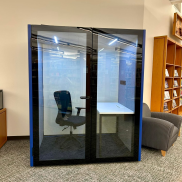
The kiosks—private meeting spaces with seating, a work surface, and internet access—provide a welcoming environment for engaging with the app and related resources. Current locations include six public libraries and the Cow Creek Band of Umpqua Tribe of Indians’ Tribal Government Offices in Roseburg. There are plans to open kiosks in two more community centers later this summer. (Pictured: North Bend Public Library kiosk. Photo courtesy of SOWIB.)
“The kiosks are great for several reasons,” explains Teresa Scott, SOWIB’s Workforce Benefits Navigator. “First, they are comfortable and soundproof. Privacy is respected, and the user can feel at ease.…Also, a single parent would be able to easily keep their child in close proximity. Secondly, each kiosk has a computer tablet inside. These are designed to be intuitive—preloaded with everything a community member would need to search for jobs, find courses…look up statewide employment trends, find effective resume templates, learn how to write a cover letter that gets attention, and so much more! Best of all, during business hours, individuals can receive live, one-on-one coaching from staff trained to connect them with resources to improve their lives.”
|
Future Ready Oregon in the News
Recent Articles Feature Projects Supported by Workforce Ready Grants
WorkSource Reentry Program for DRCI adults released from custody. June 9, 2025. Madras Pioneer. By Marilyn Clark. “It’s no secret that many businesses are struggling to maintain adequate staffing levels while Deer Ridge Correctional Institution has regular releases of adults following time served…” Note: This article covers a program for which Oregon Workforce Partnership received Workforce Ready Grants in 2022 and 2023.
Nehalem Bay Health Center & Pharmacy launches Pathways to Equity Program. June 7, 2025. Tillamook Headlight Herald. “Nehalem Bay Health Center & Pharmacy (NBHCP) has launched the Pathways to Equity program, a new initiative aimed at expanding access to healthcare careers for students throughout Tillamook County…” Note: This article covers a 2024 Healthcare Workforce Ready Grant project.
Aviva Health welcomes newest cohort of Earn to Learn Scholars at annual dinner. June 2, 2025. 16 KMTR Eugene, Oregon. “Aviva Health is hosting its annual welcome dinner to celebrate recipients of the Earn to Learn (E2L) Scholarship and honor the community partnerships that make the program possible…” Note: This article covers a project for which Umpqua Community College received a 2023 “Innovation in Workforce Programs” Workforce Ready Grant.
GO STEM names Elaine Swanson as AI and technology educator to lead rural workforce initiatives. May 28, 2025. Eastern Oregon University Current News. “Eastern Oregon University and the Greater Oregon STEM Hub (GO STEM) are proud to announce the appointment of Elaine Swanson as the region’s new Technology Workforce Exploration Educator…” Note: This article covers a 2024 Technology Workforce Ready Grant project.
Unique internship percolates results for students, local businesses. April 25, 2025. Pacific University News and Stories. By Blake Timm. “On any given afternoon, you can find Pacific University students enjoying a cup of coffee and catching up on homework at Telvet Coffee…” Note: This article covers a 2024 Technology Workforce Ready Grant project.
Future Ready Oregon in the News contains links to news content that includes information created, published, maintained, or otherwise posted by institutions or organizations independent of the HECC. The content represents a selection of recent coverage from reputable, non-partisan media sources and institutional or government partners. We do not guarantee the accuracy, completeness, or timeliness of information available via these links.
HECC publishes a weekly News Clips email featuring HECC opportunities and links to recent media stories from across the postsecondary landscape. Sign up for HECC News Clips and other HECC newsletters here.
|