Message from Executive Director Ben Cannon
As the 2025 legislative session wraps up this week, we thank the Legislature, Governor Kotek, our community partners, and all who testified, analyzed, and engaged on important issues for higher education and workforce development. We appreciate the budgets that the Oregon Legislature has adopted for higher education and workforce training, and we recognize the hard decisions they faced due to a challenging and uncertain state fiscal environment.
The Legislature adopted a nearly $4 billion budget for higher education and workforce training that equates, for the most part, to the state’s official estimates of "current service level (CSL)” for 2025-27. As we’ve noted previously, however, because CSL often underestimates the actual cost of maintaining programs and services, this budget will place significant stress on the agency, institutions, and students. The HECC is committed to working with our partners, the Governor, and Legislature to administer these investments in ways that best serve Oregonians.
The state budget picture is, of course, intricately connected to the federal budget, and it's important to be clear about the potential impact of significant federal decisions. We are closely watching Congress's work on the budget reconciliation package, including as detailed to the Commission in June by Tom Harnisch, Vice President for Government Relations at the State Higher Education Executive Officers Association (SHEEO).
As the Oregon agency that administers state financial aid, we are especially concerned about the House version of the reconciliation package that would significantly reduce access to the Pell Grant and subsidized student loans that serve tens of thousands of Oregonians. The American Council on Education (ACE) estimates that this version of the proposal would result in a loss of between $35-48 million in federal Pell Grant funds that would impact up to 37,500 Oregon students. We are concerned for the potential impact on college access and affordability for Oregonians at a time when too many students and families already face serious affordability challenges.
As we stay informed, we at the HECC remain steadfast in our mission to drive equitable opportunity to the life-changing benefits of workforce training and higher education. The great majority (93 percent) of jobs in Oregon that pay more than average require some form postsecondary education/training—whether an apprenticeship, a certificate, a college degree, or other credential—for applicants to be competitive. Protecting fair access to postsecondary education contributes to thriving communities and a thriving economy for the state and the country.
In this newsletter, you can read about some of our ongoing efforts, and successes, in promoting opportunity for Oregonians, including how Oregon has rebounded in its FAFSA/ORSAA completion rates, strategic investments we are making in some of the most high-demand career pathways in the state, and more. It is a privilege to do this work, and we appreciate your engagement as always.
Higher Education and Workforce Budget Largely at Current Service Level – Highlights
Stay tuned for more information in our August issue, when we will share our full legislative summary and fact sheet on the 2025-27 outcomes
Thank you to all who engaged with the HECC on the needs of Oregon learners this session. We are pleased to report a few anticipated results from the 2025 legislative session for higher education and workforce development. What becomes the HECC budget is a collection of bills that appropriate or allocate resources to the agency and the system, and we will report fully on outcomes after all legislation is approved and signed by the Governor.
HECC's primary budget bill, SB 5525, totals $3.9 billion—and higher education and workforce programming is, for the most part, sustained at current service level (CSL) for the next biennium. The three largest funds in the HECC budget are the operating funds for the institutions and the state’s largest financial aid program.
- The Community College and Public University Support Funds are funded at CSL, or $854.3 million and $1,068.8 million, respectively.
- The state’s need-based financial aid program, the Oregon Opportunity Grant, is also funded at CSL, or $329.4 million.
Funding for other state-administered financial aid programs (Oregon Promise, Oregon Tribal Student Grant, Oregon National Guard State Tuition Assistance Grant, and others), Statewide Public Service Programs, and workforce funding for the nine local workforce development boards were also funded at CSL. Notably, the budget retains dedicated funding for institutional benefits navigators, positions designed to assist students in enrolling in and receiving state and federal benefits for which they are eligible. Additionally, SB 5525 reappropriates the remaining balance of one-time funds that the 2024 Legislature established for financial sustainability initiatives at the technical and regional universities and PSU.
For the HECC agency, the Legislature approved a reauthorization of $77 million in currently available and already encumbered federal funding to continue Future Ready Oregon as planned through 2026, and an expenditure limitation for $5 million in capital bonds for the next phase of HECC’s information technology modernization project. HB 5006 also restores some funding for the Oregon Conservation Corps workforce program. We will report more comprehensively on the budget, including capital construction and new legislation impacting higher ed, in our upcoming summary.
State of Oregon Awards $1.5 Million to Support Workforce Training in Housing Production and Behavioral Health
The HECC is pleased to award $1.5 million through the Governor’s Statewide Activities Grant Program to help train more Oregonians in the housing production and behavioral health care sectors. The awards will support two innovative projects that strengthen regional responses to workforce needs in Southern Oregon and the Portland metro area.
The grants support identified workforce needs. In 2024, in response to Governor Kotek’s goals for housing production, the HECC Office of Workforce Investments commissioned and published an assessment of Oregon’s housing production workforce. The researchers reported that an average of 12,700 additional workers will be needed per year from 2028–34 (taking into account a ramping up period) to meet the Governor’s goal. HECC also commissioned and published an assessment of behavioral health industry workforce needs, which highlighted significant statewide shortages of trained behavioral health professionals. For example, it showed that 32 of Oregon's 36 counties lack even one behavioral health provider per 1,000 residents.
A $750,000 housing production workforce grant will support Southwestern Oregon Workforce Investment Board, in partnership with Rogue Workforce Partnership, in developing and expanding housing production career pathways that are expected to serve approximately 160 participants across Coos, Curry, Douglas, Jackson, and Josephine counties. The program in housing production offers multiple entry points into construction-related occupations and apprenticeships. Participants will complete a construction pre-apprenticeship and earn industry recognized credentials.
A $750,000 behavioral health grant will support Worksystems, Inc., in partnership with Clackamas Workforce Partnership, in expanding an innovative Peer Worker Training Project (PWTP). The program aims to recruit and train 80 new behavioral health care Peer Support Specialists for positions with employers across Clackamas, Multnomah and Washington counties. Building on a pilot program, this project will help local employers recruit, hire and retain qualified peer workers in behavioral health care, with a focus on culturally-specific and bilingual service delivery.
The statewide employment and education activities supported by these grants are funded through the U.S. Workforce Innovation and Opportunity Act. Julia Pontoni, director of the HECC Office of Workforce Investments, says, “We are thrilled to fund these two projects that complement our ongoing work to provide training and career services to Oregon’s job-seekers, and to produce qualified applicants for some of the most critical and hard-to-fill jobs in our state.”
FAFSA/ORSAA Completion Rates Return to Levels Seen Before the New FAFSA
For many students, completing the Free Application for Federal Student Aid (FAFSA) or the Oregon Student Aid Application (ORSAA) is a critical first step toward securing financial aid and pursuing their college goals. A recent report from the HECC Office of Student Access and Completion (OSAC) shows that Oregonians are making progress in this important process.
On June 1, 2025, OSAC released its latest FAFSA/ORSAA completion report for public high schools, revealing a completion rate of 46.3%. This marks an increase from the previous month and a return to the 2023 FAFSA/ORSAA completion levels, prior to the rollout of the new FAFSA.
In 2024, the Department of Education launched the new FAFSA. However, this update unintentionally delayed the FAFSA’s release and created difficulties for some students and families trying to complete the form. Consequently, FAFSA completion rates for Oregon’s high school class of 2024 dropped to 49.1%, down from 51% for the class of 2023. Nationally, the completion rate fell to 46%, compared to 53.4% in 2023.
This year, the opening of the FAFSA was once again delayed, making recent increases in FAFSA/ORSAA completion rates a hard-fought victory. To support FAFSA/ORSAA completion, this year, OSAC hosted 23 FAFSA/ORSAA training workshops, reaching over 250 school and college access staff, and ASPIRE sites hosted over 1,300 FAFSA/ORSAA completion events. Additionally, OSAC received more than 200 requests for FAFSA/ORSAA support.
By working together, Oregon can ensure even more students can access the resources they need to succeed in higher education.
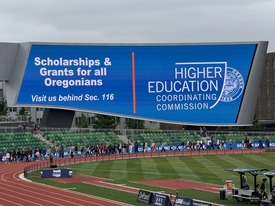
OSAC Outreach Reaches the Playing Field
As just one example of our statewide college and career planning outreach, HECC-OSAC worked with the Oregon Schools Activities Association this year to advertise state financial aid applications at high school athletic stadiums. We are pleased to share a photo from a track and field event for recent high school graduates at Hayward Field in Eugene. To learn more about OSAC outreach activities, visit the link below.
|
ASPIRE Highlights for 2023-25: Oregon’s Statewide Career and College Readiness Program Grows, Thanks to Statewide Partnerships
The ASPIRE program's work to prepare Oregon students for college or career expanded considerably in 2023-25 and is seeing results. ASPIRE, administered by the HECC Office of Student Access and Completion (OSAC), provides mentoring and college and career readiness support to students statewide.
ASPIRE sites prepare students for a variety of postsecondary pathways after high school, including college, apprenticeships, trades, and direct employment. State investments in the HECC budget support the administration of this program, while the vast majority of direct student support through ASPIRE is performed by a wide network of community and site volunteers who receive training and resources through OSAC. More than 53,000 students in grades 6–12 received mentoring support through ASPIRE sites during the 2023–2025 biennium. Students were supported by more than 2,000 community volunteer mentors and 7,000 building and staff mentors.
The program now includes 200 active sites at schools and community-based organizations, including 56 new sites that were added this biennium. Each year, ASPIRE sites receive training and professional development focused on supporting Oregon students through the financial aid process. During the 2023–2025 biennium, ASPIRE sites hosted over 3,000 financial aid workshops, as well as ongoing training and coaching on FAFSA and ORSAA completion. As a result, ASPIRE sites have consistently achieved FAFSA/ORSAA completion rates above the state average.
Read highlights on ASPIRE's recent activity in the recent OSAC newsletter here.
Academic Program Approvals and Notifications
At its June public meeting, the HECC approved the following new academic programs at Oregon's public institutions.
Programs approved at community colleges (CCs):
- Central Oregon CC: Behavioral Health and Early Learning Less Than One-Year Certificate of Completion (CC0)
- Clackamas CC Geographic Information Systems (GIS) Technology, Less Than One-Year Certificate of Completion (CC0)
- Clackamas CC: Emergency Management Professional, Associate of Applied Science (AAS)
- Lane CC: Behavioral Health, Less Than One-Year Certificate of Completion (CC0)
- Umpqua CC: Emergency Services, Associate of Applied Science (AAS); Fire Science, Associate of Applied Science (AAS); Paramedicine, One-Year Certificate of Completion (CC1)
Programs approved at public universities:
- Eastern Oregon University: Master of Arts in Educational Leadership (MA)
- Oregon Institute of Technology: Bachelor of Science in Allied Health (BS)
- Portland State University: Bachelor of Science in Linguistics and Computer Science (BS)
The HECC also received notifications of statements of need for new Bachelor programs at Oregon community colleges (CCs). The statement of need is Phase One of a three phase review process for these types of programs.
- Chemeketa CC: Education, Bachelor of Applied Science (BAS)
- Columbia Gorge CC: Education, Bachelor of Applied Science (BAS)
- Klamath CC: Business Management – Salon Emphasis, Bachelor of Applied Science (BAS)
- Linn-Benton CC: Education, Bachelor of Applied Science (BAS)
- Rogue CC: Education, Bachelor of Applied Science (BAS)
- Treasure Valley CC: Education, Bachelor of Applied Science (BAS)
Recent Legislative Reports
Oregon Conservation Corps Report
The HECC has submitted to the Oregon Legislature its report on the Oregon Conservation Corps program, after approving the report at its June public meeting. The Oregon Conservation Corps (OCC) is a youth-focused wildfire risk reduction and workforce development initiative that has been operating for three and a half years. OCC engages youth from underserved communities in fire fuels mitigation efforts while providing job training and relevant certifications.
From January 2022 through June 2025, the program served 1,079 youth participants and treated 7,406 acres of land throughout Oregon. A total of $21.7M in grant funds was disbursed. Read the full report at the link below.
Plant Closings and Layoffs Annual Report
The HECC has released its annual report on plant closings and layoffs for calendar year 2024.
As Part of a Fellow Feature Series, Advance CTE Interviews HECC Analyst on "Democratizing Data for All"
We are pleased to share an interview with Kelly Zinck, research analyst in the HECC Office of Community Colleges and Workforce Development (CCWD), who is serving as a fellow in the third cohort of the Postsecondary State CTE Leaders Fellowship through the national organization Advance CTE. Kelly’s research as a fellow is directly related to CCWD's work with partners to carry out the state’s career and technical education (CTE) plan for Oregonians. In a feature interview by Advance CTE, Kelly Zinck describes her energetic commitment to "democratizing data for all" in CTE work, and the importance of intentionally using data insights to help close opportunity gaps. Kelly enjoys engaging others in data insights, including bringing "data snippets" to internal meetings for analysis, and she emphasizes the importance of demystifying data and making it available to communities served. She stresses the importance of disaggregating data to uncover opportunities for customized interventions to better serve specific communities.
|