Message from Executive Director Ben Cannon
Over the course of six, 90-minute hearings at the Capitol earlier this month, I led HECC staff in presenting the Governor’s budget recommendations for higher education and workforce development.
While our presentation focused on the 2025-27 HECC budget, the hearings were also an opportunity to talk to legislators about what higher education is, why it is important, and how state investment benefits individuals and communities.
Especially at this moment, it is important to uplift the unique and critical role that public postsecondary education institutions play in our society.
They are engines of economic mobility. They are centers of research and discovery. They are havens of free expression and academic freedom, allowing teaching and research to occur without fear of outside intrusion. They are communities that foster dialogue and understanding across difference, allowing divergent opinions to be voiced. They bring together diverse people from around our state–and around our world–for learning, teaching, and discovery.
At HECC, we unreservedly support the work our colleges and universities are doing to foster safe, inclusive, and welcoming environments for all: including Oregonians from all backgrounds, and students and scholars from across the U.S. and across the world. Oregon benefits enormously from institutions that reflect our world’s racial, ethnic, geographic, religious, and political diversity. We are committed to addressing the specific and varied needs of different communities to eliminate barriers as we work to foster equitable opportunity for all. And we honor the principles of academic freedom and institutional autonomy as indispensable conditions for innovation, creativity, and discovery.
Our presentations to the Legislature this month focused on the impact of current state investments on fostering opportunity, driving economic mobility, and strengthening Oregon’s future. They also recognize that Oregon higher education has much work to do to live up to its greatest potential. One of the benefits of the legislative session is the chance to discuss research, policy and outcomes to drive improvements. We need to work together to make higher education more affordable and accessible, improve completion rates, connect college to career, and strengthen learners’ sense of belonging. As we work with the Legislature and Governor to address these critical issues, it’s important to remember that longstanding values and principles undergirding U.S. higher education must continue to be sustained and strengthened, this year and every year.
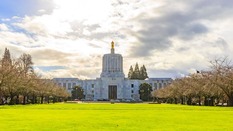
HECC Budget Presentations Emphasize the Return on Investment for Higher Education and Workforce Training
We are pleased to share highlights of the HECC presentation to the Oregon Legislature’s Joint Ways and Means Subcommittee on Education on the Governor’s Recommended Budget (GRB) for higher education and training in Oregon. Over six hearings, HECC agency leaders shared data and findings about the benefits to Oregon and Oregonians of investing in postsecondary education, and these were followed by numerous hearings for partner presentations and public testimony, which are still underway.
The HECC presentations emphasize the critical importance of state investment in ensuring equitable opportunity for Oregonians and thriving communities for Oregon. You can view the full set of HECC slides below:
|
The budget presentations emphasize ways in which state investments drive equitable access and success for all Oregonians, foster economic mobility and a strong economy, support college affordability, and support core operating funds for Oregon's public institutions.
-
Improving Equitable Access: Investments support our continued work to ensure that the benefits of postsecondary education and training are realized equitably across all groups. Educational attainment rates continue to vary widely by race/ethnicity. And while students from low-income families can achieve upward mobility through postsecondary education, only 9.8 percent of public institution students are from the lowest income bracket.
-
Driving Economic Mobility and Workforce Needs: Postsecondary education fosters innovation and knowledge to prepare Oregonians for jobs of the future. For example, 93 percent of jobs that offer above-average earnings in Oregon require postsecondary education or training in order for applicants to be competitive.
-
Prioritizing Affordability: Oregon's investment in financial aid trails the national average and is far below our neighboring Western states despite state investments over the last decade. Students are shouldering the burden of increased college costs. The GRB’s investment in several financial aid programs, including the Oregon Opportunity Grant and the Oregon Tribal Student Grant, help address this serious affordability gap.
-
Sustaining Public Institutions and Workforce Service Providers: The GRB maintains a Current Service Level (CSL) investment in community colleges, public universities and workforce development boards. These state investments fund the operating costs for education and research at Oregon's 24 public institutions and ensure the workforce system is able to respond to state and local needs.
Additional public testimony opportunities on the HECC budget are coming up on April 28, April 30, and May 1. Sign up to testify on the Subcommittee webpage here, where you can also view recordings of HECC’s presentations (March 31-April 8). The HECC will present concluding remarks on Thursday, May 1.
HECC Commission Approves Five Major Transfer Maps
The HECC, community colleges, and public universities continue to work together to expand Major Transfer Maps (MTMs) across Oregon public institutions. MTMs are major-specific transfer degrees that allow students to transfer credits from Oregon community colleges to Oregon public universities if the participating institutions offer programs in the MTM subject area.
At its April 10 public meeting, the HECC Commission approved five Major Transfer Maps (MTMs) in Human Development and Family Services, English, Sociology, Biology, and Business. Three of the approved MTMs reflect updates and improvements to existing maps (for English, Biology, and Business), and two represent newly created MTMs (for Human Development and Family Services and Sociology). With the addition of the two new MTMs, the number of fully aligned majors in Oregon grows from five to seven.
Both new MTMs create two streamlined transfer degree pathways for community college students:
-
Human Development and Family Services: Associate of Arts Transfer (AAT) and Associate of Science Transfer (AST) degrees in Human Development and Family Services
-
Sociology: AAT and AST degrees leading to a Bachelor of Arts (BA) or Bachelor of Science (BS) degree, respectively, in Sociology or Sociology/Anthropology (depending on what the major is called at the institution where the student transfers).
MTMs are one component of the statewide transfer work that HECC leads, catalyzed by the Oregon Legislature in 2017 and 2021 and made possible through faculty collaboration. Oregon’s statewide transfer work is helping to save students time and money, reduce barriers to completion, and improve equitable pathways to graduation.
Three Years in, Oregon’s Historic Investment in the Oregon Tribal Student Grant is Changing Lives
In a recent press release, the HECC reported growing participation in the Oregon Tribal Student Grant (OTSG) since the historic launch of this new state program three years ago. Launched in 2022, the Tribal Grant is opening doors to postsecondary degrees and certificates for hundreds of students from Oregon’s nine federally recognized Tribes, and there have been more applicants each year. In the first two years alone, 215 grantees earned credentials at community colleges and public universities. The application is open for 2025-26 and tribal students are encouraged to learn about eligibility and apply.
The Oregon Tribal Student Grant pays for most or all public college-related expenses—including tuition, housing, books, and other costs not covered by other grants—for eligible students who are enrolled members of Oregon’s nine federally recognized Tribes. In the program’s first three years, the HECC Office of Student Access and Completion has seen applications and awards steadily increase. The agency has awarded 616 grants so far in 2024-25, compared to 501 in 2023-24, and 412 in 2022-23. The applications have also grown since 2022 from 917 to 1,052. In addition to the credentials earned so far, HECC analysis is showing that university students with the OTSG are more likely to return after their first year than students without the grant.
The program is funded at $24 million for the current two-year budget cycle. With increased demand for the program, Governor Tina Kotek has recommended a $2.5 million increase in program funding for the upcoming 2025-27 biennium.
In recognition and respect of the sovereignty of Oregon’s nine federally recognized Tribes, the State of Oregon works with tribal leaders through a Government-to-Government process. The HECC Office of Student Access and Completion administers the grant and works in close partnership with the Tribes to inform communities of this opportunity.
Read About the Positive Impacts of the Oregon Tribal Student Grant on Four Grantees
The application for the program is now open for 2025-2026 - learn more here.
We are pleased to share stories of how the historic investment in the Oregon Tribal Student Grant has made a difference in several students' lives. In its first three years, the OTSG has been awarded to tribal students from all nine federally recognized Tribes in Oregon.
Among state financial aid programs, the OTSG is unique in its flexibility—it can cover total college costs at a time when the financial strain of housing and living expenses can be as much of a barrier as tuition. The OTSG can be applied toward undergraduate or graduate study at Oregon’s 24 public colleges and universities as well as eligible Oregon private non-profit institutions, where awards can go up to the allowable maximum amount at a public university. The grant is available to students at all levels, including those who just graduated from high school or earned their GED® and adults wanting to start or return to college.
OTSG recipient Jacob Olson, a member of the Confederated Tribes of Grand Ronde, says, “Getting the grant was the real reason I kept going.” He adds, “It was definitely life-changing. It was a change from having to grasp my head around $50,000-60,000 in student loans by the time I graduated to not having to take any more student loans. It opened the door to be able to go to a four-year university.”
A student in construction engineering management at Oregon State University, Jacob’s goal is to work as a construction project manager or field engineer in Oregon after completing his degrees, and eventually to run his own company. Before receiving the grant, Jacob considered stopping out of college because of the amount of student loan debt he expected to have to take on. Receiving the OTSG drastically reduced his expected debt load, allowing him to persist in his bachelor’s degree, and now he plans to pursue a graduate degree as well. Read more about Jacob’s story.
Alexa Burgess, an OTSG recipient and a recent Southern Oregon University (SOU) graduate, has a job at Lithia Driveway Finance and business ideas bubbling for the future. With a bachelor’s degree in business administration, she hopes to continue to grow in her job and to one day own her own business. A member of the Cow Creek Band of Umpqua Tribe of Indians, Alexa received the OTSG during her junior and senior years at SOU. Alexa says, “I was able to say OK, I can focus on my schooling, get that done and find the job that I want. ... And thanks to the Tribal Grant, I don't have college debt, so I'm able to kind of jump-start my life.” Read more about Alexa’s story.
A returning adult student who is active in his tribal community, Mark Petrie used the OTSG to earn his degree in social work with a focus on indigenous cultural knowledge in social services. A member of Hanis Coos, one of the tribes of the Confederated Tribes of Coos, Lower Umpqua and Siuslaw Indians, Mark has already devoted years to tribal community work, and he is excited to expand his career in this area. With the help of the OTSG, Mark recently graduated with a bachelor’s from Portland State University. With his degree, Mark hopes to embed indigenous cultural knowledge into social work and health work in new ways, and to focus on meaningful connections and evidence-based health practices. He says, “My degrees are helping me be a better advocate for and supporter of indigenous cultural ways of healing within the [tribal] community and wider community.” Read more about Mark’s story.
Jaylin (aka Jay) Hardin, a member of the Cow Creek Band of Umpqua Tribe of Indians, has the freedom to be involved in campus activities, clubs, sports, and more in the Western Oregon University campus community while she is working toward her degree and dream to become a teacher. Receiving the OTSG removed financial stress, allowing Jaylin to focus her time and energy on activities relevant to her interests. While completing a degree in early childhood and elementary education, she also plays in the WOU rugby club, coordinates events for the Native and Indigenous Cultures Club, writes for the campus paper The Western Howl, and works in the Childhood Development Center. She says the grant is “changing my life and making it so much easier and making it to where I can be involved in my campus life and I can be part of my campus culture.” Read more about Jaylin’s story.
Modernized Platform for the Eligible Training Provider List (ETPL) to Open in May
The HECC is pleased to announce that the Eligible Training Provider List (ETPL) system, a resource for workforce partners and job seekers, will be launched on a user-friendly, modernized platform in early May.
As part of HECC’s work administering higher education and workforce programs, our agency needs to reliably collect and manage information from numerous partners. With the HECC Modernization Project, we are working to create a new integrated IT solution called LEARN—Lifelong Educational Advancement Resource Network.
The first publicly-launched component of the LEARN project, Oregon's Eligible Training Provider List (ETPL), is a tool for Oregon job-seekers and the WorkSource Oregon partners who support them. As a WorkSource Oregon partner, the HECC Office of Workforce Investments oversees a number of workforce programs, including federally-funded programs authorized by the U.S. Workforce Innovation and Opportunity Act (WIOA). To be eligible to receive WIOA funding to support training for a WIOA program participant, the training provider and its program of study must be on this list.
The new system will make searching and navigating the list easier, helping individuals make more informed training and career decisions. Additionally, the enhanced system will make initial and continuing applications to the ETPL easier. Individuals seeking training: you can explore the Eligible Training Provider List webpage, which now has training guides for your convenience. For training providers, if you currently have programs listed on the ETPL or are interested in being included, visit the ETPL Provider Guidelines web page.
Stay tuned as we continue to enhance the tools that connect Oregonians with education and workforce opportunities!
|