 Improving Transfer Pathways
Welcome to the December Transfer Hub newsletter. This month’s newsletter highlights three students who have struggled with the issue of excess credits or credits that don’t count toward a degree or credential.
You are receiving this newsletter as a subscriber. If you are not a subscriber but would like to sign up to receive this newsletter, please subscribe here.
Oregon Transfer Council News
In September, Transfer Council (TC) reviewed its membership nomination process for both reappointments and filling vacant seats. Newly adopted rules for Major Transfer Maps (MTMs) were reviewed and the new MTM Curriculum Articulation Policy (CAP)—which has taken the place of MOUs—were approved. A draft report on the implementation surveys for MTMs, Core Transfer Maps (CTMs), and Common Course Numbering (CCN) was shared and TC members Alix Gitelman (OSU) and David Plotkin (Clackamas) volunteered to work on revising the report, which was shared with the HECC Commission in December. During summer 2023, the surveys were sent to Oregon’s 17 community colleges and seven public universities. Surveys were designed to gather information on institutions’ progress implementing CCN/CTMs/MTMs. The report contains findings and recommendations based on the survey results. Also during the September meeting, Western Oregon University (WOU) Provost and VP of Academic Affairs Jose Coll was appointed as the new TC Co-chair, replacing Susan Jeffords and joining existing Co-chair Teresa Rivenes (Umpqua). Additionally, replacements for vacancies on CCN and MTM subcommittees were confirmed.
In October, TC approved the subcommittee charge for a new subcommittee (CCN Rule Subcommittee Charge) that will work on a draft of the CCN Oregon Administrative Rules (OARs). CCN Subcommittees (Business, English, Math) provided updates. Nominations for vacancies in CCN and MTM subcommittees were confirmed. An update on the TC Report on CCN, CTMs, and MTMs 2023 was also provided.
At the November TC meeting, the TC Report on CCN, CTM, and MTM 2023 was approved and was shared with the HECC Commission at the December 14, 2023 meeting. Recommendation Reports from the CCN Business, English, and Psychology subcommittees were approved to be sent to the HECC Commission and received final approval at the December 14 meeting. Several people shared opinions during public comments concerning the CCN Math Recommendation and Minority Report and the number of credits for MTH 251Z Differential Calculus and MTH 252Z Integral Calculus. TC decided to defer approval of the MTH Recommendation Report, to gather information on how credits are aligned under the CCN framework. The new MTM CAP for Computer Science (CS) was also shared during the meeting, and discussion of the MTM Recommendation Report for Psychology was postponed until the next Transfer Council meeting (January 18, 2024). Approval of the Computer Science MTM was deferred until student facing documents can be shared with TC (January 18, 2024). Replacements for vacancies on CCN and MTM subcommittees were confirmed.
 |
|
Transfer Spotlight
Each edition of the Transfer Hub spotlights a group, subcommittee, institution, or organization that is working to improve the transfer experience for students in Oregon.
This fall’s Student Spotlight is on three students for whom excess credits have been a barrier to degree completion. The HECC values student and partner perspectives. Information in Student Spotlights are shared for the purpose of candid engagement and opinions expressed do not necessarily represent the position of the HECC. For more on excess credits and how they impact student success, see Featured Research, below.
|
Student Spotlight
Transfer student success stories.
 |
|
Shannon Vandiver-Pickering attends Western Oregon University (WOU) and is pursuing a BA in Interdisciplinary Studies (IDS). After graduation June 2024, she will apply to the Master of Arts in Teaching (MAT) program, also at WOU. Shannon’s transfer journey took her from WOU to 18 years in the workforce, to Pacific University, and back to WOU where she is nearing completion. Along the way she faced challenges such as exhausting her financial aid. But after returning and getting the help of advisors, she is now just 10 credits away from her bachelor’s degree. |
Shannon’s story: After leaving WOU the first time, I worked for 18 years from home as a contractor until I was encouraged to check back with WOU to see what it would take to complete my bachelor’s degree. This time I had the good fortune to meet the Degree Completion and Interdisciplinary Studies Coordinator/Advisor, and that was when I got the good news about IDS, which allows students to develop their own degree plan. Although I am a full-time working mom, I made the tough decision to leave my job to apply for jobs in a school district, so I could get experience as well as credit for teaching to help complete my degree. I can’t thank WOU enough for offering the IDS option and helping me solve the complicated puzzle of my credits. In June I’ll start my master’s degree, which just blows my mind. In the past three months I’ve gone from feeling like I gave up on my dream to literally watching it become a reality!
Shannon’s advice for students: Resist the urge to settle when it comes to your degree. You’re paying for your education, so do what you want to do. I also would advise students to check out the IDS degree at WOU because it is so versatile, especially if you have diverse credits and interests.
 |
|
Maizie McCoy attends Western Oregon University (WOU) and is pursuing a BA in English studies with a concentration in Literature. She is on track to graduate in 2024. After earning her GED in 2017, Maizie decided to move from Texas to Oregon, where she eventually enrolled in coursework at Chemeketa Community College. Maizie returned to college after the COVID-19 pandemic, which was challenging, and taking advantage of WOU advising and programs has helped her succeed. |
Maizie’s story: I struggled to understand how my credits applied toward my degree when I transferred to WOU. Some credits from Chemeketa transferred as electives and some counted toward my bachelor’s degree. Working with an advisor was important. WOU has a great student portal (Scholarship Universe), that provides access to institutional and outside scholarships. At first, I wasn’t even going to apply for any scholarships, but when I did, I was surprised to receive several awards! I also took advantage of Destination Western, which allows admitted student to attend mock classes to get comfortable on campus before classes begin. Attending WOU allowed me to live at home, which was very helpful.
Maizie’s advice for students: I recommend that students work with an advisor when transferring credits from a previous institution. Students should know that they can file an appeal when credits don’t count toward a degree, especially when you think they should. Don’t be afraid of using this process!
 |
|
Charleen Kepner attends Portland State University (PSU) and is pursuing a BA in Children, Youth, and Family Studies. She also holds an AA in Computer Science from Denver Technical College (DTC). Charleen has also attended Portland Community College and after 20+ years of working in early childhood education, hopes to work with pre-service teachers to help them use compassionate communication to better connect with their students. |
Charleen’s story: Throughout my life I have worked in early childhood education. As a lifelong learner, I read everything to continue learning but it wasn’t until three years ago, at my son’s graduation from college, that I felt a glimmer of hope that I could someday finish my own degree. Eventually I applied to PSU and was accepted to the University’s Honor College. I also applied for (and received) a transfer scholarship and am now working under a fellowship for the Pacific Historical Review. It’s been a long road for me and many of my credits from DTC did not count toward a degree because it is not a regionally accredited college. I think it’s important to find a college and program that fits you, which I did when I found PSU. The university’s motto is “Let Knowledge Serve the City,” which is a great fit because trauma-informed teaching and giving back is at the heart of my personal pedagogy.
Charleen’s advice for students: Work with advisors. Consider your values and what you want and then find the college and program that fits you.
To nominate a student for a future Student Spotlight, contact Jane Denison-Furness at jane.denison-furness@hecc.oregon.gov
Common Course Numbering in Oregon
 |
|
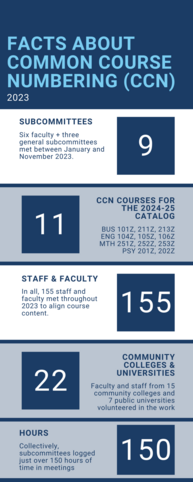
In 2023, five faculty subcommittees (Business, English, Math, Psychology, Writing) met to align 14 courses. Additionally, the Statistics Subcommittee met several times to finish up alignment of ST or STAT 243Z. Eventually, three courses were deferred until a later date (MTH 254, PSY 101, and WR 115).
Three general subcommittees also met to address a variety of questions concerning transfer and transfer-related initiatives (Systems & Operations, Outcomes Assessment, and Gen Ed).
Another subcommittee (CCN OARs) is currently meeting to create rules and guidelines for institutions regarding the implementation of Common Course Numbering (CCN).
Subcommittees consist of volunteers from Oregon’s 17 community colleges and 7 public universities. Recommendations from subcommittees are sent to Transfer Council, which votes to send decisions to the HECC Commission for final approval. CCN—a uniform numbering convention used at all public postsecondary institutions for the most transferred lower-division courses—was created by Senate Bill (SB) 233 in 2021. Oregon is one of 20 states that has adopted CCN (Education Commission of the States, 2022).
With final approval of the courses aligned in 2023, 21 of the most transferred, lower-division courses will be fully aligned across all community colleges and public universities in Oregon.
|
Resources for Common Course Numbering Webpage
As issues related to Common Course Numbering (CCN) arise and are addressed, HECC updates the Resources for Common Course Numbering webpage to reflect decisions and new information. Here are some highlights that can be found on the revised and updated webpage.
2023 List of CCN Subcommittee Members. An updated list of subcommittee members for groups that met or are meeting during 2023. This list includes all members who served at any time during 2023.
Reports & Memos. In August, the Systems and Operations (SYS/OPs) Subcommittee submitted a memo to Transfer Council with feedback on the Major Transfer Map (MTM) Curriculum Articulation Policy (CAP) Template. The MTM CAP replaced MTM MOUs. The memo was used to revise and edit the MTM CAP, which was approved by Transfer Council on September 28, 2023. The Transfer Council also voted to approve a Work Product Memo template, which will be used when Transfer Council has a transfer-related question or request of a subcommittee.
During the November 16, 2023 Transfer Council meeting, several CCN Subcommittees submitted Recommendation Reports detailing their alignment recommendations for assigned coursework. The CCN Business Recommendation Report and the CCN English Recommendation Report were voted on and recommended to the HECC Commission along with the CCN Psychology Recommendation Report. The CCN Math Recommendation Report is on hold, pending a decision by TC regarding credit alignment. The HECC Commission approved the courses in the CCN Business, English, and Psychology Recommendation Reports at the December 14, 2023 meeting.
Transfer Council’s List of CCN Courses. The approved CCN course list for 2024 has been added to the Transfer Council’s List of CCN Courses. For information on submitting a nomination for a 2024 CCN Subcommittee, see the Nomination Process CCN Subcommittees PDF.
Transfer Council: Common Course Numbering Update
Throughout fall 2023, the CCN Business, English, and Math Subcommittees met to align nine courses. Then in November, each subcommittee submitted Recommendation Reports detailing their work. Additionally, the CCN Math Subcommittee submitted a Minority Report, detailing an alternate solution to the decision aligning credits in the Recommendation Report. The CCN Business and English reports were agreed upon (unanimously) and were sent to the full HECC Commission for approval at the December 14, 2023 meeting. The CCN Math Recommendation Report was deferred, pending information in the CCN Math Minority Report and a review of alignment decisions regarding course credits. Details on the CCN Reports has been published on the Resources for Common Course Numbering webpage under CCN Reports, 2023. Letters with information on course alignment were sent to CAOs and Provosts with details on the alignment of BA 101Z, 211Z 213Z; ENG 104Z, 105Z, 106Z; MTH 251Z, 252Z, 253Z (all MTH courses are pending approval in 2024); and PSY 201Z, 202Z.
In December, Transfer Council Co-chairs sent out a letter requesting nominations for 2024 Faculty Subcommittees. Two Faculty Subcommittees from 2023 will reconvene in 2024 (Business and Psychology) to align additional courses. They will be joined by the following new subcommittees: Biology, Chemistry, Economics, and Sociology.
The Systems and Operations Subcommittee has updated its subcommittee charge and responded to questions posed by subcommittees. The Outcomes Assessment subcommittee has been active advising Faculty Subcommittees. Members of the subcommittee regularly attended Faculty Subcommittees in 2023 (BA, ENG, MTH, PSY) to provide feedback on aligning course learning outcomes (CLOs). Additionally, this subcommittee is updating the section of the CCN Handbook that provides guidance on CLOs. The Gen Ed Subcommittee has been working to clarify early- and long-term goals in its charge, which will guide the work of the subcommittee. Finally, the CCN Oregon Administrative Rules (OAR) Subcommittee has begun meeting to frame the Common Course Numbering Articulation Policy (CCNAP), which will provide guidance for the adoption and implementation of CCN. Refer to the Public Meeting webpage for information on all scheduled CCN meetings.
For more on Common Course Numbering (CCN) in the State of Oregon, visit the HECC’s Resources for Common Course Numbering webpage.
Transfer Council: Major Transfer Maps Update
Major Transfer Maps (MTMs) Faculty Subcommittees for Biology, Business, Computer Science, Elementary Education, and English Literature are meeting this year to update their MTM agreements into the new format approved by the Transfer Council and the HECC Commission--the Curriculum Articulation Policy or CAP. Computer Science presented a proposal for an updated CAP at the November 2023 Transfer Council meeting; Psychology is revising its proposed CAP for a new MTM in that discipline. The Faculty Subcommittee for Sociology will meet for the first time in more than a year (November) to begin finalizing two proposed MTM CAPs: one for Sociology and another for Sociology/Anthropology
Featured Research on Excess Credits
Adelman C. (2006). The toolbox revisited: Paths to degree completion from high school through college. Washington, DC: U.S. Department of Education.
Bicak, I., Schudde, L., & Flores, K. (2023). Predictors and consequences of math course repetition: The role of horizontal and vertical repetition in success among community college transfer students. Research in Higher Education, 64(2), 260–299. https://doi-org.library.cocc.edu/10.1007/s11162-022-09706-7
Excess credit hours are symptom, not cause, of poor completion rates. (2013). Community College Week, 25(23), 4. http://search.ebscohost.com/login.aspx?direct=true&db=f5h&AN=89635247&site=ehost-live
Hodara, M., Martinez-Wenzl, M., Stevens, D., & Mazzeo, C. (2016). Improving credit mobility for community college transfer students. Planning for Higher Education, 45(1), 50-116.
Hodara, M., Martinez-Wenzl, M., Stevens, D., & Mazzeo, C. (2017). Exploring credit mobility and major-specific pathways: A policy analysis and student perspective on community college to university transfer. Community College Review, 45(4), 331–349.
Kramer, D. A., Holcomb, M. R., & Kelchen, R. (2018). The costs and consequences of excess credit hours policies. Educational Evaluation and Policy Analysis, 40(1), 3–28. https://doi.org/10.3102/0162373717709968
Robb, C., Heckman, S., & Chanda, T. (2022). Excess credits and labor market outcomes: Is there a return on additional hours of education? College Student Journal, 56(1), 12–28.
Smith, A. A. (2017, July 19). A punishment that doesn’t work. Inside Higher Ed
Join in the Public Process
Fall 2023 Transfer Council Public Meeting Schedule
Transfer Council welcomes public comment on public meetings relating to transfer. Sign up for public meeting notices here to receive final meeting dates and links to agendas, supporting documents, etc. Upcoming meeting dates are listed below:
-
Transfer Council: January 18, February 15, March 21 (10 am to 12:30 pm, for all meetings)
-
Transfer Council Subcommittees: CCN Faculty Subcommittees will reconvene late January/early February 2024. See the HECC public meeting webpage for all other meeting dates/times. The MTM Elementary Ed Subcommittee will meet on January 8, 2024.
|