Community Partnership is Key to Launching New Investments, Planning for 2023-25
Message from Executive Director Ben Cannon
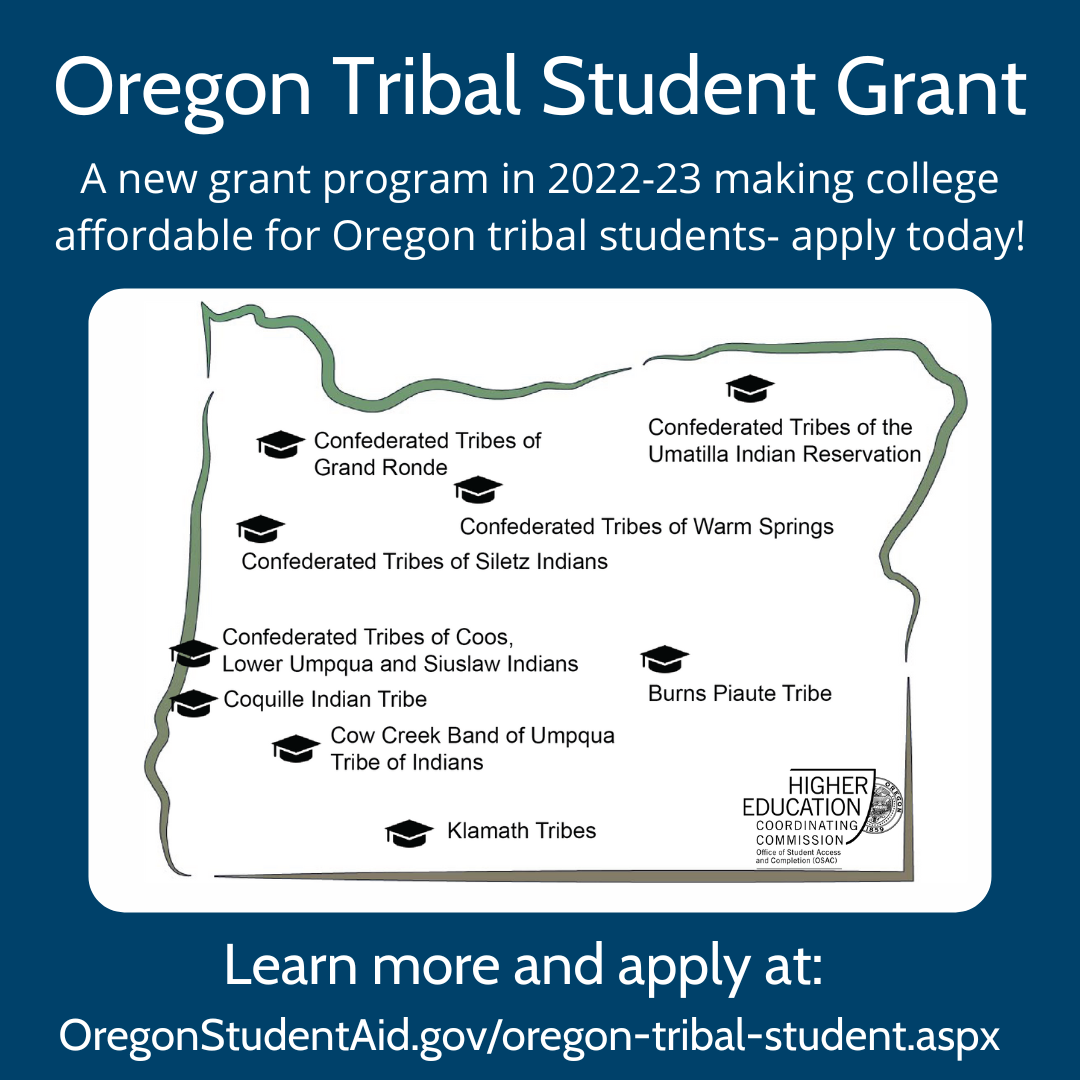
This spring HECC has been bustling with several exciting new developments that will impact Oregon and Oregon students for years to come. This month we have the honor of launching the application for the new Oregon Tribal Student Grant, a historic $19 million investment for 2022-23 focused on removing college costs barriers for students who are enrolled members of Oregon’s nine federally recognized Tribes. This grant could change the lives of 700 or more Oregon tribal students this year by supporting their pursuit of undergraduate or graduate degrees in Oregon. We encourage all our partners to help us get the word out to tribal students and families about this historic opportunity!
It has been exciting and illuminating to participate in the first campus listening sessions in the statewide tour of the Joint Legislative Task Force on Student Success for Underrepresented Students in Higher Education, which has so far visited campus communities in the Portland area, Willamette Valley, and Eastern Oregon. Thank you to all students who have come to testify already and bravely shared often very personal stories of the numerous, complex barriers they have faced: affordability obstacles, childcare needs, challenges accessing campus services, and so much more. Legislators and we at the HECC are listening closely. We encourage students and community members to continue to sign up and make your voices heard!
Our team here at the HECC is also engaged in numerous community conversations to inform the agency recommendations for Oregon’s comprehensive higher education and workforce budget for 2023-25. At its May public meetings, Commissioners affirmed the need for bold affordability investments among all the other important components of this developing request. Read more on the Commission's process here.
And lastly, we are busy implementing the first rounds of grants in the $200 million Future Ready Oregon investment package approved in 2022, which represents a sea change in the amount and types of support we will be able to provide Oregonians needing education and training for family-wage careers. At our April 12 Talent Summit, we brought together hundreds of Oregon leaders to officially launch this initiative and roll up our sleeves together. Future Ready Oregon depends on the collaboration and innovation of our grantees, education and training providers, partners and community leaders who will deliver services and programming to Oregonians. I encourage our partners stay involved if you are not already.
Launch of Future Ready Oregon: Updates on HECC-administered Components
The HECC and partner agencies have started implementation of Future Ready Oregon, a comprehensive $200 million package of strategic and targeted investments supporting the education and training Oregonians need for family-wage careers. This package, approved in the 2022 Legislative Session, invests in existing successful programs and in innovative equity-focused solutions to bolster recruitment, retention, and career advancement opportunities for priority populations. Highlights on each component of the funding administered by the HECC are included below. Information on these packages can also be found on the Future Ready Oregon web page here.
"Prosperity 10,000" Grants: $35 million total investment
Local Workforce Development Boards (LWDBs) will distribute funds to nonprofit
community-based organizations, educational institutions, labor organizations
and other workforce service providers to provide services including: career coaching, occupational training, job placement services, wraparound supports, paid work experiences and targeted recruitment and engagement efforts. LWDBs will receive their first round of funds in May 2022.
Workforce Ready Grants: $95 million total investment
Grants will be awarded to nonprofit workforce service providers and nonprofit
community-based organizations who administer workforce programs in the health
care, manufacturing, and technology industry sectors. Grants will support paid work experiences, workforce program tuition and fee assistance, wraparound services, the development of culturally and linguistically specific career pathways and organizational developments. The first Request for Application will be posted in Spring 2022 and will focus on capacity building.
Postsecondary Career Pathway Training Program: $14.9 million total investment
Grants will be awarded to community colleges for the development and support of postsecondary career pathway training programs that support individuals from priority populations in gaining the necessary skills for securing a job or career advancement in high-wage, high-demand industries and occupations. The grants will be distributed using a funding formula. Community colleges have been informed of their expected awarded amount, and are required to submit a budget and descriptions of fund usage.
Credit for Prior Learning Grants: $10 million total investment
Grants will be awarded to community colleges and universities to support increasing opportunities for students from priority populations to receive credit for prior learning. Grants will be awarded based on the criteria outlined in SB 1545 and in alignment with the Oregon Credit for Prior Learning Standards. The Request for Applications is coming soon.
Benefits Navigators: $10 million total investment
Grants will be awarded to LWDBs to place workforce benefits navigators in comprehensive one-stop WorkSource Oregon centers or community-based organizations. We anticipate having more to share in the coming months.
Industry Consortia: $1 million total investment
Three separate, statewide industry consortia will be established to represent the health care, manufacturing, and technology industry sectors. We anticipate having more to share in the coming months.
Community Input Informs Budget Development Process and Progress on Roadmap
We continue to welcome and encourage community input as we work on developing and submitting to Oregon’s Governor a comprehensive and integrated postsecondary education Agency Request Budget (ARB) for 2023-25. The Commission is considering key budget components over the course of numerous public meetings through August, and welcomes public comment. This year's process is anchored in the priorities for strategic action articulated in the Strategic Roadmap for Postsecondary Education. The HECC is broadening and deepening engagement with communities of color and other underrepresented populations as we develop potential proposals.
Recently the HECC Funding and Achievement Subcommittee at its May 11 meeting considered a presentation from the HECC Office of Student Access and Completion on emerging proposals for state-funded financial aid programs. The subcommittee also heard detailed presentations on funding priorities of institutional associations, the Oregon Student Association, faculty and staff representatives, and workforce partners. The Commission will consider more detail on emerging proposals at the June meeting and will consider the full ARB for approval in August. Learn more about the typical budget timeline here.
In addition to the budget process, at each full public meeting the Commission now invites community testimony to inform our collective work on the transformations described in the Strategic Roadmap. In April, the Commission invited experts to speak on Native American Perspectives in Oregon Higher Education, and heard presentations from Angela Fasana, education department manager for the Confederated Tribes of Grand Ronde; Melissa Palanuk Mercier, education career coach for the Confederated Tribes of Grand Ronde; and Dr. Kelly Gonzales, citizen of the Cherokee Nation and professor in the OHSU-PSU School of Public Health. Dr. Gonzalez's presentation Cultivating from Vibrance and Beauty, as well as other materials from this presentation are available in the April 14 meeting materials. At its May 12 meeting, the Commission heard invited testimony from Kim Parker-Llerenas, executive director of Willamette Workforce Partnership and Oregon Workforce Partnership Chair on the unique collaborative leadership of workforce boards and partners.
The Oregon Transfer Council Forges Forward with Strategies to Save Students Time and Money
The Oregon Transfer Council has made considerable progress on implementation of the goals set forth by Senate Bill 233 (2021) to streamline the credit transfer process from two to four-year institutions to save students time and money. Since convening in October 2021, the Transfer Council and its subcommittees have convened over 30 public meetings focused on developing a common course numbering system, advancing the work on Major Transfer Maps, and other credit transfer-related issues.
The work to establish common course numbering is intended to help students know that if they take a course at one campus, it will be equivalent to any course with the same number on another campus, simplifying planning and credit transfer. The Transfer Council has developed an initial list of courses to focus on for common course numbering and a process for selecting future courses, and is actively convening subcommittees to advance common course numbering. The initial list was created by registrars and reflects the top transfer courses and the number of times that a course transferred into public universities from an Oregon community college over a period of three years.
The Transfer Council is also moving forward the Oregon Transfer Compass Maps that started with HB 2998 (2017). This legislation required establishment of statewide foundational curricula, now called Core Transfer Maps, as well as major-specific agreements now called Major Transfer Maps. To date, MTMs have been established in Biology, English Literature, Elementary Education, Business, and Computer Science, and MTMs are in progress for Sociology, Psychology, and Human Development and Family Studies.
Oregon Provides Historic Investment in Financial Aid for Tribal Students, Encourages Students to Apply
The HECC announced in a recent press release that the application is now open for the Oregon Tribal Student Grant for 2022-23, a new state financial aid program supported by the Oregon Legislature’s 2022 historic investment in equitable college access and success for tribal students.
The Oregon Tribal Student Grant is expected to pay for most or all public college-related expenses—including tuition, housing, books, and other costs not covered by other grants—for eligible students who are enrolled members of Oregon’s nine federally recognized Tribes. It can be applied toward undergraduate or graduate study at Oregon public colleges and universities as well as eligible private non-profit institutions, where award amounts can go up to the public institution maximum level, in the upcoming 2022-23 school year. The HECC Office of Student Access and Completion (OSAC) will administer the grant, and encourages tribal students to apply by the priority application deadline of August 1, 2022. Tribal partners, schools, universities, communities, and families are encouraged to learn more and help share news on the grant with potential applicants, by viewing and sharing our website, informational documents, and social media images available here.
Governor Kate Brown proposed this program in the 2022 Legislative Session, in consultation with Oregon Tribal government leadership, and working closely with HECC. The grant is currently only funded for the 2022-23 academic school year, and renewal is dependent upon reauthorization and permanent funding which will need to be considered by the Oregon Legislature in 2023. The HECC is currently developing its recommendations for the next budget cycle on sustaining this and other financial aid investments. Read more about the grant in our recent press release here.
Public Teacher Education Investments See Results
Beginning in 2020, and expanded in 2021, the Educator Advancement Council has invested over $1.4 million in supporting implementation of Public University Educator Equity Plans, through which six of Oregon's public universities have received just over $230,000 in grant funding. HECC has distributed this funding to the public universities that have educator preparation programs to support the development, implementation, and evaluation of evidence-based strategies which improve conditions for the preparation and graduation of educator candidates, with a particular focus on racially, ethnically, and linguistically diverse candidates.
Two regional universities, Southern Oregon University (SOU) and Western Oregon University (WOU), brought exciting results to share with HECC commissioners in May. Through educator equity planning, relatively modest investments, and a focus on university student experiences, more racially, ethnically, and linguistically diverse teachers are earning credentials and working in Oregon. A new learning community will support teams of faculty and staff from public universities to sustain and grow these changes over time. Strategies for 2022-2024 will include:
- Recruitment - a focus on developing program quality and relevance through effective partnerships with schools and districts
- Retention - a focus on developing quality learning experiences for teacher candidates
The HECC is collaborating closely with the Teacher Standards and Practices Commission and Educator Advancement Council to implement the strategic grants, and grow their impacts over time.
Read more through these links to plans from SOU and WOU and the Educator Advancement Council.
Governor Brown Nominates Three HECC Commissioners
We are pleased to report that Governor Brown has nominated Emily Simnitt, Fernando Rojas-Galván, and Natalie Arnot to serve on the Higher Education Coordinating Commission. Their nominations will be considered for confirmation by the Oregon Senate. Dr. Simnitt is a senior instructor and multilingual writing specialist director at University of Oregon, and is nominated for the university faculty position on the Commission. Fernando Rojas-Galván is an instructor of Spanish & ESL at Clatsop Community College, and is nominated for the community college faculty position. Natalie Arnot is a student at Oregon Institute of Technology and is nominated for the currently vacant student position. Emily Simnitt and Fernando Rojas-Galván have been nominated to fill positions currently held by Lee Ayers-Preboski and Frank Goulard, who have served on the Commission since its inception in 2013. Their nominations will be considered for confirmation by the Oregon Senate. We will share more after the confirmation hearing, expected to occur in early June. If confirmed, their service will begin July 1, 2022.
Oregon Talent Summit 2022: Videos now Available
We are pleased to announce that the presentations from the 2022 Oregon Talent Summit are now available by video here. The Summit, held on April 12, 2022 in Portland, brought hundreds of partners together to plan a successful launch of Future Ready Oregon, a package of investments that provides a transformational $200 million investment to foster a diverse, skilled workforce.
Keynote speaker William B. Bonvillian from the Massachusetts Institute of Technology and co-author of Workforce Education, a New Roadmap, set the stage at the event with a presentation on transforming workforce and education in the United States. The morning program also featured the shapers of the Future Ready Oregon 2022 who were instrumental in the development of this historic investment package, including representatives from the Governor's Office, key legislative leaders, and the co-chairs of the Governor's Racial Justice Council's Workforce Workgroup. John Tapogna of ECONorthwest shared early results of this year's Oregon Talent Assessment, analyzing the needs of Oregon industries. Governor Brown joined in the afternoon to share her insights on the tremendous opportunities in the strategies supported by this funding. In addition, presenters described best practices related to community and industry engagement, and the afternoon included interactive sessions focused on implementation.
We thank all participants for joining us, and invite those who were not able to join to view the presentation materials and videos of the event panels at the link below.
Commissioner Hamann receives 2022 Leadership Award from the American Association of Community Colleges
Congratulations to HECC Commissioner Greg Hamann, who was recently honored as one of the 2022 Leadership Award recipients by the American Association of Community Colleges, presented during the 2022 AACC Annual Meeting this month in New York. AACC's Leadership Award, an annual tradition since 1982, is presented to individuals whose accomplishments and professional contributions to the community college field have been outstanding. Past and future recipients of its Leadership Award, which the association has presented since 1982, will automatically join the AACC Hall of Fame.
Dr. Greg Hamann is president emeritus of Linn Benton Community College, and he has advocated for community colleges at the state and national level. As president of LBCC from 2010 to 2020, he prioritized student success, launched equity and affordability initiatives, implemented Guided Pathways which is now used as a model for other institutions, expanded programs and facilities, championed community collaboration, and deepened university partnerships. Dr. Hamann was previously president of Clatsop Community College for seven years, and has served on numerous task forces, boards, and leadership positions, including the AACC board of directors, the oversight board for AACC’s Voluntary Framework for Accountability, and the President’s Advisory Council to the Association of Community College Trustees.
WICHE Annual Forum Brings Top Academic Leaders from Across Western States to Oregon to Discuss Pandemic Changes
With the theme “Looking to the Future: New Directions for Higher Education,” the Western Interstate Commission for Higher Education (WICHE) Annual Forum was held in Portland, Oregon this year, and was focused on taking stock of the impact of the pandemic and the future of higher education as it responds to the new and changing landscape. The Western Academic Leadership Forum brings together the West’s top academic leaders to share perspectives on current issues to help inform their future decision making and leadership, as well as engage in planning and developing innovative regional initiatives addressing common concerns.
Veronica Dujon, HECC director of academic policy and authorization, is serving as chair of the Western Academic Leadership Forum this year for WICHE, and welcomed national representatives to the 2022 Forum Annual Meeting. Sessions focused on: innovation in research & economic development; improving retention, persistence and completion during the pandemic recovery; leading in times of crisis; financial stability during uncertain times; disciplinary equity; and indigenous-serving institutions in the West. Read more about the event and WICHE resources here.
Academic Program Approvals
The Commission approved the following new academic programs at the April and May 2022 public meetings. Find details on the programs below in the April 14 meeting materials here and the May 12 meeting materials here.
Oregon Community Colleges (CCs) New Programs:
- Central Oregon CC: Certificate of Completion, Outdoor Leadership; Certificate of Completion, Illustration; Certificate of Completion, Graphic Design
- Chemeketa CC: Certificate of Completion in Healthcare Billing; Certificate of Completion in Healthcare Coding
- Clackamas CC: Certificate of Completion, Computer-Aided Drafting; AAS in Computer-Aided Manufacturing; AAS in Machine Tool Technology; Certificate of Completion in Mechatronics; AAS in Renewable Energy Technology
- Columbia Gorge CC: AAS, Paramedic
- Lane CC: Certificate of Completion, Entry-Level Trades Worker; Certificate of Completion, Culinary and Baking
- Portland CC: AAS, Microelectronics Technology
- Southwestern Oregon CC: Certificate of Completion, Medical Assistant; AAS, Culinary Management; AAS, Baking and Pastry Arts; AAS, Baking Management; AAS, Culinary Arts; AAS in Fire Science
- Umpqua CC: AAS, Paramedicine
Public Universities New Programs:
- Eastern Oregon University: Master of Healthcare Administration
- Southern Oregon University, B.A./B.S., Sustainable Tourism Management
- Oregon State University: B.A./B.S., Applied Humanities; B.A./B.S., Theatre Arts; B.S., Oceanography; B.A./B.S., Economics
- University of Oregon, M.S., Applied Behavior Analysis
University Program Approvals for a New Location:
- Oregon State University: B.A./B.S., Political Science
- Oregon Institute of Technology: B.S., Business; B.S., Health Care Management
|