|
Psilocybin Program 2026 Fall Newsletter
On September 1, 2026, Oregon Psilocybin Services (OPS) and the Oregon Medical Marijuana Program (OMMP) merged to form the Medical Cannabis & Psilocybin (MCAP) Section. Although MCAP includes the Medical Cannabis Program and Psilocybin Program, each program’s statutes and rules will remain separate.
We are updating our new section name on forms, website pages, and other resources over the coming months, but it may take some time. The merger has not created a disruption in services or processes.
The MCAP Psilocybin Program has published budget information on the Psilocybin Budget Information page on the Psilocybin website. Please visit this page for more information.
The Medical Cannabis & Psilocybin (MCAP) section is convening a new rulemaking process to consider psilocybin rule changes unrelated to proposed fee changes, with a planned effective date of Jan. 15, 2027.
Rules Advisory Committee (RAC) meetings were held on Monday, November 2 and Wednesday, November 4. The MCAP Psilocybin Program will consider RAC input and revise the proposed rules in preparation for public comment period. Public comment period begins December 1, 2026, and concludes on December 21, 2026. A public hearing on rules is scheduled for December 15, 2026, from 11-12:30 Pacific Time. After the public comment period concludes, the program will finalize administrative rules by filing with the Oregon Secretary of State. Revised rules are expected to become effective on January 15, 2027.
To share your feedback, please participate in the 21-day public comment period by submitting written comments or by providing verbal comments at the public hearing. For more information, please visit the MCAP Psilocybin Administrative Rules and Rulemaking Process website.
The Oregon Health Authority (OHA) is pleased to announce the Opioid Settlement Community Grant Request for Grant Proposals (RFGP). This funding opportunity provides $13.5 million to Oregon organizations working to prevent and reduce health, social, and community impacts related to substance use while advancing equity.
Any Oregon-based organization may apply with the exception of state agencies and Tribal governments. Fiscal sponsors are welcome. Proposals should aim to advance one or more of these goals:
- Reduce substance use and substance use disorders (SUD)
- Reduce deaths related to substance use
- Reduce disparities and inequities related to substance use
Proposals are due December 17, 2026. For more information, please go to the Opioid Settlement Community Grants Request for Grant Proposals Dashboard.
To meet federal accessibility requirements, the Oregon Health Authority has been working on website remediation. You may see that certain documents have been removed from the psilocybin website due to remediation changes. If you are unable to find a document, please reach out to the psilocybin general inbox at oha.psilocybin@oha.oregon.gov, and our team will support you.
The second quarter (Q2) of 2026 data is now available on the MCAP Psilocybin Data Dashboard. The third quarter, or Q3, data for 2026 will be published in late December.
Data on Client Veteran Status
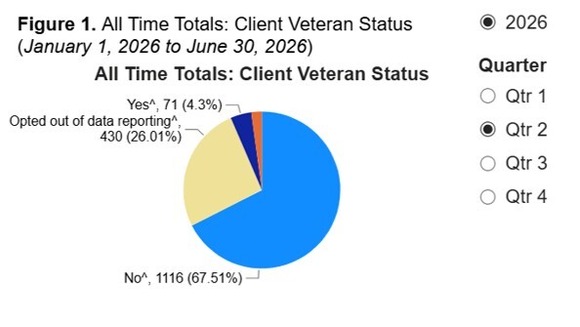
Beginning in 2026, we now collect 'veteran status' of clients. This information is shared on the Client Demographic Page of the MCAP Psilocybin Data Dashboard.
- Among clients who responded to the question in the first two quarters of 2026, 71 clients identified as veterans.
Since January 1, 2025, 104 clients have responded that they accessed psilocybin services to address trauma related to combat or military se
Data on Dual Licensed Facilitators
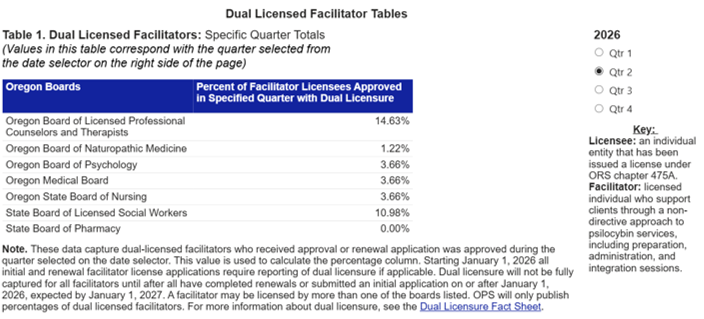
We have begun gathering information about facilitators who are also licensed by other specific professional boards. This information is published on the Licensing Page of the MCAP Psilocybin Data Dashboard. We will not have a full understanding of the total number of dual licensed facilitators until Q4 of 2026 is published in the spring of 2027 due to varying renewal timeframes for facilitator applicants.
The percentage of licensed psilocybin facilitators who were issued licenses during the second quarter of 2026 and reported having dual licensure are as follows:
- 14.6% of licensed psilocybin facilitators issued licenses in Q2 of 2026 are also licensed by the Oregon Board of Licensed Professional Counselors and Therapists
- 10.98% of licensed psilocybin facilitators issued licenses in Q2 of 2026 are also licensed by the State Board of Licensed Social Workers
- 3.66% of licensed psilocybin facilitators issued licenses in Q2 of 2026 are also licensed by the Oregon Board of Psychology
- 3.66% of licensed psilocybin facilitators issued licenses in Q2 of 2026 are also licensed by the Oregon Medical Board
- 3.66% of licensed psilocybin facilitators issued licenses in Q2 of 2026 are also licensed by the Oregon Board of Nursing
- 1.22% of licensed psilocybin facilitators issued licenses in Q2 of 2026 are also licensed by the Oregon Board of Naturopathic Medicine
There are currently 384 facilitators licensed under ORS 475A as of November 13, 2026.
Compliance Data
MCAP would like to address recent concerns regarding compliance data published on the MCAP Psilocybin Data Dashboard related to the number of investigations conducted by the program. First, as a reminder, investigations are confidential under law. Once a complaint is received, an investigation is opened to review and process the complaint. Compliance determines whether the case can be closed, whether the complaint should be referred to another state agency, or whether we will investigate further. Not all investigations are lengthy or time-consuming. Some complaints are immediately closed, some are referred, some involve simple requests for information from licensees, and others are more complex and may require interviews with complainants, witnesses, licensees, and requests for information. Most investigations result in education/technical assistance or are closed.
Beginning in 2026, the MCAP Psilocybin Program posts new data on administrative hearings on the Compliance Page of the MCAP Psilocybin Data Dashboard. This includes the number of administrative hearings requested, withdrawn, and completed and the total number of administrative violations issued by category of severity and license type.
Final orders are published on the MCAP Psilocybin Data Dashboard, which are findings of cases that either were not contested by licensees, or if they were contested, have gone through the hearing process and an administrative law judge provided a proposed order. These final orders are categorized based on administrative action, however, to understand the details please refer to the Final Orders on the Final Orders webpage.
The 85th Oregon Legislative Assembly will convene next year in January. There are no legislative concepts for the psilocybin program, however, we will continue to work with other state agencies and partners on any legislation that will be introduced that modifies or impacts the program.
As a reminder, OHA is part of the Executive Branch and supports Governor and agency priorities. The Oregon Legislative Assembly enacts laws through the legislative process. For more information on how to work with the legislature, please visit the Community Engagement with the Oregon Legislature page on the psilocybin website.
OPS is interested in partnering with community-based organizations to explore how we can work together to increase public awareness, community engagement, and collaborations that support the SHIP strategy to destigmatize the use of psilocybin as a culturally responsive option for healing and wellness.
If you know of a community-based organization that would like to join this conversation, please email us at: OHA.psilocybin@oha.oregon.gov
The Rethink the Drink campaign is a public health and communication initiative launched by the Oregon Health Authority (OHA).
“Rethink the Drink” is not a code phrase for “stop drinking” (Although OHA does offer resources to help you drink less). OHA is simply asking people to pause and consider the role of alcohol in our lives and communities.
About 3,000 people in Oregon die from alcohol-related causes every year. That’s more than die from other drug overdoses.4 In the U.S., excessive alcohol use causes an alarming 1 in 5 deaths of people ages 20-49.5 We can start to reduce that toll. We can recognize how society makes excessive drinking seem harmless and even “normal."
Let’s Rethink the Drink.
 |
-
What a scientific study reveals about Oregon’s psilocybin therapy program – OPB, October 26, 2026
-
New human data hints at psychedelics’ potential to combat inflammation – NPR, October 21, 2026
-
‘Am I a candidate for magic mushrooms?” A mystery shopper study of Oregon psilocybin service centers – Health Affairs Scholar, October 2026
-
Oregon regulators nix higher fees for psilocybin after industry backlash – Oregon Public Broadcasting (OPB), September 23, 2026
-
Oregon Retreats from Massive Fee Hike Plan, Giving Psychedelic Therapy Providers Relief – Willamette Week, September 22, 2026
-
Exploring the Therapeutic Potential of Psilocybin: A Comprehensive Review of clinical Trial Evidence and Implications for Rescheduling – September 18, 2026
-
Psilocybin May Prevent Nerve Damage Caused by Chemotherapy, Study Finds – The New York Times, September 3, 2026
-
Psychedelic-Assisted Therapy and Medicaid: Considerations for Coverage and Access – Center for Health Care Strategies, August 31, 2026
-
Portland Medical Leaders Rally Around the Potential of Shrooms – Willamette Week, August 22, 2026
-
More than 20,000 people have used legal psilocybin in Oregon – Oregon Public Broadcasting (OPB), August 21, 2026 Oregon’s largest psilocybin study finds less depression, anxiety after use – The Oregonian, August 20, 2026
-
OHSU study tracks long-term benefits of magic mushroom therapy– FOX12, August 19, 2026
-
Safety and Mental Health Outcomes of Oregon State-Regulated Psilocybin Services – JAMA, August 19, 2026
We welcome your feedback.
Please reach out with your comments or questions.
www.oregon.gov/psilocybin
The Medical Cannabis & Psilocybin (MCAP) Section remains committed to Oregon Health Authority's mission of ensuring all people and communities can achieve optimum physical, mental, and social well-being through partnerships, prevention, and access to quality, affordable health care. Every change in federal administration presents potential disruptions to health care policy. MCAP wants to reassure community members and partners that it will continue to serve them and will keep them apprised of any potential federal changes that could impact the program. MCAP will continue supporting OHA's important work of expanding opportunity, improving well-being, and eliminating health inequities for all Oregonians.

|