|
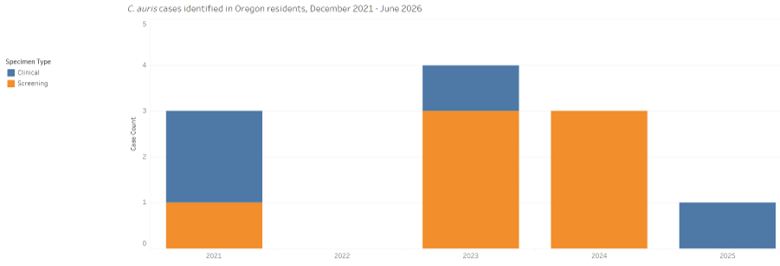
Oregon has reported 10 cumulative cases of C. auris since tracking began in 2020. While Oregon remains a low-prevalence state, cases continue to rise across the West Coast. The Oregon Multidrug-resistant Organism (MDRO) dashboard provides detailed data on MDRO cases in Oregon, which is updated quarterly. The dashboard now includes C. auris data.
C. auris Cases in Oregon by Year
Looking for easy-to-use infection prevention resources? The new Oregon Project Firstline website has tools and resources for healthcare workers, trainers and students.
A rapidly growing outbreak of Ebola disease caused by Bundibugyo virus is ongoing in the Democratic Republic of the Congo (DRC). As of August 14, 2026, the DRC has reported 4,665 confirmed cases and 2,184 deaths. The outbreak has spread across six provinces, with most cases concentrated in Ituri Province. While the likelihood of Ebola spreading to the United States remains very low, healthcare providers should be prepared to recognize patients who may have Ebola disease and appropriately assess their travel and exposure history. To date, no cases associated with this outbreak have been confirmed in the United States.
Resources for healthcare providers:
Outpatient antibiotic prescribing in Oregon continues to decline. In 2025, prescribing rates were about 35% lower than in 2008 and remained below pre-pandemic levels. The report highlights seasonal patterns and changes in prescribing by antibiotic class to inform clinicians and public health partners.
HAI Program staff at the 2026 Oregon Epidemiology Conference.

Evelyn has served as an MDRO Epidemiologist with Oregon’s Healthcare-Associated Infections Program for the past four years. Evelyn leads statewide surveillance, response, and technical support for critical multidrug-resistant organism pathogens, including carbapenem-resistant and carbapenemase producing organisms, and Candidozyma auris. Her work helps ensure timely detection, coordination, and public health action. She also contributes to the Cluster Busters team, responding to whole genome sequencing–identified clusters of gastrointestinal illness across Oregon.
Evelyn holds an MPH from the Rollins School of Public Health and is certified in infection control (CIC). Her experience spans academic teaching, local and state public health, and global humanitarian work. Before joining OHA, she worked as a contact tracer and epidemiologist for Marion County, served as a lecturer in the undergraduate public health program at the University of North Carolina, and spent two years in the Democratic Republic of the Congo with IMA World Health, supporting international health programs.
Outside of work, Evelyn continues to contribute to global humanitarian response by volunteering with the Humanitarian OpenStreetMap Team (HOT)m where she supports international disaster‑mapping efforts. She enjoys time with her community and family—including two fun, creative, and feisty kids—and has recently enjoyed reconnecting with her roots through travels across the Canadian plains and Rockies.
|
|