|
|
Oregon hospitals made progress in decreasing health care-associated infections (HAIs) among hospitalized patients and met some reduction goals in 2024, according to newly published data.
But hospitals around the state did not meet national standards for reducing surgical site infections, catheter-associated urinary tract infections, central line-associated bloodstream infections, and methicillin-resistant Staphylococcus aureus (MRSA) bloodstream infections. Read more highlights in the press release.
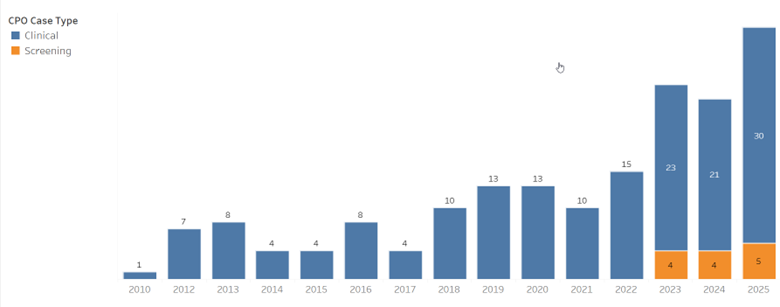
Carbapenemase-producing organism (CPO) cases reached 35 in 2025, a new record. Although Oregon remains a low-prevalence state, cases continue to rise across the West Coast. The Oregon Multidrug-resistant Organism (MDRO) dashboard provides detailed data on MDRO cases in Oregon. This dashboard replaces the quarterly Carbapenem-resistant Enterobacterales (CRE) Report.
CPO Cases by Year
Oregon CPO Cases by Year
With measles increasing nationwide, and 13 cases as of April 3, 2026, healthcare staff should prepare to prevent transmission in their facility. View the Interim Infection Prevention and Control Recommendations for Measles in Healthcare Settings to get started.
Oregon Health Authority (OHA) has published a new Clinical Algorithm for Suspect Measles Cases Without Known Exposure to Measles to assist clinicians in evaluating patients with measles-like illness. We encourage all health care providers to review this useful tool and consider printing it and placing it in relevant care areas.
|
|
|
Join the OHA HAI Program for a two-day statewide virtual convening to share best practices, showcase successes, and strengthen partnerships in infection prevention and antimicrobial stewardship. Agenda will be posted in July. Register now.
Our experienced Infection Preventionists are here to help! Our team can offer expert guidance if you're managing an outbreak or looking to strengthen your infection prevention practices. Reach out for a consultation, and let us help you keep patients and staff safe!
Sign up to enhance your infection prevention knowledge and stay ahead in protecting patients, residents, and staff. Reach out if you're interested in joining our Eastern or Western Oregon IP Collaborative, where we spend one hour discussing the latest infection prevention strategies. All interested healthcare and public health staff are welcome to attend.
HAIAC membership is an opportunity to provide input and expertise, help guide our work, and stay informed about our program’s activities. Members serve a two-year term and attend as many meetings as they can. There are no additional time commitments. Current vacancies are:
- Physician with expertise in infectious diseases
- Physician who practices in an ambulatory surgical center (ASC) with interest and involvement in infection control
- Hospital quality director
The next meeting is scheduled for June 10 from 1 to 2 pm. Everyone is welcome, regardless of membership. Tentative topics include:
- fire season and healthcare facility air quality
- antibiograms,
- and federal updates.
|
|
|
One year ago, her dentist told Dolores that she needed a tooth pulled. After the procedure, her dentist prescribed clindamycin, the second-most used drug in dentistry. That’s when Dolores’ life changed. She developed Clostridioides difficile infection (CDI), complicated by sepsis, which is a life-threatening condition in which the immune system overreacts and damages multiple organs. While almost all antibiotics increase risk of developing CDI, clindamycin is among those that impart the greatest risk. Yet clindamycin is one of the go-to antibiotics for dentists.
Dolores’ story is not unique. U.S. dentists are prescribing antibiotics at increasing rates, contributing to rising antimicrobial resistance, and exposing patients to unnecessary risks. Read more in the CIDRAP Special Series: Antibiotic Aftershocks.
|
|
|
Composed of public health labs in all 50 states, 5 large cities, and 2 U.S. territories, the AR Lab Network (ARLN) is the first national network for comprehensive AR testing of healthcare-associated infections and community-associated infections, fungal diseases, sexually transmitted infections, and drug-resistant Mycobacterium tuberculosis.
Through the end of 2025, the AR Lab Network has tested more than 1.5 million samples, including 424,000+ isolate characterizations, 464,000+ colonization screenings, and 611,000+ whole-genome sequences to rapidly identify AR and control outbreaks.
Antimicrobial Resistance Isolate Bank (AR Isolate Bank) is one of the largest collections of drug-resistant bacterial and fungal isolates gathered from specimens in healthcare, food, and community settings. The AR isolate Bank has offered the scientific community free access to high-quality and well-characterized isolates and their associated testing data. The AR Isolate Bank recently reached two major milestones: 10 years of service and 500,000 isolates shipped. Check out this fact sheet to learn more!

Get to know the exceptional members of the HAI team.

Adel serves as an Epidemiologist with the Healthcare-Associated Infections (HAI) Emerging Infections Program (EIP) team.
He monitors taeniasis and cysticercosis, and leads surveillance for two CDC-funded projects:
- Candidemia Surveillance – tracking Candida bloodstream infections, which cause significant illness and death.
- Non-Tuberculous Mycobacterial (NTM) Infections – including pulmonary (P-NTM) and extra-pulmonary (E-NTM) cases. Oregon was the first state to make E-NTM reportable due to its public health impact.
Adel completed his medical training at Alexandria University in Egypt, earning both his MBChB and a Master’s in Internal Medicine. He brings extensive experience in clinical infectious diseases and research from his years with the U.S. Naval Medical Research Unit–3 in Cairo. He later led fieldwork with the CDC’s International Emerging Infections Program in Egypt and has contributed to more than 40 published research papers.
During the COVID-19 pandemic, Adel moved to the U.S., first joining the Chicago Department of Public Health as a COVID-19 epidemiologist, then relocating to Oregon in 2021 to continue his work with EIP. He values Oregon as a wonderful place to live and work and appreciates the dedication of OHA and local public health authorities in keeping Oregonians safe.
Outside of work, Adel enjoys traveling with his family, reading, fishing, exploring art and museums, and listening to music.
Favorite Quote: “The way we work in public health is, we make the best recommendations and decisions based on the best available data” - Tom Frieden, Former CDC Director
|
|
|
|
Credit: Dan Thompson
The content for this newsletter was edited for plain language with assistance from AI tools. It was reviewed and fact-checked by a team of humans before publication.
|
|
|
Oregon Health Authority works to transform the health care system in Oregon by lowering and containing costs, improving quality and increasing access to care to improve the lifelong health of Oregonians. OHA is overseen by the nine-member citizen Oregon Health Policy Board working toward comprehensive health reform in our state.
The HAI program within the OHA Public Health Division is dedicated to preventing and containing healthcare associated infections (HAIs) and addressing the growing challenge of antimicrobial resistance (AR). Through initiatives such as the Antimicrobial Resistance Laboratory Network (AR Lab Network) and the National Healthcare Safety Network (NHSN), we are bolstering our ability to detect and respond to antibiotic resistance while strengthening the nation's most widely used HAI tracking system. We also focus on antibiotic stewardship to improve the appropriate use of antibiotics, and we provide comprehensive infection prevention and control (IPC) education and training to equip the health care workforce with the necessary skills. Our team further offers IPC consultations to health care facilities throughout the state, providing expert guidance and support in implementing effective infection prevention strategies and responding to outbreaks. Together, we are committed to enhancing patient safety and reducing the impact of HAIs and antimicrobial resistance.
|
|
|
|
|