|

Yesterday was World Bipolar Day, and like many mental health observances, it's designed to raise awareness about mental health conditions and reduce the harmful perceptions around seeking help.
The people we care for at OSH have faced many challenges, and we don’t always know why or if they’ve sought help before they’ve been admitted to OSH by a judge’s order. What we do know is that OSH ensures patients receive care in the right place at the right time, so they are prepared for their next steps after they leave the hospital. That work is critical to the effectiveness of Oregon’s behavioral health system.
This edition of Recovery Times shares a bit more about work we’ve done to maintain compliance with the Centers for Medicare and Medicaid Services. We recognize compliance is foundational to our work, and we strive daily to continuously improve upon the care and safety provided to every patient.
Recovery Times shares snapshots of our story through the voices of the caregivers who work here and the patients who receive care at OSH. This edition includes a feature on a unique job offered through our Vocational Services program – which fosters skills-building and responsibility to help prepare patients for discharge, and expertise from a psychiatric nurse practitioner who shares about bipolar disorder. There’s also an interview with Dr. Sasha Rai, the hospital’s deputy chief medical officer and chief of psychiatry. Dr. Rai shares that he wished the public understood more about what happens at OSH, and that is something we can improve on – telling our own story.
There is good that happens here. There is change that happens here. I’m grateful to be a part of it, and hope that you take the time to read about the people of OSH in the stories below.
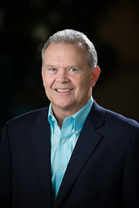
James A. Diegel, OSH Interim Superintendent
|
|
|

Dr. Sasha Rai is the deputy chief medical officer (forensics) and chief of psychiatry at OSH. Forensic psychiatry focuses on supporting people who have mental health conditions and are involved with the legal system.
|
The opportunity to be a part of change – in both people’s lives and within a system of care – motivates Dr. Sasha Rai in his role as deputy chief medical officer and chief of psychiatry at OSH.
“We're moving forward for both patients and the hospital, and it’s good to see the improvement, especially in efforts we’ve made to decrease the amount of time patients spend in seclusion or restraint,” Rai said.
When a patient experiences a behavioral health emergency and may be a harm to themselves or others, the patient is secluded from other patients in a separate room for observation or possibly restrained. Seclusion or restraint are last resort interventions and used as long as necessary to keep the patient and others safe. Through increased focus on training on interventions and patient monitoring and assessment, the average duration of seclusion events declined from 27.8 hours between Nov. 2024 and Jan. 2025 to 4.1 hours between Nov. 2025 and Jan. 2026. That downward trend has continued for the average duration of restraint events, dropping from 3.5 hours between Nov. 2024 and Jan. 2025 to 2.6 hours between Nov. 2025 and Jan. 2026.
In his leadership role, Rai oversees psychiatric services, admissions, forensic evaluation services and patient programs. Through his collaborative leadership style, he works with teams across disciplines to strengthen hospital operations and support continuous improvement at OSH. While patient treatment is not part of his daily work, he values the opportunities for patient engagement when providing coverage for other psychiatrists at the hospital.
Rai joined OSH in January 2025 as the psychiatry supervisor for patients who are newly admitted or have acute psychiatric needs before moving into his current leadership role in May 2025. Rai brings prior experience leading psychiatry services in forensic and acute care hospital settings.
The opportunity to return to forensic psychiatry appealed to him, he said of his decision to work at OSH.
“I chose OSH because I had worked in forensic psychiatry in a few places in different states and missed the West Coast culture that seems to be more open to reform and change. I enjoy seeing how processes can improve and change and being a part of that change,” he said.
Through his work at the hospital, Rai said he’s gained a greater understanding of OSH’s critical role in supporting the state’s behavioral health system.
“I think people don’t have the full sense of what we do for people here,” he said. “We are thoughtful in our approach to ensure patients receive the care they need and are ready to discharge. For those who are here under aid and assist orders – we work to restore them to competency so they can help in their own defense. For those who are here under the Psychiatry Security Review Board, we help them prepare to discharge to the appropriate level of care and transition into the community. We do good stuff every day for people who are really sick and we work to help make them better.”
|
|
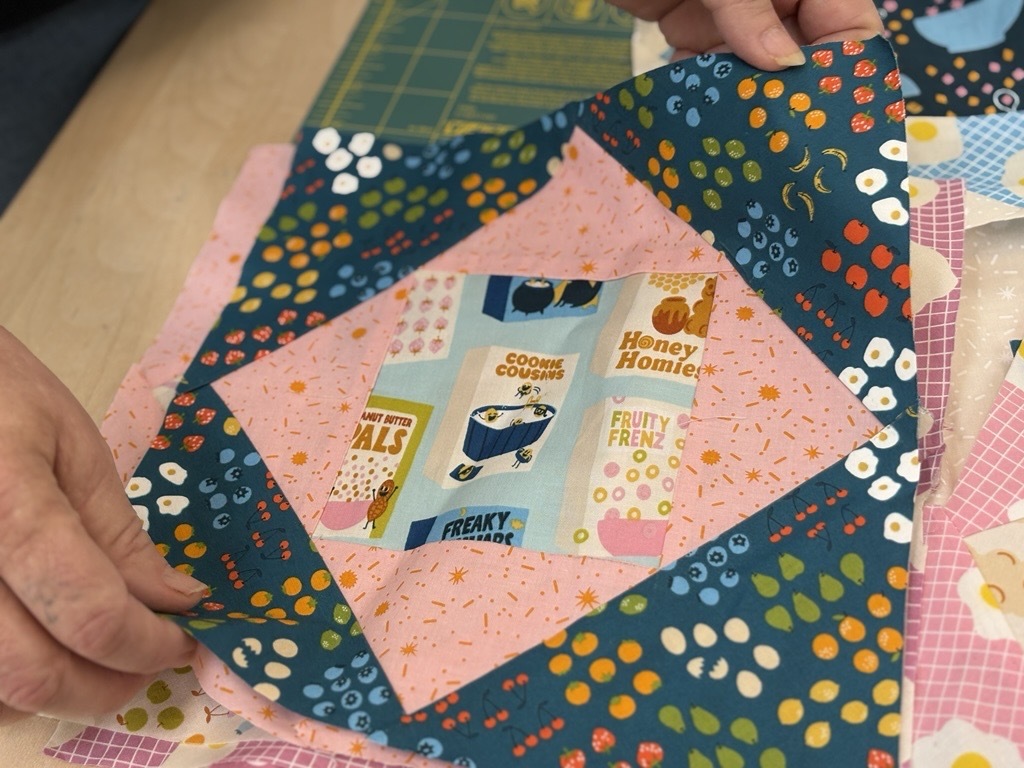 Fabric collages made by OSH patients are displayed on the walls of OSH in Junction City. This square is part of a collage, "Ode to Breakfast," that will hang in one of the patient dining halls.
Patients learn sewing and design skills
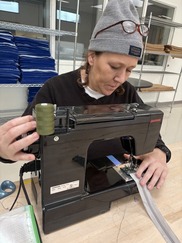
Walk into the Vocational Services program room at Oregon State Hospital (OSH) in Junction City and you’ll hear the steady, unexpected hum of sewing machines. Inside, patients like Kelly and Keppa use their creativity to brighten the walls, halls and days throughout the hospital.
As part of their paid positions in the Vocational Services program, Kelly and Keppa turn donated fabrics into display quilts that beautify the campus, as well as quilted, zippered bags, embellished cards and reusable grocery bags.
The Vocational Services program offers patients far more than a paycheck. The experience – like other jobs offered through the program – prepares OSH patients to gain skills and confidence as they prepare for life after the hospital.
“I enjoy the time to create and have time to myself away from community living. That’s the hardest part for me about being here – living with other clients,” said Kelly. “I’m also learning different skills that could help me with a future job. I like the actual action of doing the sewing but also being able to design something. I always wanted to be an interior designer and with this, I’m picking out colors and seeing what design works.”
|
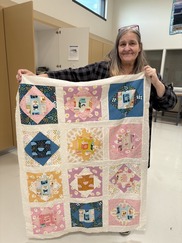
The bags and cards the crew makes are sold to hospital employees and proceeds go into the general fund. The crew is focused on making more quilted, zippered bags in time to sell ahead of Mother’s Day in May.
“It’s nice to hear the staff brag about what we make,” Keppa said. “It helps with your self-esteem to see people like and appreciate something that you’ve made.”
Junction City Treatment Services Supervisor Charlene Turman oversees the production crew.
“I’ve seen their skills progress so much. They’re making designs on their own and their confidence has grown. They take pride in their work and seeing staff take an interest in their work is rewarding,” Turman said.
|
Ways to get involved
The production crew uses donations of cotton, quilting fabric. OSH Volunteer Services facilitates all donations to the hospital – from art supplies and clothing to fabric. All items are screened for safety compliance before being routed to hospital programs. To learn more or donate, please contact Volunteer Services at oshvolunteer.services@odhsoha.oregon.gov.
|
|
 |
|
Samantha Cuffe, DNP, PMHNP-BC, a psychiatric mental health nurse practitioner at Oregon State Hospital, shared the following in recognition of World Bipolar Day to raise awareness about bipolar disorder, a mental health condition that is often misunderstood and misdiagnosed. Many people avoid getting help because of harmful misconceptions connected to the disorder. |
Bipolar disorder is a long-term mental health condition that causes strong mood swings between mania and depression.
Mania is a long-lasting rise in mood and energy, during which time an individual might experience severe effects on daily life, with or without the development of psychotic symptoms.
Depression is a chronic state of deep sadness, hopelessness, distress, with low energy, low interest or ability to participate in daily activities, and can include suicidal thoughts.
About 2-4 percent of adults in the U.S. are affected by bipolar disorder—men and women are affected almost equally. Symptoms often start in late teenage years or early adulthood. Genetic, biological and environmental factors can either cause or contribute to the onset of symptoms.
Bipolar disorder is usually grouped into two main types based on how strong the symptoms are and how long they last.
- Bipolar I includes at least one manic episode. A person may experience at least one episode of depression, but it is not required for diagnosis.
- Bipolar II includes at least one episode of “hypomania,” which is like mania but is shorter in duration and typically less intense.
To help understand how these mood shifts may feel, I want you to imagine a time when you reached a hard-earned goal. You might remember feeling happy, resilient, proud, and likely relieved after seeing all your hard work come to a desired end. Now I want you to imagine what it might be like to amplify those positive feelings, supercharged as one might experience during a manic episode.
The feeling of resiliency now turns into feelings of invincibility and superiority, intensifying the pride of achieving one goal into a quest to accomplish every task imaginable, all at once, regardless of realistic limitations, with no need to rest.
As the days wear on with little to no sleep in between, your thoughts become increasingly disorganized. Elation turns into agitation. Reality becomes suspended. The initial tasks you set out to achieve may no longer be relevant. Friends and family might try to help, but paranoia prevents any successful assistance until emergency interventions are required.
Now imagine what it might be like to experience a depressive episode. The goal you achieved is months behind you and feels meaningless.
Your fatigue and apathy might make it impossible to imagine that you once felt motivated to complete any task, leading to feelings of guilt, shame, and worthlessness. The days blur together, and the world seems to move around you while you are stalled in a state of low mood and emptiness, as an idea that your family would be better off without you looms nearby.”
But there is help. Through medication and talk therapy, the symptoms of bipolar and related mood disorders can be effectively managed.
It is important to remember that having a diagnosis of bipolar disorder does not define you. You are so much more than the moods you experience or the medications you take. Taking the step to reach out for support from a mental health professional can lead to living the life you want and deserve without symptoms or stigma.
If you are feeling symptoms of bipolar disorder, or you just need to talk, call or text 988 or start an online chat to reach a trained counselor who will listen to you without judgment. Visit 988lifeline.org for more information and resources to support mental health.
|
|
After making significant improvements to patient care and safety, Oregon State Hospital (OSH) learned in January that it maintained its compliance with Centers for Medicare and Medicaid Services (CMS) patient care and safety standards and is no longer at risk of losing eligibility to participate in the CMS reimbursement program.
The hospital implemented comprehensive corrective actions in response to a March 2025 sentinel event. CMS surveyors conducted a revisit of the OSH Salem campus in early January to review the hospital’s implementation of the corrective actions.
“CMS’s decision affirms the significant progress staff have made to strengthen patient care and safety. I am proud of this team and tremendously grateful for this organization’s hard work – and we’re clear-eyed that this milestone is not the finish line,” said Sejal Hathi, M.D., MBA, director of Oregon Health Authority. “Our charge now is to hardwire these gains into everyday practice through continued cultural and operational change, so that every patient, every day, receives safe, high-quality, therapeutic care.”
OSH provides psychiatric treatment for people from across Oregon who are in need of hospital-level mental health treatment who are traditionally marginalized, stigmatized and underserved, including many people with co-occurring disorders and those impacted by structural racism, and disproportionally represented in the criminal justice system.
|
|
32 homes and on-site behavioral health services open in Clatsop County

Each Recovery Times shares stories of Oregon Health Authority's work to strengthen the behavioral health continuum throughout Oregon.
|
Oregon Housing and Community Services (OHCS) and Oregon Health Authority (OHA) celebrate the grand opening of the Baker Building in Astoria.
The Baker Building represents the first large-scale Permanent Supportive Housing project developed by Clatsop Behavioral Healthcare (CBH) in Clatsop County and marks a major step toward addressing chronic homelessness through integrated housing and behavioral health solutions in the region. The project welcomed its first residents in late March.
“Every Oregonian deserves the dignity and stability of a safe place to call home,” Governor Tina Kotek said. “This is the kind of coordinated, community-based solution we need more of across our state that pairs stable housing with the behavioral health services people need to recover and thrive.”
Developed by Clatsop Behavioral Healthcare and Edlen & Company, this Permanent Supportive Housing (PSH) development will provide 32 affordable homes for people who have mental health and substance use disorders, including at least nine units for individuals living with Serious and Persistent Mental Illness (SPMI). “Having homes prioritized for people living with serious mental illness and offering services on site lowers systemic barriers and provides them with the opportunity to live with autonomy and stability, while also being part of a community,” said OHA’s Behavioral Health Division Director Ebony Clarke. “Investment in the Baker Building is part of OHA’s priority to ensure equitable access to behavioral health services in all corners of the state.”
Problem gambling resources
Oregon Health Authority’s Program Gambling Services has a new short video called “How Gambling Hijacks the Brain.” It explains, in simple terms, how gambling affects the brain and why gambling addiction is a real health condition that can be treated. |
|
 |
|
|
 |
|
The OSH Museum of Mental Health is an independent, nonprofit organization that shares the stories of people who have lived and worked at OSH. Learn more at https://oshmuseum.org/. |
|
|


The Oregon State Hospital Advisory Board includes community members, patients and staff and its work supports patient care, safety and security. As part of its role, the board may review state and federal laws related to OSH policies and procedures and make recommendations to the OSH superintendent, Oregon Health Authority and Legislature.
|
|
|

The Recovery Times is a quarterly publication that shares stories about the people and programs of Oregon State Hospital in support of OSH’s vision of hope, safety and recovery for all.
OSH serves a patient population that is traditionally marginalized, stigmatized and underserved, including many people with co-occurring disorders and those impacted by structural racism, and disproportionally represented in the criminal justice system.
|
|
|
If you need mental health support for any reason, help is out there. |
|
 |
|
|
|
|
|