|
Having trouble viewing this email? View it as a Web page.
Lea en español
March 2, 2026
In this issue...

Reflections from Chelsea Holcomb, Oregon Health Authority (OHA) Child, Family and Lifespan Behavioral Health (CFLBH) Director

As the days grow longer and the first signs of spring appear, March reminds us that change and growth are always possible. In children’s behavioral health, this season is a perfect time to nurture new skills, encourage emotional resilience and celebrate small victories. As March unfolds, we welcome a season of renewal, reflection and togetherness.
This month, we also embrace the spirit of Ramadan — a time that reminds us of the power of compassion, patience and community. For children and families, it’s an opportunity to nurture emotional well-being through shared traditions, mindful moments and acts of kindness.
We’re also reminded that growth takes time, care and community — just like the first buds of spring. In our Continuum of Care, we believe every child and family deserves to be seen, heard and supported in ways that honor their unique strengths and needs.
This month, we’re reflecting on the values that guide our work: family-driven and youth-guided care, cultural and linguistic responsiveness, collaboration across systems, and a commitment to equity and inclusion. These principles aren’t just word — They’re the heart of how we build trust, foster resilience and create pathways for children to thrive.
This month, let’s turn values into action:
(walk with) Listen deeply to the voices of children and families. (show up) Work together across schools, providers and communities. (do better) Celebrate strengths and build on them.
When we act with compassion and unity, we create a network of care where every child can thrive. Let’s make March a month of connection, courage and meaningful change — together. Together, let’s keep planting seeds of hope, compassion and connection, because when we work as one community, every child has the chance to blossom. Let’s continue to nurture resilience, encourage hope and create spaces where every child feels seen, heard and valued.
Here’s to a month of growth, kindness and meaningful connection.
|
Oregon faces a serious shortage of behavioral health providers, especially those from communities of color. Fewer than one in five licensed mental health providers in the state identify as people of color. This gap makes it harder for people to find culturally responsive care and adds stress to an already strained system.
The Trillium Community Benefit Award was created to address this challenge by supporting clinicians of color during one of the hardest stages of their career: the path from graduation to licensure. The award was co-designed with Oregon-based supervisors and leaders of color, including Dr. Unique Page, Dr. Keith Dempsey and Dr. Robin Beavers, to ensure the work was guided by community voices and lived experience.
By funding high-quality clinical supervision, the award removed a major financial barrier in the licensure process. It connected clinicians of color with supervisors of color from graduation through licensure. As a result, four emerging clinicians completed licensure as Licensed Clinical Social Workers, Licensed Professional Counselors, and Licensed Marriage and Family Therapists. This effort also tested a community-based workforce model with strong potential for impact.
Even though the program was small, its impact was significant. Participants said the award allowed them to focus on learning and professional growth without worrying about the cost of supervision. Many reported feeling more confident, developing a stronger professional identity, and improving their ability to provide culturally responsive, trauma-informed care to children and families across Oregon.
As one participant shared: “This support removed the financial burden of supervision and allowed me to fully engage in learning, reflection, and growth.”
Supervisors also saw benefits. As Dr. Page shared, “supervision is where new clinicians build their skills, judgment, and professional voice. By covering the cost of supervision, this award created rare freedom for clinicians of color to learn and grow without carrying yet another financial burden on top of the racial and identity-based stressors they already navigate. This kind of support strengthens not only individual clinicians, but also the quality, stability, and cultural responsiveness of care for children, families, and communities across Oregon.”
By supporting clinicians at a critical transition point, the Community Benefit Award did more than help individual careers. It improved workforce stability, expanded access to care, and supported healthier communities statewide.
As one supervisor reflected: “This initiative demonstrates what is possible when equity is resourced, not just named.”
With modest investment and strong community partnership, Oregon can continue building a more inclusive and sustainable behavioral health workforce for the future.
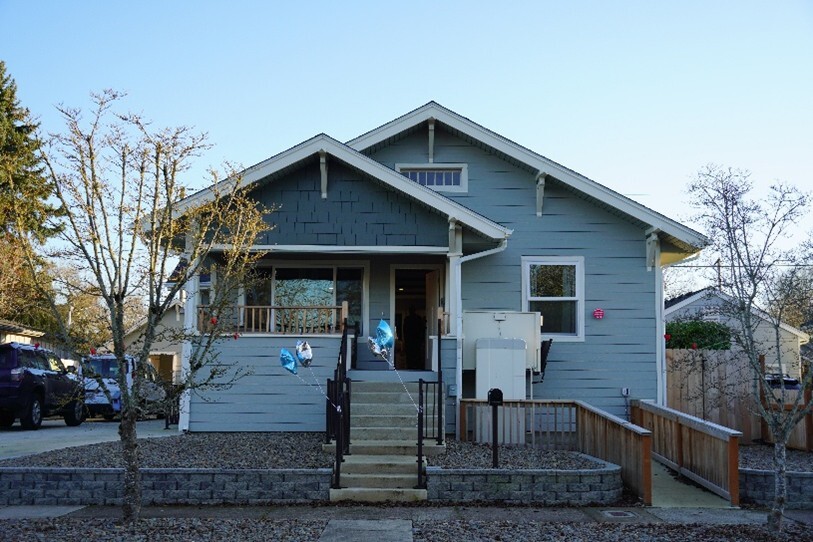
Caption: Juniper Street Young Adult in Transition Residential Treatment Home, with tiny hearts in the front trees where neighbors decorated for Valentine’s Day.
The Albany community recently gathered to celebrate the opening of a second Trillium Family Services Young Adult in Transition Residential Treatment Home. For those who couldn’t attend, the new space is more than just a building — It’s a reflection of care, dignity, and the belief that young people deserve safe, supportive environments. It will serve young people from ages 17 through 25 who experience complex behavioral health needs. The home provides 24-hour supervision and support, focusing on helping residents develop the skills needed to manage their mental health symptoms and transition into adulthood.
Neighbors, community partners and even a few potential future residents joined the open house, making the event feel deeply connected to the broader community. Jamie Vandergon, Trillium Family Services Chief Executive Officer, shared, “You can feel the thought and intention in every detail. It’s a space that truly welcomes young people.”
What makes this program special isn’t just the physical space—it’s the team behind it. “They’ve built something purposeful, and they’re ready to be there for young adults with both skill and heart”, says Christie Taylor, OHA Young Adult Services Coordinator.
The program was made possible through funding from the OHA, whose support helped create a resource that is intentionally integrated into the community. This partnership shows what can happen when collaboration and purpose come together.
For questions about Young Adults in Transition, please contact Christie Taylor, christie.taylor@oha.oregon.gov.
AMHPAC is on the lookout for a passionate community member who wants to make a real difference. We currently have an opening for a parent or guardian of someone age 18 or younger with serious mental illness (SMI) or serious emotional disturbance (SED). If this is you, the council would love to hear from you.
As a council member, you will help shape Oregon’s behavioral health landscape by:
- Advocating for Oregonians living with behavioral health challenges
- Monitoring and making recommendations to OHA about how publicly funded behavioral health services are allocated and how well they’re working
- Reviewing the state’s Combined Mental Health and Substance Abuse Prevention and Treatment Block Grant application and annual reports
- Taking on additional advisory roles as requested by the Oregon Health Authority (OHA) Director
Why join?
Serving on AMHPAC is a meaningful way to elevate community voices, influence statewide decisions, and support better behavioral health services for all Oregonians. If you care deeply about mental health and substance use disorder service delivery, and want to help guide positive change within behavioral health, this is a great place to plug in.
What is the time commitment?
Members are appointed to a two-year term and may serve up to three consecutive terms, for a maximum of six years of service. Members are expected to attend monthly council meetings, which are held on the second Thursday of each month from 10 to 11:30 a.m. Pacific Time.
Ready to get involved?
If you are interested in applying, you can find the AMHPAC application on the council’s website. If you have any questions please reach out to Hanna.G.Atenafu@oha.oregon.gov or June.S.Bernard@oha.oregon.gov.
The Life-Sustaining Practices Fellowship offers a culturally specific approach to suicide prevention in Oregon. American University recently announced that the Life-Sustaining Practices Fellowship will receive funds to enhance their toolkit and to create a short film about the program. This fellowship and its youth camp, called Camp Quilombo, is one of the black youth suicide prevention programs supported by OHA and is led by Dr. Tiffani Marie and Dr. Kenjus Watson. The program is in its second cohort of fellows. To learn more, read American University’s article on the project here.
Join us for a focused community engagement session to include family voice in the amendment process for the rule set on mobile crisis response (OAR 309 Div. 072 rules). We will present and discuss the existing rule set and cover the proposed changes we have received so far. We intend to save time to hear insight from families and look for ways to enhance the rule set to meet the needs of youth and families. Your voice matters, come share it with us.
- Date: March 18
- Time: 2:30 to 4:30 p.m. Pacific Time
- Location: Virtual
- Link to join: Teams Meeting
- Meeting ID: 210 811 948 224 49
- Passcode: 8ed2Gj7F
Please contact tamara.bavaro2@oha.oregon.gov if you have any questions.
Ask Dr. Jill: Are AI Chatbots Dangerous for Teens?
Ask Dr. Jill is a podcast that breaks down a wide array of important health topics. In this episode, Dr. Jill Waggoner and guest Robbie Torney explore the research on teen use of artificial intelligence chatbots for companionship, including practical advice for parents to help kids maintain a healthy relationship with artificial intelligence chatbots.
Find events, opportunities, trainings and resources in last month’s posting on our newsletter page. Many of these trainings are also on our training opportunities page. We will send updates mid-month — Look for the next one in your inbox on March 16.
For feedback and suggestions for our newsletter and information: kids.team@oha.oregon.gov.
Subscribe to OHA Behavioral Health Updates
Did someone forward or share this with you? You can subscribe here to get future issues of Holding Hope and other updates for Oregon behavioral health providers and partners.
|