Reprinted AOPs being Mailed

When the updated Acknowledgment of Parentage forms were printed, a mistake occurred during the final stages of printing resulting in an error in the red phrase on the bottom of page 4. “Alleged Genetic Parent’s Copy” was printed as “Alleged Generic Parent’s Copy.”
We apologize that we did not catch the mistake on the printed forms before they were mailed to facilities. New forms are being printed and will be sent as soon as possible.
When you receive your new forms, please shred the versions that contain the error.
If you have any questions about the Acknowledgment of Parentage forms, please contact Partner Services.
|
Updated Birth Parent Worksheet
The Informant section of the Birth Parent Worksheet has been updated to help reduce some errors that have been occurring regarding the relationship of the informant to the child.
The previous form had Father/second parent named on record as one selection. The updated worksheet has split these relationships into two different selections so there is no confusion when entering the information into OVERS.
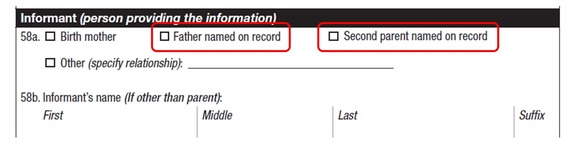 The updated Birth Parent Worksheets are available in English and Spanish. The other translations will still use the combined option for the relationship. If you have questions about the updated Birth Parent Worksheet, contact Partner Services.
Senate Bill 163 – The Acknowledgment of Parentage and Hospital Witnesses
On January 1 of this year, Senate Bill 163 amended ORS 109.070 to add the following requirement to our Acknowledgment of Parentage forms:
“(3) The voluntary acknowledgment of parentage form must contain:
(e) If the acknowledgment is witnessed by staff in the health care facility, a statement that the witness read to the parties the rights, responsibilities, alternatives and consequences listed on the acknowledgment prior to signing the acknowledgment;”
The forms have been changed to remain in compliance with the law. This means that birth facility staff who sign the “hospital witness” section of the form are acknowledging that they have read the Statement of Rights, Responsibilities, Alternatives and Consequences to the parents.
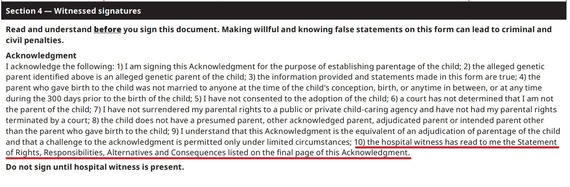 It is up to each birth facility to decide the processes they and their staff will use. If you have questions about those processes, you may wish to consult your administrators and legal department. The Center for Health Statistics cannot offer legal advice about meeting this requirement.
More resources:
For questions, please contact Partner Services.
Why Hepatitis B Information and the OVERS Immunization Questions are Important
Curious about the purpose of the immunization screen in OVERS? This month, the state coordinators for the Perinatal Hepatitis B Prevention Program (PHBPP) answered some questions to provide us more insight about hepatitis B information and the immunization data we collect.
What is the goal of Perinatal Hepatitis B Prevention Program?
The program aims to prevent infants from getting hepatitis B from their mother. Exposed infants have a very high risk of becoming infected (up to 85% for those that don’t receive treatment at birth), and 9 out of 10 infected infants will develop a chronic infection. There is no cure for chronic hepatitis B, and many people infected as infants will die prematurely from diseases such as cirrhosis and liver cancer.
Healthcare providers are required to screen pregnant people for hepatitis B (a common test is for the viral hepatitis B surface antigen, or “HBsAg”). People that test positive are enrolled in the program, and local health departments then track the care of the pregnant person and the infant. The first step of care for the infant begins at birth. At that time, infants should receive a dose of hepatitis B vaccine and hepatitis B immune globulin. The infant’s care will also involve two more doses of vaccine in the first year of life, followed by a blood test to confirm they are immune and not infected.
How does PHBPP use OVERS data?
We check OVERS regularly for any recent births to people that have hepatitis B. We look for a ‘positive’ result for the “Mother HepB surface antigen” question in the Immunization section. We also look to see if the “hepatitis B infection” box in the Pregnancy Risk Factor section is checked. In addition, the immunization questions are used to examine how well Oregon does at screening women for hepatitis B and administering the hepatitis B vaccine at birth.
Why is the OVERS immunization screen important?
The data you provide on the OVERS immunization screen is important for tracking and reporting purposes. Accurate reporting of these fields helps local health department staff become aware of deliveries sooner and sometimes alerts us to ‘at risk’ births where the mother was previously missed or didn’t receive prenatal care. This ensures infants are enrolled in PHBPP and their providers are notified of care recommendations. It also helps to confirm the appropriate care was received at birth.
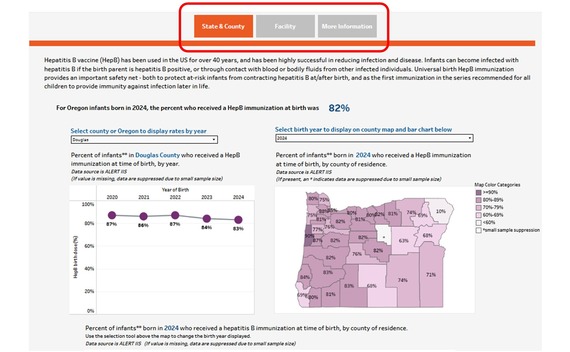
Because infants are so susceptible to infection, and because there is no cure for hepatitis B, the hepatitis B vaccine is also recommended for every infant as a safety net against unknown exposure. In 2024, 82% of Oregon infants received the hepatitis B vaccine at birth. Additionally, 93% of 2024 hospital births entered in OVERS included hepatitis B screening results for the birth parent. Overall, the PHBPP has been highly successful in preventing perinatal transmission, and cases of infant infection from perinatal exposure is rare.
Thanks for the work you and your colleagues do to support this program that protects infants in Oregon from contracting this chronic disease!
Due to the critical nature of this information, the Facility Birth Worksheet has been updated for improved clarity concerning what is being asked for on the Immunization screen concerning Mother HBsAG+. That question will now appear as Mother HBsAg+ (mother’s Hepatitis B screening result). The updated Facility Birth Worksheet is available here as well as on the BIS page of our website.
NOTE: Several other questions in the Facility Birth Worksheet were also updated to reflect the order options as they appear in OVERS.
Tools to help with reporting and analyzing the immunization fields:
The OVERS Guide: Answering Immunization Questions on the Facility Birth Worksheet can be found on the BIS page of the Vital Records website.
The Perinatal Hepatitis B Prevention Program shared that their “Infant Hepatitis B Immunization Dashboard” recently went live. This dashboard has a county tab and a facility tab. On the facility tab, you can see OVERS data for the birth hospitals, including the percentage of infants that received the birth dose of hepatitis B vaccine and the rate at which the birth parent was screened for hepatitis B infection. We encourage you to check out their dashboard to see and experience the data you collect!
|