|

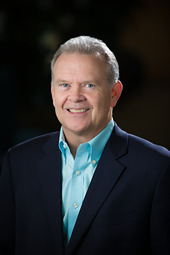
As we prepare for the new year, I am filled with gratitude for the outpouring of care Oregon State Hospital patients received from community members, OSH caregivers, and our fellow state employees through the OSH Volunteer Services Caring Tree program.
Now in its 40th year, the program has ensured every patient at OSH knows that someone is thinking of them through the donation of items during the holiday season. For those separated from family and friends or without a support system, that kindness offers a healing of its own.
In this issue of Recovery Times, you’ll find stories about how OSH is including patients in decisions that impact their day-to-day life at the hospital, the return of the sweat lodge tradition and a program that enables patients to gain valuable job skills as they prepare for discharge.
Thank you,
Jim Diegel
|
|
|
In the past year, Oregon State Hospital has worked to expand opportunities for patients to voice their concerns and provide feedback about decisions that impact their day-to-day life at the hospital.
“This is where people live – even if for a brief period of time. It is a community. They deserve to be engaged in decisions that impact the community that they live in,” said Cee Carver, OSH Director of Peer Recovery Services.
Carver’s department provides direct support to patients during their time in the hospital through services that help them navigate the challenges of being in an institutional setting. One long-time program is the Peer Advocacy Council (PAC) which enables patients to bring forward their own concerns and those of their peers. More recently, the hospital’s leadership team began meeting quarterly, and as of July, bi-monthly, with PAC representatives to hear their concerns and respond to requests with commitment of action or explanation of why the concern could not be addressed.
The dialogue has brought leadership’s attention to fast track some changes like more variety in the food menu, more social activities outside of designated treatment group time and ensuring all patient units hold unit community meetings where patients have the opportunity to co-lead with staff to discuss concerns, questions and suggestions to improve life on the unit.
“We’re all just normal people just trying to get by in a mental hospital. Everybody has had a rough day or a difficult time in their past. We’re not scary people,” said Tashina, an OSH patient involved with PAC. “I’ve just really enjoyed being a part of something bigger through PAC, and I hope that it will help me be more open to listening to other people’s ideas.
|
|
|
After a five-year hiatus, the Native tradition of the sweat lodge has returned to Oregon State Hospital.
The Native tradition of sweat lodge is rooted in healing, prayer, community and finding balance among one’s physical, mental, emotional and spiritual self. For those patients who follow Native traditions – it's an important part of their treatment process, said Kqalsan Mayuk, OSH Native Services program coordinator.
“For a lot of Native communities, it is equivalent to church,” Mayuk said. “When people pray together, things happen. Healing doesn't happen by ourselves. You need that interaction. We learn from each other. We listen to that other person’s prayers, and it might help us.”
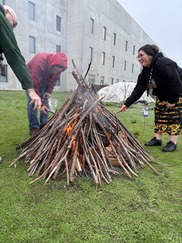
For patients like Gary, it is like church.
“We’ve been waiting a long time for it to happen again, so when it did, it was nice in a deep breath exhale kind of way because it’s so good for your system – both spiritual and physical,” Gary said. “It’s a purge at the same time. It symbolizes a rebirth, a cleansing. In a place like this – where things are so stagnant for so long with the same classes, same controls. It’s taking that deep breath, exhaling and moving forward.”
Sweat lodges on both campuses paused in 2020 during the global pandemic, and a plan to safely resume the tradition is now in place. The plan includes a screening process to ensure patients are medically and psychologically in a place to participate.
For now, the sweat lodge is being piloted on the OSH Junction City campus, wThe goal is to continue a monthly cadence in Junction City and learn from the experience to restart sweat lodges on the Salem campus in the new year, Mayuk said.
(Pictured above, OSH Native Services and Junction City team members prepare a fire to heat lava stones used in the sweat lodge pictured in the background.)
|
|
|
|
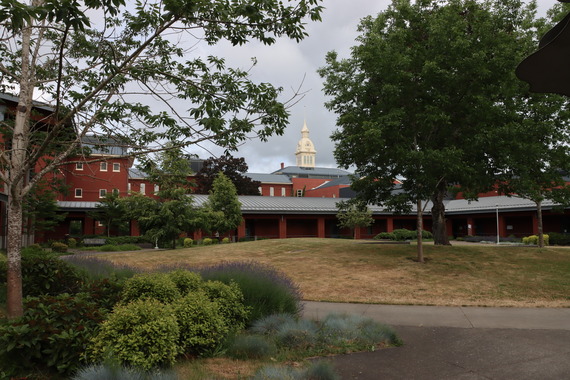
"You’d be surprised how many areas I designed,” said Andrew, an OSH patient, as he proudly described his contribution to the beauty of the hospital grounds.
Through the OSH Vocational Services program, patients like Andrew have work opportunities ranging from carpentry, food service and landscaping. They learn and build skills that prepare them for life in the community.
The opportunity for Andrew to be a part of a landscaping crew with other patients involved more than developing skills – like pruning and outdoor space design – but a sense of autonomy and ownership in creating spaces enjoyed by other patients and staff alike.
“You can feel the joy that patients have when they are out there and how accomplished they feel by completing these tasks,” said Kate Barnes, an OSH occupational therapist who works closely with the landscaping crew.
|
|
 |
|
In each Recovery Times, we share stories of OHA's work to strengthen the behavioral health continuum throughout Oregon. |
Innovative high school program equips students for behavioral health careers
An initiative to build a more diverse, culturally responsive behavioral health workforce is preparing Oregon students for a future career in the field.
High school juniors and seniors are gaining real world experience to explore potential career paths in behavioral health through the High School Behavioral Health Career and Technical Education (CTE) grant program offered in the Salem- Keizer School District and—new this school year—in Sunset-Beaverton and Lane County school districts.
“Students report the program is helping them prepare for their future and understand themselves and others better,” said Casey Reid, PhD, behavioral health pathway specialist, Lane Education Service District. “We are excited to prepare Oregon’s future behavioral health workforce and build the culture of schools along the way in ways that are supportive of students and communities.”
Behavioral health care facilities and centers improve access to care
Several new behavioral health care facilities and centers opened to improve access to care across the state.
This video offers a look inside one new recovery center, Bay Area First Step in Coos Bay.
|
|
|
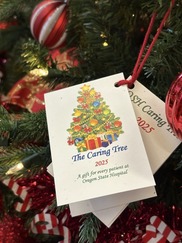
Now in its 40th year, the OSH Volunteer Services Caring Tree program continues to brighten the holidays for OSH patients through the support of donors.
Last week, every patient at OSH received gifts during the holidays thanks to the generosity of hundreds of community members, OSH employees and state employees who donated gifts and time.
The Volunteer Services team extends a huge thank you to all donors who supported the Caring Tree program. There are opportunities to donate to support patients throughout the year. Currently, the team is gearing up for future holidays and is seeking the following donations:
- Wrapping paper and tissue paper for gifts
- Greeting cards of all types, including:
- Winter holiday cards (all traditions and cultures welcome)
- Mother’s Day cards
- Father’s Day cards
- General encouragement or “thinking of you” cards
- Other holidays/occasions/life events
Donations may be dropped at reception on either campus marked: Attention Volunteer Services or contact OSHVolunteer.Services@odhsoha.Oregon.gov to arrange for a pick-up. Donations are tax-deductible.
|
 |

Want to learn more about the history of Oregon State Hospital and of mental health access and treatment in Oregon?
The OSH Museum of Mental Health is an independent, nonprofit organization that tells the stories of the people who lived and worked at OSH. Learn more at https://oshmuseum.org/.
|
|
|

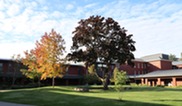
The Oregon State Hospital Advisory Board includes community members, patients and staff and its work supports patient care, safety and security. As part of its role, the board may review state and federal laws related to OSH policies and procedures and make recommendations to the OSH superintendent, Oregon Health Authority and Legislature.
|
|
|
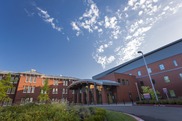
The Recovery Times is a quarterly publication that shares stories about the people and programs of Oregon State Hospital in support of OSH’s vision of hope, safety and recovery for all.
OSH serves a patient population that is traditionally marginalized, stigmatized and underserved, including many people with co-occurring disorders and those impacted by structural racism, and disproportionally represented in the criminal justice system.
|
|
|
If you need mental health support for any reason, help is out there. |
|
 |
|
|
|
|
|