House Bill 3127: Drop to Paper Exception Process (Funeral Directors)
Beginning January 1, 2026, House Bill 3127 requires that death records be completed electronically using OVERS. On December 31 at 5 p.m. Pacific Time, the drop to paper option will no longer appear in OVERS. However, there may be instances where a drop to paper record is needed in 2026.
Reasons for a drop to paper record after the deadline would include:
- If a 2025 death record needs to be dropped to paper and was not dropped to paper by December 31.
- If a 2025 death record needs to be re-dropped to paper, or if a new certifier is needed, and the certifier does not have an active OVERS account.
- Out-of-state medical certifiers exception: If a medical certifier is from out-of-state who rarely certifies death records, then a drop to paper record can be requested.
To request a drop to paper record for the above reasons, funeral directors can email or call the OVERS Help Desk at CHS.OVERSaccess@oha.oregon.gov or 971-673-1190 opt.1, then opt. 4. If you send an email or receive voicemail, include the following information:
- OVERS Case ID
- Your name
- Funeral home name
- Email address
- Phone number
- Reason for the exception request
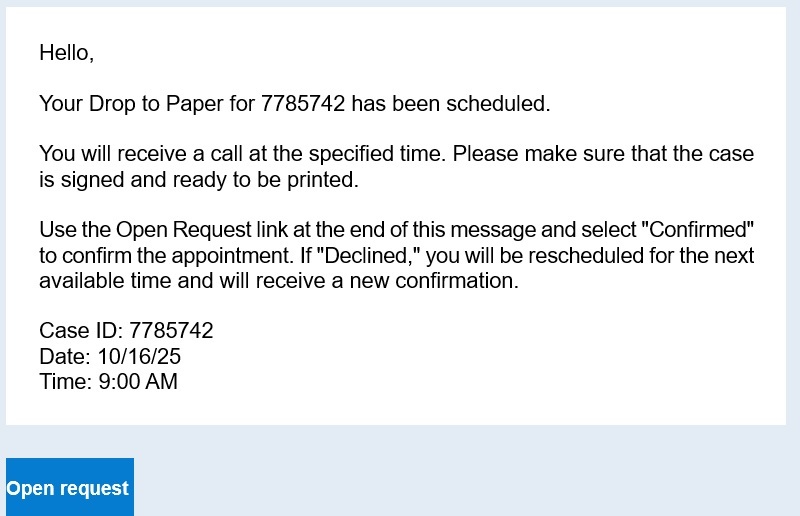
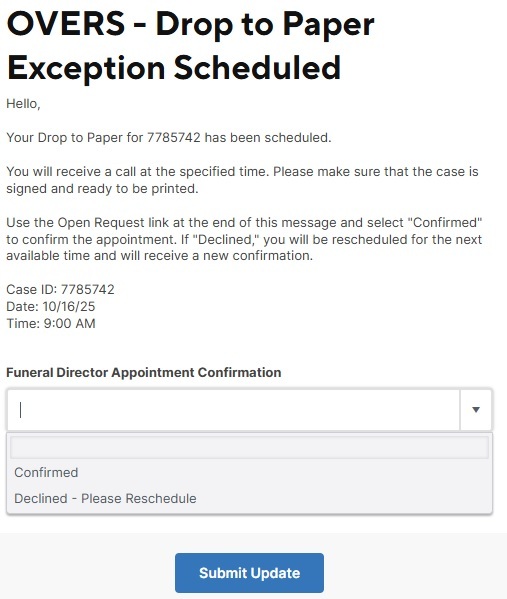
You will receive an email with an appointment for a date and time that a Center for Health Statistics employee will call you to create a drop to paper record. Click Open request in the email to confirm or reschedule the appointment.
Example email:
Select an option from the drop-down menu and click Submit Update to confirm or reschedule your appointment.
You will receive a phone call at your appointment time to complete the drop to paper record. Please be ready to receive the call and be logged into OVERS.
The procedure to print a drop to paper record will be changing with the next OVERS release. More information about that change will be in a future newsletter.
If you have any questions concerning HB 3127 or the drop to paper process, please contact CHS.PartnerServices@oha.oregon.gov.
Maintaining the Chain of Evidence
Maintaining vital records information as if it were part of a chain of evidence is extremely important. This means that it is clear where information came from, and each change to that information is documented so that it is clear who is accountable for it.
The following are fictitious scenarios based on events that funeral directors encounter followed by an analysis for the vital records chain of evidence.
Scenario 1: A funeral home could not locate any closer kin to the decedent than the neighbor who reported the death to them. The very basic information provided by the neighbor was used to create the death record. The funeral home correctly lists the informant as the neighbor. After the record has been registered, the funeral home locates an estranged spouse who provides additional information about the decedent and wants to be listed as the informant.
Analysis: In this scenario the informant cannot be changed to the alleged spouse. Doing so would confuse the chain of information, making it seem that the spouse is the one who provided the initial limited information with many Unknowns rather than the neighbor.
The informant is also an important safeguard against fraud. In this scenario, they would need to agree that the alleged spouse is the spouse of the decedent for them to be added to the death record as the decedent’s spouse. Without the proper informant, any ex-spouse of the decedent could produce a marriage record and attempt to fraudulently take control of the decedent’s assets.
Scenario 2: Vital records staff process an amendment by a funeral director and there is an incomplete or missing footnote on the record.
Analysis: Footnotes document what information was changed, by whom, when, and by what authority. For non-medical amendments they also document what the previous information was. Sometimes they reference file numbers that correspond with physical evidence documents that are permanently retained. This allows someone to look at an amended certificate and know who originally provided the information (the informant) and trace all the changes that have been made to that information through the footnotes. Funeral home directors and staff can always email Amendments if they feel information was not accurately documented or is completely missing in a footnote.
Scenario 3: A funeral home amends a record in OVERS, changing the spelling of the spouse’s first name. The funeral home does not write anything in the description field to clarify why the change was made.
Analysis: Vital records staff in this scenario would be unable to determine if the change can be made (because it was a clerical error) or if additional items are needed (because it was updated information from the informant). They would need to contact the funeral director, and the amendment may need to be resubmitted.
Helpful tips for maintaining the vital records chain of evidence:
- Appropriately identify the informant. They should be the primary source of the personal information used to create the death record. If other sources provide supplementary information, the informant should agree with it.
- If you receive amended death certificates with missing or incomplete footnotes, email Amendments.
- In the description field for electronic amendments, provide the reason for amending the record. For example, Clerical error due to typographical mistake, Updated information from informant, etc. This is important in documenting why information was changed and whether a change is authorized.
Properly accounting for information is important because death records are legal documents that identify a person, their relations, and facts about how they lived and died. Sometimes there are disputes about the facts on a record, and the outcome of those disputes can have large personal and financial impacts. When a death certificate ends up in a court proceeding, is being examined for possible fraud, or is being used to resolve the decedent’s affairs, it’s critical to know who the source of the information is.
For questions or to contact the Amendments Unit please email CHS.Amendments@oha.oregon.gov.
|