Additional Language Options for Birth Parent Worksheets
In an effort to provide greater language access, the Center for Health Statistics is excited to announce that the Birth Parent Worksheet has been translated into the following languages:
These languages were selected because, along with Spanish, they represent the most common non-English languages used in Oregon.
 The new translated worksheets can be found on the BIS Partner page of the Vital Records website in the Birth Worksheets section. Please remind parents that the answers they provide on the worksheets must be written in English.
In addition to the new translations, recent updates have been made to the English and Spanish version of the worksheet. These changes do not require replacement of any currently printed worksheets that you might have. The changes are:
- Removed and shifted divider lines in the address information boxes.
- Removed PO Box from the Birth mother’s address of residence question.
- Removing the day entry for the date of last live birth and date of last other outcome in questions 56 and 57. This now matches the entry required for OVERS.
- New translation of a word for the answer to the “How well does the mother/father speak English” on the Spanish Worksheet.
Contact CHS.PartnerServices@oha.oregon.gov if you have any questions about the new translations or the updates that have been made to the Birth Parent Worksheets.
Family and Child Health Programs and Vital Records Data: Family Connects Oregon
In the past few months, we have discussed some of the programs of the Oregon Health Authority’s Family and Child Health (FCH) section (formerly called Maternal and Child Health) who use vital records data.
The final program we are highlighting is Family Connects Oregon (FCO). FCO is a universally offered home visiting program. The goal of Family Connects Oregon is to provide a nurse home visit for all newborns.
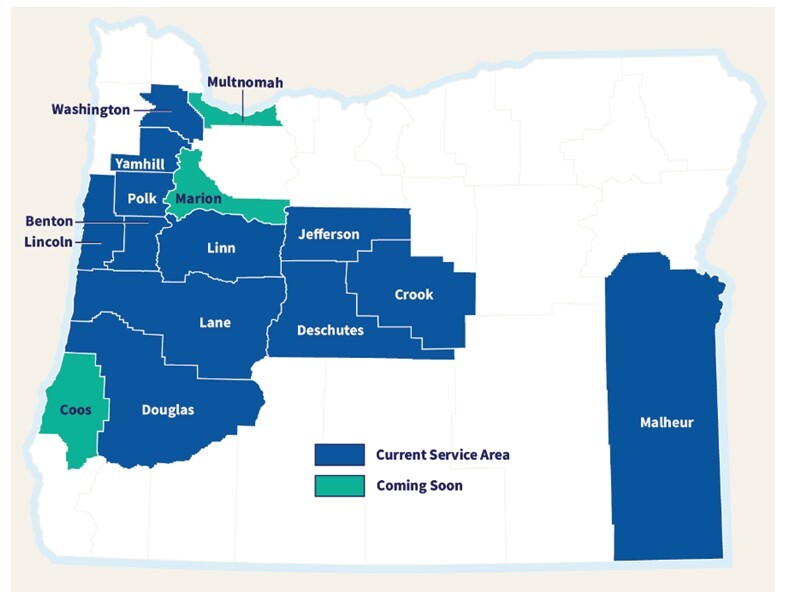
The program was piloted in 2021 and is currently available in 12 counties with additional counties being added (see map). Parents or caregivers of newborns that live in these counties are eligible to receive a home visit by a registered nurse. Income, number of children, health insurance, or citizenship status don’t affect a person’s eligibility for the program.
 The data entered on birth records helps FCO identify those who are eligible for home visits and help track their participation goals per county. Birth record data regarding the race/ethnicity and language spoken by the parent are also data points used to help ensure that materials and services are provided appropriately.
How does the program work? Parents or caregivers are contacted and, if they are interested, schedule the visit. This takes place about three weeks after birth. The visit usually takes place at the home of the child but can also be done online or another agreed upon location. The visit is free, and no questions are asked about citizenship.
What happens at the visit? The visit is typically 90 minutes in length and the nurse checks in with the health and well being of the baby, birthing parent, and the whole family. They help families connect with resources in their local community.
Baby: (weight, temperature, heart rate| discuss baby’s feeding and sleeping | discuss tips about bathing, swaddling and diaper changing | how to help baby sleep safely)
Birthing Parent: (overall health check | postpartum body healing | lactation support | sleep support | postpartum depression check-in and support | family planning information)
Whole Family: (follow up doctor appointments | checking in on older siblings | child-care and community resources | best practices for supporting the birth parent)

Why are home visits important? The Family Connects model is built on years of research and evidence that shows when newborns and families have the support they need, communities grow stronger and healthier.
Studies of Family Connects services have shown:
Healthier babies, and 50% fewer trips to the emergency room.
Calmer, more confident birth moms who are 30% less likely to suffer from postpartum depression.
|
Informational resources for Family Connects Oregon:
Family Connect Oregon website: familyconnectsoregon.org
Short video about the program:
This video is available in multiple languages: Arabic | Mam | Mandarin | Russian | Somali | Spanish | Vietnamese
To contact FCO directly, email Oregon.uohv@odhsoha.oregon.gov or use their FCO Questions and Feedback form.
Who to Contact at CHS
Birth Information Specialists are valued partners in our shared vital records system. Your participation is very important to the Center for Health Statistics, and we understand that providing accurate and timely birth record information is critical to our mission and can be challenging at times.
If you need assistance from CHS staff, the following are the best ways to contact us:
For questions about paternity establishment, corrections or amendments to the birth record, CHS.Amendments@oha.oregon.gov.
For support in completing a birth record, CHS.Registration@oha.oregon.gov.
For technical assistance with the OVERS system, call 971-673-1190, option 1, then option 4.
For training and training resources, or for any questions that don’t fall into the above categories, contact CHS.PartnerServices@oha.oregon.gov.
|