|
Having trouble viewing this email? View it as a Web page.
Lea en español
 Links in the "Changes to Big River Suicide Prevention trainings" article are now corrected.
Oct. 1, 2025
In this issue...

Reflections from Kathleen Burns, Oregon Health Authority (OHA) Child and Family Behavioral Health (CFBH) Program and Policy Development Coordinator

As autumn settles in, there’s a familiar shift in the air — a quiet turning, a season preparing for change. Nature begins its slow release, letting go in order to rest, reset, and renew. In many ways, it feels like the right time for me to do the same. After 21 years with the state, I’ll be retiring at the end of December.
I was hired to the (then) Department of Human Services, Office of Mental Health and Addiction Services, in 2004. I had never worked in a government agency before, and it was a whole new world. After many years as a clinician, I was excited to support children’s mental health at the state level. I joined at a key time, when the unit was forming. We were learning together what it meant to truly connect with Oregon communities, especially families and youth.
I’ve learned many things I didn’t expect to. The Affordable Care Act had a major impact and helped spark the creation of OHA in 2009, along with a legislative mandate. It pushed us to do our work differently. I began to understand the deep value of listening to stories from families and youth with lived experience. I had seen the effects of trauma in my clinical work, and I wanted to learn how to respond to it at a systems level. That led me to help make DHS/OHA more trauma aware and trauma informed. One of the things I’m most proud of is helping create a trauma-informed services policy that is still in place today — both in county programs and in Oregon’s administrative rules.
A defining moment for me came in early 2013 during the legislative session, when our manager shared that a legislator wanted to take meaningful action on children’s behavioral health. In the wake of the Sandy Hook school shooting, Senator Peter Courtney was determined to prevent a similar tragedy in Oregon. After years of limited funding, this led to a $21 million investment in the children’s mental health system — launching new programs and expanding others. The months that followed were some of our busiest and most hopeful, as we built or grew services that still exist today: Parent-Child Interaction Therapy, Youth Hubs, the Early Assessment and Support Alliance (EASA), Trauma Informed Oregon, and School-Based Mental Health Services. We expanded Wraparound statewide, advanced the System of Care framework, and increased support for family engagement and youth and family peer support. We also created a program for youth impacted by commercial sexual exploitation, offered training in Collaborative Problem Solving, and helped physicians begin screening for adolescent depression.
At the time, it felt like nearly everything we had hoped for in system development was finally possible, and I believe it truly changed the course of this unit’s work. While there is always more to be done, that moment of foresight and strong legislative support helped cement the role, credibility, and value of children’s behavioral health in Oregon and across the country. It has been my privilege and honor to serve as the lead worker in this unit and to witness meaningful work take root and evolve. I am confident the unit will continue to do outstanding and impactful work in the years ahead.
A few words from Chelsea Holcomb, CFBH Director
As Kathleen steps into retirement after more than two decades of dedicated service, I want to take a moment to celebrate her incredible impact. I met Kathleen even before I joined OHA when she was facilitating collaboration among intellectual and developmental disability (IDD) and mental mealth providers in the tri-county area. She was deeply engaged in breaking down barriers, building relationships, and envisioning systems that better serve children and families. Her leadership helped spark Oregon’s Youth IDD Mental Health Summit.
I want to recognize the incredible impact she has had on Oregon’s children and families, and on all of us who have worked alongside her. Kathleen brings unmatched passion and work ethic, diving fully into every task with care and curiosity. She’s taught us the value of patience and perseverance, especially within complex systems. Her knowledge, sincerity, and unwavering advocacy for marginalized communities have made her a steady guide, a generous teacher and a true changemaker.
Thank you, Kathleen, for the legacy you leave and the heart you brought to this work every day.
|
Currently, Oregon provides psychiatric services in hospitals and programs licensed as Psychiatric Residential Treatment Facilities (PRTF) for children and youth under 21 years of age. To strengthen consistency and transparency across these services, OHA is developing a standardized eligibility criteria for inpatient psychiatric services for individuals under 21 (Psych Under 21 services). These criteria will apply across Hospital, PRTF and future home and community-based settings.
The criteria establish a clear framework for determining whether a young person receives psychiatric services in a hospital or PRTF setting. This will establish consistent and transparent eligibility standards across all Psych Under 21 services and settings. Additional processes such as the comprehensive behavioral health evaluation, certificate of need documentation, and other implementation activities will be developed through future collaboration.
After extensive community input and as part of our ongoing community engagement, we are bringing back the final draft for a last review. We invite you to join us at one of the following sessions:
Providers and community:
Family members, as a part of the Families Leading Children’s Behavioral Health Systems meeting:
- Date: October 14, noon to 1 p.m. Pacific Time
- Location: Click here to join the meeting
- Join by phone: 1(669)254-5252 | Meeting ID: 160 152 2773 | Passcode: 682297
Linked here are the redlined changes and additional slides that explain the updates.
OHA is reviewing Oregon Administrative Rules (OARs) 309-022, which govern PRTF and day treatment services for children and adolescents. A potential rule change is anticipated in winter of 2025/2026. We invite community members to participate in ongoing discussion sessions on the Intensive Treatment Services OAR set. These sessions aim to gather feedback from providers, family members and others interested.
Session 1
- Date: October 16, 9 a.m. to noon Pacific Time
- Location: Click here to join the meeting
- Join by phone: (971) 277-2343, 994128652#| Meeting ID: 282 429 254 137 6| Passcode: 44Eu9AC3
Session 2
- Date: October 23, 9 a.m. to noon Pacific Time
- Location: Click here to join the meeting
- Join by phone: (971) 277-2343, 781797366#| Meeting ID: 229 115 992 865 3| Passcode: ia3xd37M
Please contact Julie.Graves2@oha.oregon.gov for any questions, input or interest regarding the proposed rule changes.
“Communities of practice are groups of people who share a concern, a set of problems, or a passion about a topic, and who deepen their knowledge and expertise in this area by interacting on an ongoing basis.”
— E. Wenger, 2002, Cultivating Communities of Practice
We are pleased to announce the launch of a new Community of Practice in Oregon created specifically for staff in leadership roles at PRTFs. The goal of this group is to offer a dedicated and consistent space for PRTF leaders to connect, exchange ideas, and share resources. The Community of Practice will hold regular virtual meetings featuring facilitated discussion and guest speakers. Topics for meetings could include clinical protocols, industry challenges such as funding and workforce support, state and local initiatives impacting work, and professional development opportunities.
The Community of Practice will be led by Dr. Karen Bos, child and adolescent psychiatrist at Oregon Health & Science University, and is supported by OHA. This initiative is rooted in a collective commitment to advancing care and sustaining programs across the state. All Oregon PRTF programs will be invited to join initial brainstorming sessions in October 2025 to help shape the direction and priorities of this new Community of Practice. For more information, please contact Karen Bos at bosk@ohsu.edu.
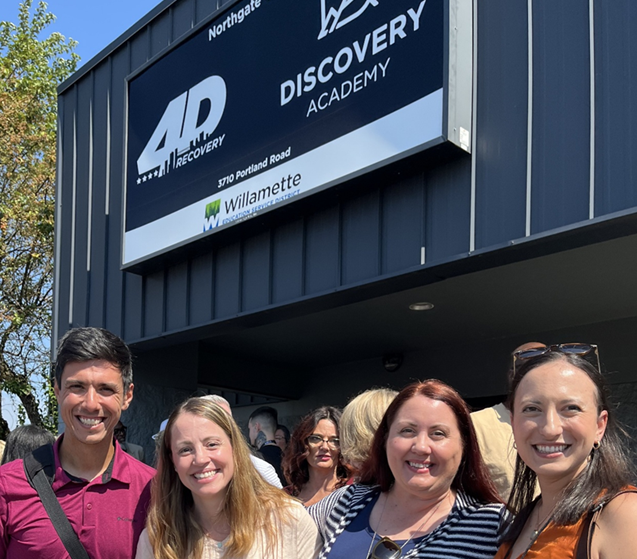
On August 28, a ribbon cutting ceremony was held in Salem to celebrate the official opening of the newest recovery school in Oregon: Discovery Academy. In partnership with 4D Recovery, young adults struggling with substance use disorder will now have access to both education and treatment services in one supportive space. This long-awaited and much-needed resource will serve students across Marion, Polk and Yamhill counties.
As Max Preminger, Principal of Discovery Academy, shared,
"Standing in that space, surrounded by so many who share a vision of hope and opportunity, was truly moving. This event was more than a ribbon cutting—it was a powerful reminder that community can come together to transform lives."
Tony Vezina, Executive Director of 4D Recovery, added:
"Everything that has unfolded to bring Discovery Academy and 4D Recovery to this point has happened for a reason. Our commitment remains steadfast—to listen, collaborate, and work with the local community to ensure youth and families receive the support they need to thrive."
From left to right: Wes Rivers, Brittany Kintigh, Katie Clemo and Alanna Russell
CFBH recently held two informational sessions focused on CSMHSs and the SHAPE System.
CSMHSs are built on a strong foundation of collaboration among school and district professionals, including administrators, educators and helping professionals. These systems offer a wide range of services to help meet students’ emotional and behavioral needs.
The SHAPE System is a free, publicly available, web-based portal for schools, districts, education service districts, and their partners. It offers assessments, evaluations, data tools, and other resources to help strengthen school mental health programs.
Session recordings:
Part 1
Part 2
We appreciate everyone who attended the Youth IDD/Mental Health Summit in Corvallis on August 6, 2025. We hosted 305 in person and 101 online, which was our largest turnout so far. A key takeaway from the day was the need for practical strategies that address both intellectual and developmental disabilities (IDD) and youth mental health, along with better coordination among schools, providers and families.
Planning for 2026 is underway. The next Summit will take place in August 2026; the exact date will be announced later. We are forming a planning committee that will include diverse perspectives and foster collaboration. The committee will meet via Zoom on the first Tuesday of each month from 4 to 5 p.m. Pacific Time. To join or learn more, please email info@thearcoregon.org.
The Youth Suicide Prevention (YSP) Program in the CFBH Unit is making important changes to the suicide prevention trainings offered through the Big River menu. The program is phasing in Be Sensitive, Be Brave for Mental Health (BSBB for MH) while phasing out Mental Health First Aid (MHFA). BSBB for MH is a culturally informed, evidence-based training designed to help community members support mental health. It takes just two hours, is available in eight languages and is free for participants. Lines for Life will offer Trainings of Trainers for BSBB throughout 2025 and 2026. The training is available on-demand, virtually and in person. To learn more, contact learning@linesforlife.org.
YSP is also phasing out Applied Suicide Intervention Skills Training (ASIST) and developing a new training to take its place by fall 2026. Trainings of Trainers for this new option will be available in English and Spanish starting in late 2026. The Association of Oregon Community Mental Health Programs (AOCMHP), which currently coordinates MHFA and ASIST with OHA, will no longer schedule Trainings of Trainers (TTT) for these programs. However, organizations can still receive funding for trainer certification and training support through June 2027, giving them time to switch to new programs or find other funding sources.
These changes help align the Big River and the Youth Suicide Intervention and Prevention Plan with OHA’s mission to reduce health inequities and expand access to life-saving information for all communities. For questions or more information, contact Roger Brubaker, Youth Suicide Prevention Programs Coordinator.
Suicide can leave a deep impact on families, friends and entire communities. Postvention is the coordinated response after a suicide or sudden death, where organizations and systems work together to support healing and mitigate further loss. In Oregon, this work has advanced with the development of a new version of CONNECT, a nationally recognized, evidence-based postvention training from National Alliance on Mental Illness (NAMI) New Hampshire.
In July 2024, representatives from OHA, the Governor’s Challenge team and Oregon Department of Veterans’ Affairs (ODVA) met for a two-day session because CONNECT, though originally designed to be flexible, was not fully meeting the needs of Oregon’s SMVF. The session included training and focus groups that highlighted the need for a community-based, culturally responsive postvention approach. Feedback guided the AOCMHP in revising the curriculum to better reflect SMVF culture and experiences. The updated CONNECT SMVF curriculum now features local voices and trainers with military backgrounds, making the material more relatable and effective. It also offers practical tools for community use.
In August 2025, Oregon launched the updated curriculum during a three-day TTT event at the Evergreen Aviation & Space Museum in McMinnville. This first full delivery brought together a diverse group from across the state — including Pendleton, the South Coast, Bend, Lane County, and the tri-county area. 11 new trainers were certified, all with military experience or strong SMVF ties. NAMI New Hampshire has endorsed Oregon’s version and plans to adopt it nationally: an exciting example of local innovation driving broader systemic change.
With the curriculum now complete, OHA and AOCMHP are working to expand access, support new facilitators, and integrate the training into broader suicide prevention efforts under the Adult Suicide Intervention and Prevention Plan (ASIPP). Oregon’s CONNECT reflects a growing recognition that postvention must be culturally responsive and community-driven, and that healing after suicide loss is something we can do together. For more information on CONNECT, please visit the AOCMHP and NAMI New Hampshire websites.
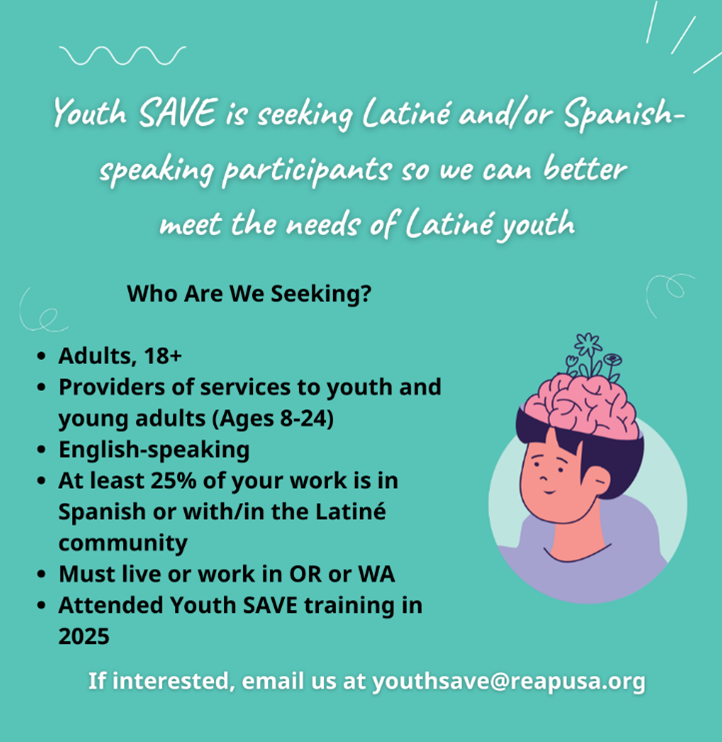
The Youth SAVE team is working to ensure that suicide prevention and intervention training better reflects the cultural and linguistic needs of Latino, Latina, Latiné, Latinx, and/or Hispanic and/or Spanish-speaking youth and families across Oregon.
We’re inviting community members to take part in this effort by participating in a Youth SAVE training and/or joining a focus group with others from the Latiné and Spanish-speaking community. Your insight will help strengthen how mental health services support young people statewide.
We’re seeking Latiné and/or Spanish-speaking adults who:
- Work with youth ages 8–24
- Speak English
- Do at least 25 percent of their work in Spanish or with the Latine community
- Live or work in Oregon or Washington
- Attended Youth SAVE training in 2025
To get involved, email youthsave@reapusa.org.
Oregon Tribal Curriculum – The Quartux Journal
The article outlines the development and challenges of Oregon’s tribal curriculum efforts. Despite a 2017 law to create a comprehensive Native American K–12 curriculum, rollout has been slow due to funding and training gaps. Many educators still teach outdated Native history, but new resources from Oregon tribes and the state education department aim to improve accuracy and representation.
Find events, opportunities, trainings and resources in last month’s posting on our newsletter page. Many of these trainings are also on our training opportunities page. We will send updates mid-month — Look for the next one in your inbox on October 15.
For feedback and suggestions for our newsletter and information: kids.team@oha.oregon.gov.
Subscribe to OHA Behavioral Health Updates
Did someone forward or share this with you? You can subscribe here to get future issues of Holding Hope and other updates for Oregon behavioral health providers and partners.
|