|
|
The National Healthcare Safety Network (NHSN) has been the nation’s cornerstone of patient safety monitoring for 20 years and will continue to be on the leading edge of innovation and healthcare quality improvement for years to come.
Beginning in 2005 with just 300 hospitals, NHSN is now accessed by more than 170,000 users across 39,000 U.S. healthcare facilities. It includes nearly every hospital, ambulatory surgery center, dialysis facility, and nursing home in all 50 states, Washington, D.C., and most U.S. territories.
NHSN has seen significant growth from 2005 to today:
- Encompasses more than 55 million patient records and processes more than 21 million data submissions each year, more than any other infection monitoring system.
- Provides data for action and accountability. Since 2015, NHSN has prevented more than 530,000 infections in hospitals and dialysis facilities.
- Runs on a modernized, cloud-based platform incorporating artificial intelligence for efficient data processing.
- Pioneering new healthcare data exchange approaches with the goal of minimizing reporting burden for users, and is working to develop fully electronic and automated measures.
Since 2011, the Centers for Medicare and Medicaid Services (CMS) has relied on NHSN data for several regulatory, payment, and quality improvement programs. In addition, CMS Care Compare displays NHSN data for patients and caregivers to make decisions about health care.
NHSN continues to evolve and will always rely on partnerships with healthcare facilities to identify and address emerging and enduring threats across healthcare.
Oregon Public Health Division summarizes key Oregon-specific data from NHSN and other sources on the HAI Dashboard. For questions, contact Lisa Iguchi, HAI Reporting Epidemiologist.
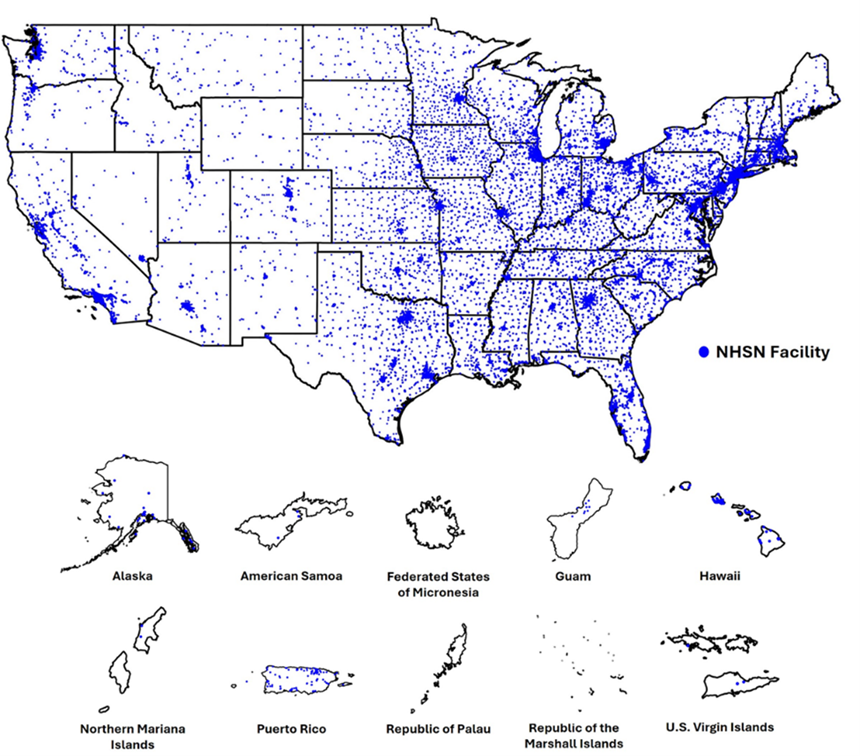 Image: Map of Healthcare Facilities Enrolled in NHSN
|
|
-
Need infection prevention support? Our experienced Infection Preventionists are here to help! Our team can offer expert guidance if you're managing an outbreak or looking to strengthen your infection prevention practices. Reach out for a consultation, and let us help you keep patients and staff safe!
-
Quarterly Oregon IP Collaboratives: Sign up to enhance your infection prevention knowledge and stay ahead in protecting patients, residents, and staff. Reach out if you're interested in joining our Eastern or Western Oregon IP Collaboratives, where we spend one hour discussing the latest infection prevention strategies. All interested healthcare and public health staff are welcome to attend.
August 19, 2025 - West - It's OK to Have a Dirty Urine
August 20, 2025 - East - The ABCs of Antibiotics
- The CRE Quarterly Report has been updated through June 2025. NDM continues to be the most prevalent carbapenemase detected in Oregon.
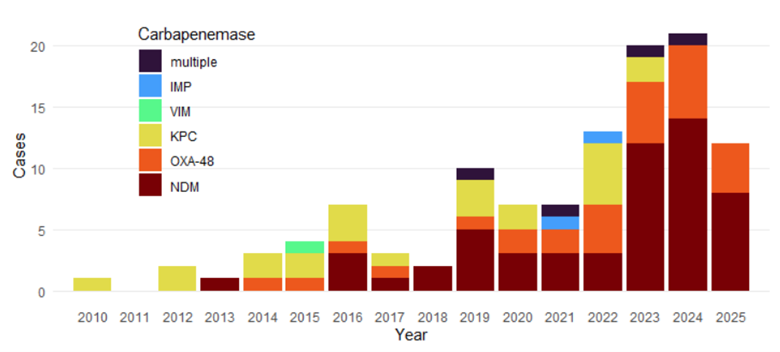 Image: Histogram of CP-CRE identified by Oregon laboratories by year, Nov 2010 – Jun 2025
-
Meet our Antimicrobial Stewardship team! Liz (our AS Pharmacist) and Kristen (our AS Epidemiologist) will be at the Beaverton Farmers Market on November 22nd. Bring your kiddos by for a fun activity!
-
Have questions about fungal diseases? Contact CDC Mycotic Diseases Branch’s NEW clinical consult service at 404-639-5168 or email fungalconsult@cdc.gov for consultation on diagnosis or treatment for suspected or confirmed fungal diseases. The Mycotic Diseases Branch will support you in caring for your patient.
|
|
 September was Sepsis Awareness Month. Click above to find the signs and symptoms to watch for. Image: A nurse looking at a patient in a wheelchair.
Get to know the exceptional members of the HAI team.

Dr. Dat Tran is the HAI Program Medical Director. His responsibilities include serving as the Principal Investigator for CDC’s Epidemiology and Laboratory Capacity (ELC) HAI activities, providing subject matter expertise related to outbreak response for healthcare-associated pathogens and antimicrobial stewardship, and piloting HAI prevention efforts, such as deployment of Oregon’s Antibiotic Resistant Information Exchange (ARIE) and wastewater surveillance of multidrug-resistant organisms (MDROs). Dat also advises on response-related policy development and health-medical response activities as needed in his role as a Senior Health Advisor.
Dat received his medical degree from the University of Toronto, his Master of Science in Biomedical Informatics from Oregon Health & Science University, and his clinical training in pediatrics and infectious diseases at The Hospital for Sick Children (SickKids) in Toronto. He has more than 25 years of experience in pediatrics, infectious diseases, academia, and public health, combined. Dat has served on numerous medical journal editorial boards, Canadian and U.S. peer review grant panels, and various provincial, state, national and international public health committees and working groups. Before joining the Oregon HAI team in 2016, he was a faculty member at SickKids (Division of Infectious Diseases) and the Dalla Lana School of Public Health at the University of Toronto. At SickKids, Dat’s clinical interests included management of patients referred for adverse events following immunization and working with vaccine-hesitant parents, while his research focused on determinants of influenza severity in children.
Away from work, Dat is a visual arts enthusiast, and enjoys tennis, skiing and scuba diving. He also relishes in optimizing redemption of credit card points for memorable travel experiences. His favorite quote is one from Ralph Waldo Emerson:
“What lies behind you and what lies in front of you pales in comparison to what lies inside of you”.
|
 Image: Know when to Test Residents for Urinary Tract Infections!
|
|
- The Post-Acute and Long-Term Care Medical Association recommends against routine use of urine PCR testing for UTI diagnoses due to a lack of evidence of patient benefit and likely increase in unnecessary antibiotic use. Read the full guidance.
-
Study shows a high rate of antibiotic use in hospital-at-home (HaH) patients. Benefits of HaH compared to traditional hospitalization include lower healthcare costs, fewer readmissions, and better quality of life. Infections are a common reason for HaH admission, but antimicrobial use in HaH settings in the United States has not been well documented.
-
Following standard dialysis IPC practices was enough to prevent C. auris transmission among dialysis patients. Six patients infected or colonized with C. auris received dialysis for up to 4 months without transmission to other patients.
- A study led by researchers at the University of Michigan suggests urgent care providers are commonly prescribing unnecessary antibiotics, opioids, and glucocorticoids.
-
Spread of C. auris continues at a rapid pace in Europe. Read more from the 2025 report.
 Learn how to reduce the risk of spreading germs through ice. Image: An ice bucket being refilled from an ice machine.
CSTE Public Health Antimicrobial Stewardship Conference - October 27th 7 am to noon (free, online)
Audience: Public health personnel interested in or currently implementing antimicrobial stewardship programming.
Join us to connect with your peers and learn actionable strategies to develop or strengthen your public health antimicrobial stewardship program! Click here to register.
-------------------------------------------------------------------------------------------------------
Learning Series: How to Collect and Submit Carbapenemase-Producing Organisms (CPOs) and C. auris Samples for Testing (free, online)
Audience: Healthcare staff doing CPO or C. auris testing
The Association of Public Health Laboratories (APHL) and the Antimicrobial Resistance Laboratory Network (AR Lab Network) have developed a new learning series to assist healthcare staff in understanding the role of screening for CPOs and C. auris. This four-part series provides just-in-time training on how to collect and submit specimens to identify carbapenemase-producing organisms (CPOs) and Candida auris. Modules can be taken together or individually.
Module 1: Overview and Importance of Screening for Multidrug-Resistant Organisms (MDROs)
Module 2: Carbapenemase-producing Organisms Colonization Screening
Module 3: Candida auris Colonization Screening
Module 4: Video-Packaging and Shipping for Colonization Screening
-------------------------------------------------------------------------------------------------------
National Pharmacy Week, October 19-25, 2025
This is a yearly event to thank pharmacists and pharmacy technicians for their important help in caring for patients. Pharmacists can answer questions about antibiotics and how to get rid of unused medicines.
-------------------------------------------------------------------------------------------------------
SAVE THE DATE! U.S. Antibiotic Awareness Week is November 18-24
Keep an eye out for the special edition of our newsletter! Learn more about ways you can spread the word and participate at CDC: U.S. Antibiotic Awareness Week (USAAW)

|
|
|
Put together a colorized transmission electron microscopic image of mpox virus particles (teal), which were found within an infected cell (brown).
Solve it in under 30 seconds!
|
|
|
Oregon Health Authority works to transform the health care system in Oregon by lowering and containing costs, improving quality and increasing access to care to improve the lifelong health of Oregonians. OHA is overseen by the nine-member citizen Oregon Health Policy Board working toward comprehensive health reform in our state.
The HAI program within the OHA Public Health Division is dedicated to preventing and containing healthcare associated infections (HAIs) and addressing the growing challenge of antimicrobial resistance (AR). Through initiatives such as the Antimicrobial Resistance Laboratory Network (AR Lab Network) and the National Healthcare Safety Network (NHSN), we are bolstering our ability to detect and respond to antibiotic resistance while strengthening the nation's most widely used HAI tracking system. We also focus on antibiotic stewardship to improve the appropriate use of antibiotics, and we provide comprehensive infection prevention and control (IPC) education and training to equip the health care workforce with the necessary skills. Our team further offers IPC consultations to health care facilities throughout the state, providing expert guidance and support in implementing effective infection prevention strategies and responding to outbreaks. Together, we are committed to enhancing patient safety and reducing the impact of HAIs and antimicrobial resistance.
|
|
|
|
|