|
|
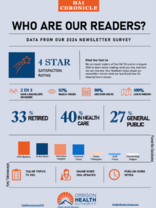
Take our survey!
Last year we asked our readers to give us feedback. Below is what we heard. This year we're asking for your feedback again.
Click to read more.
 |
The National Healthcare Safety Network (NHSN) is updating how it measures healthcare-associated infections (HAIs). It is changing the national baseline used to calculate HAI rates from 2015 to 2022.
This update affects all hospital types, including acute care, critical access, and long-term acute care hospitals. The new 2022 baseline helps hospitals compare their infection data to more recent national trends. It also reflects changes in HAI policy, surveillance definitions, and prevention practices that have been implemented since 2015.
If your hospital uses NHSN HAI reports, we encourage you to review the new baseline reports (using 2022 data). Many, but not all, are now available. You may notice changes in the infection rates compared to the older 2015 baseline. NHSN has provided talking points that can help explain these differences to your colleagues and leadership.
You can find more information on the 2022 rebaseline website. For questions, please contact Lisa Iguchi.

|
|
-
Need infection prevention support? Our experienced Infection Preventionists are here to help! Our team can offer expert guidance if you're managing an outbreak or looking to strengthen your infection prevention practices. Reach out for a consultation, and let us help you keep patients and staff safe!
-
Monthly Oregon IP Collaboratives: Sign up to enhance your infection prevention knowledge and stay ahead in protecting patients, residents, and staff. Reach out if you're interested in joining our Eastern or Western Oregon IP Collaboratives, where we spend one hour a month discussing the latest infection prevention strategies. All interested healthcare and public health staff are welcome to attend.
-
Oregon Long-term Care Facility Antibiotic Stewardship Learning Series: Sign up for a one-hour monthly training on best practices for antibiotic stewardship in nursing, assisted living, and residential care facilities. Sessions will take place on the fourth Wednesday of each month. Complete all six sessions to receive a certificate. For more details, please contact Ryan Frick, Population Health Epidemiologist.
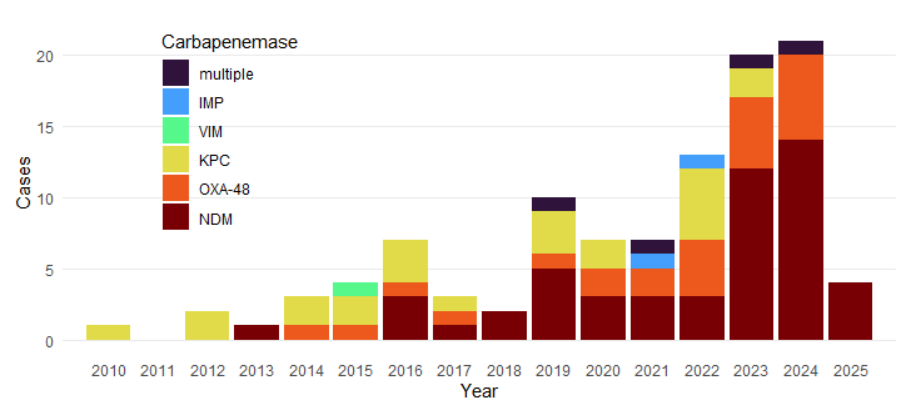
- The CRE Quarterly Report has been updated through March 2025. NDM continues to be the most prevalent carbapenemase detected.
Bar graph showing increasing trend of CP-CRE, 2010 - March 2025
A study examining trends in vaccination and antibiotic use found that as childhood vaccination rates increased over a 15-year period, antibiotic prescribing rates significantly declined. Researchers analyzed data from 6.7 million children in the U.S. Higher uptake of routine vaccines—pneumococcal, Hib, DTaP, and influenza—correlated with fewer antibiotic prescriptions and fewer antibiotic-treated respiratory infections.
Researchers found that vaccine uptake more than doubled over the study period, from 32.5% of children receiving at least one dose of each of the four vaccines to 66.8%. At the same time, overall antibiotic prescriptions decreased by 46.6%. The largest reductions were seen in macrolide and broad-spectrum antibiotics. The findings support the idea that preventing vaccine-preventable illnesses may help reduce antibiotic use.
|
|
|
Get to know the exceptional members of the HAI team.

Meet Shannon, the Oregon Emerging Infections Program’s surveillance officer for the Multi-site Gram-negative Surveillance Initiative (MuGSI) for invasive E. coli infection in Oregon. Shannon leads active, laboratory-based surveillance for these infections in Jackson County as part of a national CDC-sponsored effort. She works closely with labs and infection prevention partners to identify cases, collect clinical isolates, and conduct in-depth chart reviews—all with the goal of deepening our understanding of invasive E. coli infection and supporting vaccine development.
Shannon brings a powerhouse of experience to her role. She holds a B.S. in Microbiology from the University of Rochester and an M.P.H. in Epidemiology from Emory University. Her past work includes investigating the effects of ionizing radiation exposure at the National Institute for Occupational Safety and Health (NIOSH), serving as Oregon’s Tuberculosis Epidemiologist, and supporting COVID-19 response efforts.
Off the clock, Shannon enjoys playing tennis, genealogy, and cake decorating. She lives in Jackson County with her partner Jayme and their two teens—Natalie and Dominick. Oregon is fortunate to have talented and dedicated staff like Shannon, and we’re glad she’s part of our team!
|
|
|
-
Findings reveal that microplastics actively drive the development of antimicrobial resistance in Escherichia coli, even in the absence of antibiotics, with resistance persisting beyond the exposure to antibiotics and microplastics.
-
Report details a multiyear outbreak of Candida auris in a burn intensive care unit in Illinois.
- AHRQ Safety Program for Healthcare-Associated Infection (HAI) Prevention: CLABSI.
This 9-month program will support acute care hospital units in implementing strategies to reduce central-line-associated bloodstream infection (CLABSI) rates. Through this free program, participating units can strengthen their team-based infection prevention practices and earn continuing medical education (CME) and continuing education unit (CEU) credits. The federal Agency for Healthcare Research and Quality (AHRQ) is currently recruiting adult hospital intensive care units (ICUs) and non-ICUs for this program, slated to start in July 2025.
Register for an informational webinar.
- SHEA Online Education Center Advancing Healthcare Sustainability in Infection Prevention Course
On June 6, the Society for Healthcare Epidemiology of America (SHEA) started a three-part webinar series—”Advancing Healthcare Sustainability in Infection Prevention.” The course explores the intersection of infection prevention and sustainability in healthcare, focusing on strategies to reduce environmental impact while maintaining patient safety.
Click here to register and learn more!
-
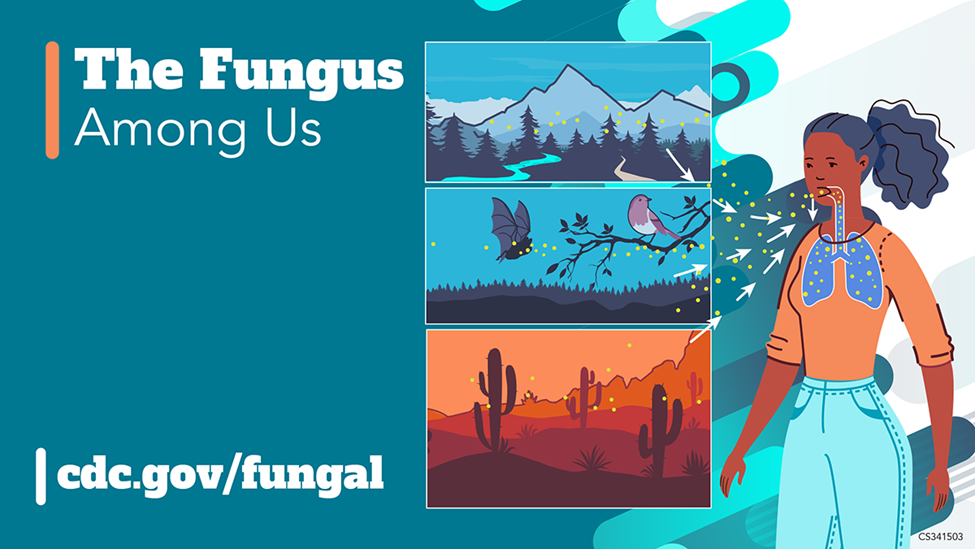
Fungal Disease Awareness Week (FDAW) 2025 is September 15th–19th
Help raise awareness with these social media graphics and messages adaptable for all major platforms. Use #FungalWeek25 across social media to help join efforts.
|
|
|
Source: https://www.gocomics.com/calvinandhobbes, Bill Watterson
|
|
|
Oregon Health Authority works to transform the health care system in Oregon by lowering and containing costs, improving quality and increasing access to care to improve the lifelong health of Oregonians. OHA is overseen by the nine-member citizen Oregon Health Policy Board working toward comprehensive health reform in our state.
The HAI program within the OHA Public Health Division is dedicated to preventing and containing healthcare associated infections (HAIs) and addressing the growing challenge of antimicrobial resistance (AR). Through initiatives such as the Antimicrobial Resistance Laboratory Network (AR Lab Network) and the National Healthcare Safety Network (NHSN), we are bolstering our ability to detect and respond to antibiotic resistance while strengthening the nation's most widely used HAI tracking system. We also focus on antibiotic stewardship to improve the appropriate use of antibiotics, and we provide comprehensive infection prevention and control (IPC) education and training to equip the health care workforce with the necessary skills. Our team further offers IPC consultations to health care facilities throughout the state, providing expert guidance and support in implementing effective infection prevention strategies and responding to outbreaks. Together, we are committed to enhancing patient safety and reducing the impact of HAIs and antimicrobial resistance.
|
|
|
|
|