|
 |
|
In this issue: |
|
|
|
Did you know that babies born in Oregon are tested for more than 45 developmental disorders within two days of birth? Moments after a baby enters this world, a few drops of blood are taken from its tiny heel and sent to a laboratory for testing—namely, the Oregon State Public Health Laboratory (OSPHL) in Hillsboro.
Called newborn bloodspot screening, this process is essential for detecting rare but serious conditions early on, and it's just one of the many ways OSPHL has been on the front lines of Oregon’s public health defense since 1903, making it one of the oldest public health programs in the state.
More than 100 OSPHL scientists perform about 5.4 million tests on 200,000 human specimens each year, identifying and analyzing everything from COVID, foodborne illnesses, harmful drug-resistant organisms, STIs, Ebola, anthrax, plague, and more.
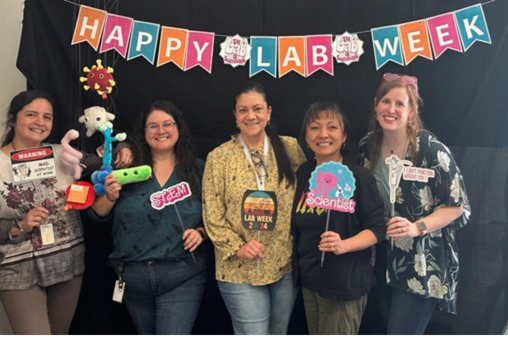
During the 50th anniversary of National Medical Laboratory Professionals Week, affectionately known as “Lab Week”—please join us in honoring and reflecting upon the largely unseen work performed by the team of laboratorians at OSPHL and clinical laboratories across Oregon and the country.
|
|
|
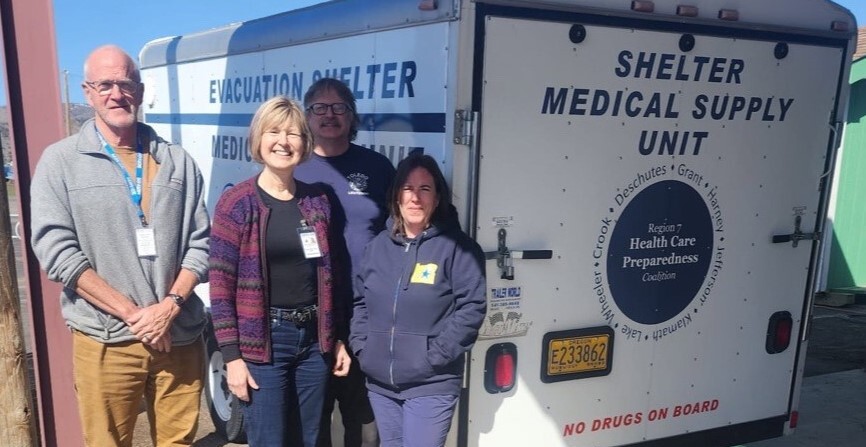
SERV-OR medical volunteers at a Harney County shelter in April 2025.
When 44-year-old volunteer Cayetana “Caye” Gomez de Soler (above, right) arrived at an emergency shelter for Harney County residents flooded out of their homes earlier this month, she was immediately gratified, if not a little stunned.
“The people staying there instantly came over to say, ‘Hi,’ thanking us for being there,” Caye said. “And I was like, ‘I haven’t done anything yet… I just got here!’”
Caye is part of an all-volunteer medically trained workforce that deploys to emergency disasters all over the state -- State Emergency Registry of Volunteers in Oregon, aka SERV-OR.
During National Volunteer Week, OHA recognizes Caye and others for their dedication to keeping Oregonians safe and healthy during public health emergencies such as wildfires, floods, extreme temperatures, and more.
SERV-OR is always looking for new members. Read our blog to learn more about SERV-OR and how to get involved.
|
|
 |
|
Health notes |
|
|
|
If you take any of these 27 prescription medications, the Oregon Prescription Drug Affordability Board (PDAB) would greatly appreciate a few minutes of your time to take an online survey. The conditions treated by the listed drugs include migraines, diabetes, skin disorders, pain, blood clots, and more.
The (PDAB) is seeking feedback from the public about certain medications that may be difficult for Oregonians and health care systems to afford. Also, if you’re a caregiver for someone who takes any of the listed medications, or an advocacy group that is impacted by these drugs’ prices, the PDAB would love your feedback as well.
If you have experience with multiple drugs on the list, please submit a separate survey for each drug. Survey results will be aggregated, and personal information will not be made public.
The survey closes next Wednesday, April 30.
You can also sign up to speak at the PDAB’s May 21 meeting by registering here. If you want to speak at the meeting, submit this public comment form by 9 a.m., May 20. For questions, email PDAB staff at pdab@dcbs.oregon.gov or call 971-374-3724. Learn more about the PDAB here.
Thank you for participating! Your input is critical to promoting affordability and access to prescription medication in Oregon.

April 29 is national Fentanyl Awareness Day, an annual observance founded in 2022 by parents who have lost loved ones to the drug overdose crisis.
In 2023, nearly 73,000 drug overdose deaths involved synthetic opioids (primarily illegally made fentanyl). This is approximately 92% of all opioid overdose deaths.
The National Fentanyl Awareness Day movement is hosting two free online seminars that offer powerful ways to understand today's drug landscape and take action to protect your community from fentanyl and fake prescription pills.
Both events take place Tuesday, April 29, and you can sign up for the event that best fits your role.
-
Parents, community members and companies (Noon PST) – REGISTER HERE
Learn how to protect the young people in your life from fentanyl and fake prescription pills with the screening of a 27-minute film, The New Drug Talk, plus a Q&A/panel with impacted family members, medical professionals and prevention experts.
-
Educators and student leaders (3 p.m. PST) – REGISTER HERE
Learn how to bring fentanyl education to students with a special screening of Real Talk About Fake Pills, a 20-minute film for middle and high school students, plus a Q&A/panel discussion with education experts.
OHA supports raising awareness of the impact and of fentanyl and information to prevent fentanyl exposure and overdose by providing Oregonians with several digital resources to keep themselves and their loved ones safe. Visit the OHA's Fentanyl Webpage to learn more about fentanyl, and sign up for OHA’s monthly Substance Use & Overdose Continuum newsletter for events, resources, and updates on how Oregon is combating the fentanyl overdose crisis. You can also print these fentanyl fact sheets, available in English and Spanish.
|
|
|
 |
|
OHA answers your questions |
|
|
Questions are answered by experts at OHA, other state agencies or community partners.
Q: Regarding H5N1 [aka Highly Pathogenic Avian Flu (HPAI)], we usually get chicken manure compost and apply it to our garden every year. Since they heat it up, I’m just not sure how high the temp gets or how consistent it is. What, if any, are the safety protocols for putting this in our garden, for other animals and my chickens, and to consume the vegetables? – Sarah, Molalla
A: Sarah, we consulted our partners at Oregon Department of Agriculture (ODA) for help answering this question. When properly completed, composting effectively inactivates (kills) the H5N1 bird flu virus. (In fact, infected organic material on infected commercial farms is often composted for the purpose of safe disposal.) On infected farms, composting follows very strict protocols and is performed under the direct supervision of experts from either ODA or the United States Department of Agriculture (USDA). The compost piles are then monitored daily over a minimum of 28 days to ensure proper temperatures are reached for the composting to successfully kill the infection.
Therefore, if completed properly as described, the compost poses no risk to your chickens or other animals, or to humans who eat the produce grown in your garden.
Additionally, you can rest assured any compost that is already being sold/distributed is safe. That’s because composting is a long process, taking at least 30 days to reach store shelves. At the same time, H5N1 very rapidly kills all poultry it infects, making it easy to spot quickly. In other words, once H5N1 is detected on a commercial farm, the above safety protocols immediately kick into gear, and any compost already for sale that came from that farm was safely processed long before the infection arrived.
If you have questions about health topics in Oregon, submit your question here. Although we are unable to answer every question, we try to address those of interest to a broad audience. Please understand that we are unable to provide specific medical advice for personal medical conditions.
|
|
|
|
|