ePipeline
OHA–Drinking Water Services
April 22, 2025
In this issue:
As part of our commitment to keeping you informed, OHA-DWS asks that water suppliers review their contact information in Drinking Water Data Online and verify that the email address on file is correct. Please send any contact information updates to your water system’s regulating agency or reach out to OHA-DWS. Thank you.
Small water system operators whose certifications expire July 31, 2025, will be receiving renewal notices in the mail. Attending the Small Water Operator Training Course and passing the exam is a requirement before renewing. Go here for information and to register for the course.
Distribution and Treatment operators with names beginning with A-K who failed to renew by December 31, 2025, received delinquent notices in the mail. They have until the end of the year to renew. Renewal information is on the Operator Certification web page.
It’s CEU audit time for randomly chosen A-K Distribution and Treatment operators. Postcards have been mailed to those selected.
EPA released the final drinking water regulation for six per- and polyfluoroalkyl (PFAS) chemicals on April 10, 2024. The rule establishes individual maximum contaminant levels (MCLs) for five of the six PFAS chemicals and a hazard index MCL for a mixture of four PFAS chemicals. All Community (C) and Non-Transient Non-Community (NTNC) water systems must comply with the final PFAS drinking water regulation.
All C and NTNC water systems must complete initial monitoring at all entry points to the distribution system and report all initial monitoring results to OHA-DWS by April 26, 2027. C and NTNC systems that have entry points served by purchased water are subject to the rule but do not have to monitor for PFAS at purchased water entry points (monitoring will be done by the seller or wholesaler). OHA-DWS encourages water systems to begin initial monitoring as soon as possible to ensure this deadline is met.
Public water systems must conduct initial monitoring either twice or quarterly during a 12-month period based on system size (population served) and source water type at an entry point (surface or groundwater). Water systems can use previously acquired PFAS monitoring data if results meet EPA method 533 or EPA method 537.1 (Version 1 or 2) to satisfy some or all of the initial monitoring requirements (for example, UCMR5 data).
Go here to find more information about the new PFAS rule and the initial monitoring requirements.
OHA-DWS is conducting a PFAS drinking water sampling project at all Community and non-profit Non-Transient, Non-Community water systems in Oregon serving less than 3,300 people that have not already sampled for PFAS. The purpose of the project is to:
- Identify water systems with PFAS detections so the systems can access currently available funding to address the issue, and
- Assist water systems by paying for one sample that will count toward meeting some of the initial monitoring requirements under the new national PFAS drinking water regulations.
The analysis is being paid for with federal funding and will be done at no cost to the water system. Sampling is scheduled to begin late summer 2025 and continue through spring 2026. DEQ staff will contact water systems directly to arrange a time for DEQ staff to collect the sample. One sample will be collected from each active entry point (EP) to the distribution system during normal operating conditions.
For more information, see the PFAS sampling project FAQ on the PFAS Rule webpage.
The 2024 Consumer Confidence Report is due by July 1, 2025. It must include the following information:
- The contaminant table must include your latest lead and copper sampling results.
- Lead service line inventory section must include:
- Summary,
- Statement that the inventory has been prepared,
- Instructions and a link to access the inventory, and
- Methods used to develop the inventory.
- Updated language for the lead educational statement, in two areas of the report:
- Contaminant table
- Stand-alone lead statement
Find more information about the CCR requirements here.
The three vendor agreements for the lead service line inventory technical assistance program formally ended on March 28, 2025. Water systems that need support with their initial survey response or with updates to their completed survey data should contact Amy Bleekman, OHA’s SRF Technical Support Coordinator, at 541-751-3154 or amy.bleekman2@oha.oregon.gov. Go here to find additional information about the service line inventory requirements in the lead and copper rule revisions.
OHA-DWS thanks the three partners that provided assistance to water systems required to complete the inventory:
- The Oregon Association of Water Utilities: https://oawu.net/
Provided onsite and remote technical assistance and created the training module for completing the inventory.
- 120Water: https://120water.com/
Created and operated an online data portal and provided several training webinars and technical support to ensure that the portal data aligned with Oregon’s data submission requirements.
For water systems who used the online data portal provided by 120Water, please note that access to the portal will formally end on April 30. Users should log in and download their data before May 1 to ensure that they have copies for their own records. 120Water will be reaching out to each system and will be able to provide assistance with downloading data, as needed.
Asset management is part of daily decision making when operating a water system. It’s also a valuable tool for communicating maintenance and operational needs to budgeting and resource-management decision makers. Oregon encourages and provides support to public water systems to develop asset management plans, as stated in the 2022 Capacity Development Strategy
The 2025 Asset Management Survey is an opportunity to provide input to OHA-DWS about asset management. Please complete this one-page survey and tell OHA-DWS whether your utility has an Asset Management Plan.
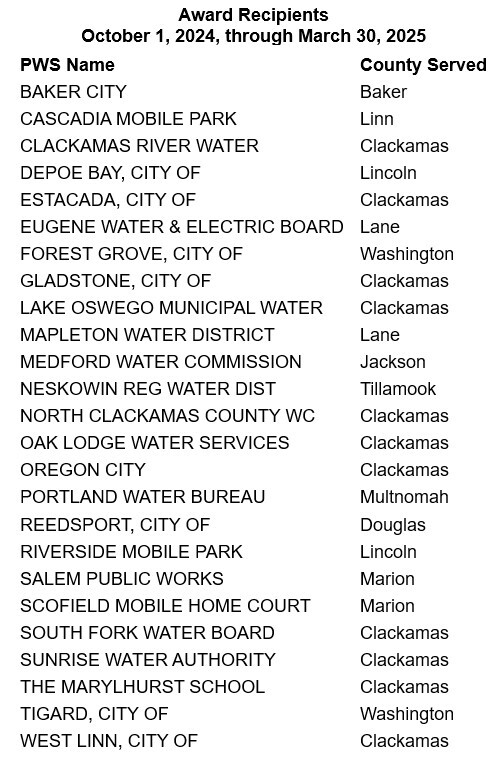
The following public water systems have demonstrated excellence in protecting their drinking water sources from sources of contamination. These systems have implemented risk-reduction strategies within their drinking water source area(s) that can reduce the risk of exposing consumers to contaminated water and potentially reduce water treatment costs. The award may be used to promote customer trust, develop positive customer relations, and build public support for protecting drinking water sources. Congratulations to all!
Want to learn more? Think you may be eligible for the award? Please go here for more information (click on the "Drinking Water Source Protection Award and survey" link), or contact DWS at 971-673-0405 or DEQ at Drinkingwater.Protection@deq.oregon.gov.
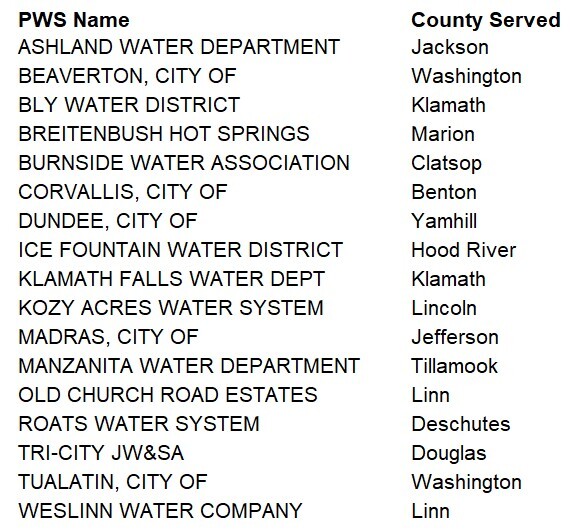
Public water systems achieve Outstanding Performer status when they have no significant deficiencies identified and no unresolved violations, as evaluated during their routine water system surveys. Those that meet the Outstanding Performer criteria have their survey frequency reduced from every three years to every five years.
Below is a list of water systems that have met the established criteria for outstanding performance during the period of October 1, 2024, through April 16, 2025. (Some survey results from that period may still be in the data entry process, so the list may be incomplete.) Drinking Water Services congratulates the operators of these systems for jobs well done!
Go here to find out how to qualify as an Outstanding Performer.
Oregon’s Drinking Water State Revolving Fund (DWSRF) provides low-cost loans to community and nonprofit non-community public water systems for planning, design, and construction of drinking water infrastructure improvements. In addition to low-cost financing and favorable repayment terms, all projects receive part of the loan as principal forgiveness.
Program Updates
- Applications for the Small System Equipment Assistance (SSEA) funding program will once again be accepted with an initial application deadline of August 15, 2025. The purpose of this program is to fund small scale additions or replacement of equipment and instrumentation needed by small water systems to ensure continued operation and protection of public health. Funding will be in the form of forgivable loan at $20,000 max per project, with minimum award of $2,000. Eligible water systems include Community or Non-Profit Non-Community water systems that serve ≤ 300 connections. Visit the SSEA funding webpage for more details, including eligible and ineligible activities.
- The following Letters of Interest (LOI) and applications were received prior to the February 15, 2025, deadline and were rated, ranked and placed on the current project priority list:
- Twenty-two (22) infrastructure project LOIs
- One (1) new BIL Emerging Contaminants application
- Fourteen (14) new Sustainable Infrastructure Planning Projects applications
The Project Priority Lists (PPL) for these projects will be available on the Project Priority Lists and Public Notices webpage during the mandated 10-day public comment period. Posting dates are still TBD. No new Lead Service Line Replacement LOIs were received during the open submission period.
Funding Programs and How to Apply – For more information about each funding program available and how to apply, visit:
-
Infrastructure Funding. This includes project funding through Oregon’s “base” DWSRF and the Bipartisan Infrastructure Law (BIL) General Supplemental programs. Annual Letters of Interest (LOI) submission deadline: February 15.
-
BIL Emerging Contaminants (EC) and Lead Service Line Replacement (LSLR) Funding. Annual submission deadline: February 15.
- To date, OHA Drinking Water Services has received 1,192 service line inventories out of 1,277 required from Community and Non-Transient Non-Community water systems. Out of the 1,192 service line inventories, there are 0 lead lines reported, 31,862 unknown lines reported, and 1,208,155 non-lead lines. View the service line summary here.
- If the water system qualifies, funding is available to help identify unknown service lines through the BIL LSLR funding.
-
Sustainable Infrastructure Planning Projects Funding (SIPP). Twice a year application submission deadline: February 15 and August 15 of each year.
-
Drinking Water Source Protection Funding (DWSPF). Annual 2025 funding applications were accepted between January 27 through March 28, 2025. See DWSPF webpage for status updates or contact Tom Pattee, Groundwater Coordinator, at 541-684-2440 or tom.pattee@oha.oregon.gov for details.
Business Oregon’s Regional Development Officers can assist eligible public water systems with the best funding options in their area.
Questions? Feel free to reach out to OHA-Drinking Water Services at dws.srf@odhsoha.oregon.gov.
Find information about free trainings, webinars and CEUs on the Operator Certification Training Opportunities web page at www.healthoregon.org/dwtraining.
You have received this message because you are signed up for the Pipeline Newsletter group of the Drinking Water Services email list.
Access past issues of the newsletter on the DWS Pipeline web page:
https://www.oregon.gov/oha/PH/HEALTHYENVIRONMENTS
/DRINKINGWATER/OPERATIONS/Pages/pipeline.aspx
Contact Drinking Water Services
info.drinkingwater@odhsoha.oregon.gov or 971-673-0405
See the Drinking Water Contacts web page for updated phone numbers and email addresses
|