OHA response to federal changes
OHA is closely monitoring and planning responses to federal changes that may impact our work. At the end of March, the U.S. Department of Health & Human Services (HHS), through the Centers for Disease Control and Prevention and the Substance Abuse and Mental Health Services Administration, abruptly terminated roughly $117 million in COVID-era grants and funding for OHA programs. This included five grants in the Behavioral Health Division that were planned to fill critical gaps in community substance use treatment, prevention and recovery services, especially for communities of color, young adults and veterans. Earlier this month, Oregon joined 23 other states and the coalition was successful in obtaining a temporary restraining order. However, there are many legal steps ahead, and the final outcome is uncertain.
All BHD partners who receive funds from these grants should have received direct communication from their partners at OHA about next steps. Please reach out to your BHD contract administrator, if you believe you receive funds from these grants, but have not received any communication.
OHA leadership and subject matter experts continue to evaluate administration actions and any impact they have on Oregon. OHA will continue to champion affordable and quality care, and to safeguard essential health freedoms and benefits. There has been and will be no deviation from this mission. For the latest updates, you can check our website on OHA federal response activities.
BHD to hold April 25 listening session on administrative burden, opens survey for written feedback
OHA is partnering with CCO Oregon and NAMI Oregon to facilitate an annual listening session to hear from you, our system partners, about the administrative burdens that you experience in your work. Save the date for an Administrative Burden Listening Session next Friday, April 25, 2025 from 1-3 p.m., on Microsoft Teams, during which BHD leadership will provide updates on efforts to address issues surrounding administrative burden.
You are also invited to provide written feedback in advance of the session through a quick SurveyMonkey. Please complete the survey by end of day next Monday, April 21, so that we can address your issues during the listening session. Thank you for your time and ongoing collaboration in supporting the best behavioral health care we can provide for Oregonians.
Please share this with your provider networks and other partners of interest:
April 25, 2025, 1-3 p.m. Listening Session:
Meeting ID: 215 133 161 142
Passcode: Wz3bj9Ar
Dial in by phone
+1 971-277-2343,,974563164# United States, Portland
Phone conference ID: 974 563 164#
Monitor progress on OHA Strategic Plan goals
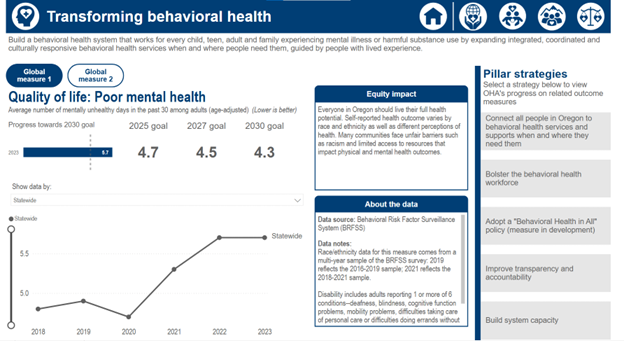
Earlier this year, OHA launched a new interactive tool that allows the public to explore our progress toward the measures and outcomes outlined in OHA’s strategic plan. For BHD, developing the Transforming Behavioral Health goal and internal strategic planning to guide organization of governance and policy work has helped us be more intentional about outcomes-focused monitoring.
We are tracking Oregonians’ quality of life, as measured by poor mental health days, calculating the unmet substance use disorder treatment need, advocating for increasing the supply of licensed behavioral health providers, and examining emergency department visits and mortality data, among other efforts. We know that if we improve Oregon’s performance in these areas—and reduce the disparities within them—we will see cascading positive effects on other health indicators across our communities. These efforts will move Oregon closer to our 2030 goal of eliminating health inequities in our state.
If you have questions about the dashboard, email oregonhealthforward@oha.oregon.gov.
BHD leaders testify on residential treatment capacity in Oregon Legislature
In alignment with Gov. Tina Kotek’s support of investments to build behavioral health system capacity, BHD Director Ebony Clarke and Deputy Director for Operations & Strategy Jon Collins recently testified at the House Committee on Behavioral Health and Health Care on House Bill 2059, which would add $90 million in funding to increase residential capacity. After noting critical gaps through the Residential+ Facility Study, Clarke and Collins highlighted that the funding could create an additional 336 treatment beds in the state, including 26 youth residential psychiatric beds, continuing the state’s recent investments in the behavioral health continuum of care. HB 2059 passed unanimously out of committee and was subsequently referred to the Joint Committee on Ways and Means. Clarke and Collins’ presentation can be viewed at 1:32:00 in the recording from the March 25 committee meeting.
This bill is among the 3,000+ reviewed by BHD this session. As the Legislature passes the halfway point to sine die, BHD is continuing to advocate the need to sustain and build on progress. Next week BHD leadership will also present at the Joint Committee on Ways and Means on progress toward improving behavioral health outcomes and infrastructure, highlighting the importance of sustained focus and investment in this work.
ROADS is live: A new era for behavioral health data in Oregon
The Compass Data Systems and Office of Data Strategy and Operations is thrilled to announce that the Resilience Outcomes Analysis & Data Submission (ROADS) system officially launched on March 11! Years of hard work, vision and dedication went into making this project a success — and we’re excited to see it in action.
ROADS replaces the legacy Measures and Outcomes Tracking System (MOTS) and is now Oregon’s official system of record for behavioral health and substance use disorder treatment data. It represents a significant step forward in our ability to collect, manage and make use of behavioral health data across the state.
Built on a modern, scalable platform, ROADS offers greater flexibility for future data collection, allowing OHA to respond more nimbly to the evolving needs of the Legislature, the Governor’s Office and the communities we serve. This new system positions us to break down data silos, expand our understanding of behavioral health outcomes and close equity gaps — key priorities of OHA.
We're especially excited about several improvements ROADS brings:
- More intuitive dashboards and enhanced system administration
- Increased ability to filter and sort data for more meaningful insights
- Improved data extraction so organizations can access exactly what they need
- Easier integration with Electronic Health Record systems, reducing manual data entry for providers
As part of the larger Compass data ecosystem, ROADS helps us center person-level data and deepen our ability to drive meaningful change in behavioral health outcomes across Oregon.
To learn more about ROADS, including additional resources, FAQs and newsletters, visit the ROADS website.
|