|
 |
|
In this issue: |
|
|
The 2025 United States’ measles outbreak is on pace to be the largest since measles was declared eliminated in the U.S. in 2000. To date, 22 states have reported more than 600 measles cases this year (including the newest cases reported in Indiana just this week), largely from a single outbreak straddling Texas and New Mexico. Over the past 30 years, only 2019 had a higher national measles case count by this time of year—with 704 cases reported by the end of April and 1,274 by year’s end.
The age group most affected by measles this year is children ages 5-19—accounting for 40% of all cases.
While we haven’t seen any measles cases in Oregon yet this year, public health officials are urging families to make sure all children are up to date on measles vaccination (MMR). Two doses of the MMR vaccine provide 97% protection against measles. The first dose is generally given to babies at 12-15 months old, and the second between ages 4 and 6 (but can be given as soon as one month after the first.)
Learn more about the MMR vaccine, including the spread and health risks of measles, here.
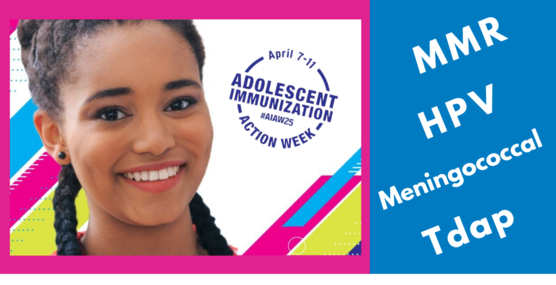
This week is Adolescent Immunization Action Week, a yearly observance aimed at raising awareness around the importance of adolescent immunizations that help protect teens against diseases and infections. In addition to MMR vaccination, the Centers for Disease Control and Prevention recommends:
-
Human Papillomavirus (HPV) vaccination, preferably at ages 9-12 to help protect from HPV-related cancers in adulthood.
-
Tetanus/diphtheria/pertussis (Tdap) booster, preferably at ages 11-12. (In Oregon, a Tdap booster is required before starting 7th grade.)
-
Meningococcal vaccination at age 11, and again at age 16.
Immunization resources for teens and young adults can be found here. To learn more about these and other recommended and required child and adolescent immunizations in Oregon, visit our website.
|
|
If you know someone doing an “exemplary job or going above and beyond to promote or foster immunizations in their communities,” nominate them for Oregon’s 2025 Immunization Champion award! Each year, the Association of Immunization Managers (AIM) honors someone from each state and U.S. territory for their dedication to immunizations. People can be recognized for their work in childhood, adolescent, or adult vaccines, and new this year—staff from local public health authorities and other local government-funded organizations are eligible for nomination.
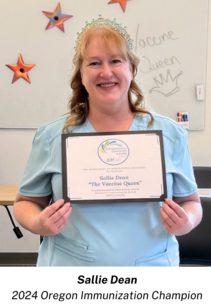
Last year, vaccine manager of Aviva Health in Roseburg Sallie Dean (the “vaccine queen”) earned the title of Oregon’s Immunization Champion for her efforts to spread vaccine positivity and accessibility throughout rural Douglas County. (See all 2024 honorees here.)
If Sallie’s story reminds you of someone, consider nominating them for the 2025 award. You can also nominate yourself! Candidates will be evaluated on leadership, innovation, collaboration and advocacy.
Eligible nominees work at the local level and may include:
- Health care professionals (i.e., pharmacists, physicians, nurses, physicians’ assistants, nurse practitioners and medical assistants)
- Nonprofit leaders or community activists
- School and education leaders, or parents
- Community-based-organization (CBO) members
- Coalition members or immunization partners
More information, including all eligibility criteria and the nomination instructions/form can be found here. Send nominations and any questions to Nora Zimmerman at nora.zimmerman2@oha.oregon.gov. You can also print out the nomination form and mail it, including all required nomination materials, to Oregon Immunization Program; Attn: Nora Zimmerman; 800 NE Oregon St. Suite 370; Portland, OR, 97232.
Nominations will be accepted until Thursday, May 15, and awards will be announced during National Immunization Awareness Month in August.
|
|
|
 |
|
Health notes |
|
|
A 1996 voter-approved program to prevent and reduce tobacco use in Oregon is working.
The work of OHA’s Tobacco Prevention and Education Program (TPEP), coupled with hikes in tobacco prices, has resulted in a 46% drop in adult smoking rates and a 70% drop in per-capital cigarette sales over the past 25+ years, according to a new report.
Key to this momentum has been the robust collaboration with community partners to further reduce tobacco-related harm and promote health equity across the state. For example, AntFarm is a community-based organization in Clackamas County that mentors youth to quit tobacco. This brief video highlights the group’s work.
TPEP also invests about 65% of its funding directly into local communities, supporting culturally relevant prevention and quitting programs.
The TPEP program’s long-term success has been an uphill battle. The program’s current annual budget amounts to about a quarter of what the tobacco industry spends each year to reach every community in Oregon to promote and sell its products. Additionally, the industry focuses its advertisements, discount offers and store displays directly toward specific groups: people facing systemic racism and discrimination, people who are stressed or struggling, people with lower incomes, people living with mental illness or addition, and youth.
Tobacco use remains the leading cause of preventable death in Oregon, claiming more than 8,000 lives each year and contributing to chronic diseases such as cancer, heart disease and diabetes.
However, as the 2023-25 Tobacco Prevention and Education Program report shows, Oregon’s close partnerships with communities and Tribes, public awareness and education efforts, and support to help people quit are taking Oregon in the right direction.
|
Five years after the COVID-19 pandemic upended the world, Oregon’s efforts to keep people covered have helped about 83% of Oregon Health Plan (OHP/Medicaid) members keep their benefits. The joint effort between OHA and Oregon Department of Human Services (ODHS) wrapped up at the end of February. A summary of this success can be found here.
OHP (managed by OHA) covers health care for nearly 1.5 million people in Oregon — including a third of the state’s adults and half of its children. ODHS helps people apply for benefits, determines applicant eligibility and provides maintenance of benefits through redeterminations.
Some highlights of Oregon’s COVID-19 Federal Public Health Emergency Unwinding Project results include:
- 1,169,042 OHP members (80.3%) kept their full benefits.
- 40,563 people (2.8%) had benefits reduced. While these members lost full OHP coverage, they were able to continue Medicare Savings Programs, which help pay Medicare costs, or a dental-only Medicaid benefit.
- 85% of Black or African American, Hispanic or Latino, and American Indian or Alaska Native people in Oregon kept their benefits, as did 83% of white people, 81% of Asians, Middle Easterners or North Africans, and 80% of Native Hawaiians or Pacific Islanders.
- 247,104 people (16.9%) were found ineligible and ended benefits.
- 130,000 people who lost OHP coverage were referred to the Oregon Health Insurance Marketplace to get private health insurance.
The full, detailed report be found here.
|
|
 |
|
OHA answers your questions |
|
|
Questions are answered by experts at OHA, other state agencies or community partners.
Q: I had the two doses of the Shingrix vaccine in 2018 for shingles. I'm 77 year old. Does its effectiveness wane? Should I have another dose, or CAN I have another dose? – Elizabeth, Salem
A: The immunity from Shingrix has been shown to last for many years. No additional doses are recommended, and we doubt that your insurance would cover more than the recommended two doses. Good job getting vaccinated!
People ages 50+ are recommended to receive two doses of Shringrix regardless of whether or not they’ve had shingles, or if they've received the previous shingles vaccine (Zostavax) or a chicken pox vaccine. Adults ages 19+ with weakened immune systems are also recommended to get two Shingrix doses. Learn more here.
Q: I quit smoking cigarettes but now vape. I can’t quit but I’m wondering if this change makes a difference at least. – Kole, Silverton
A: Congratulations on quitting cigarettes – that’s a huge accomplishment! If you have the strength to do that, you have the strength to quit vaping, too. While it’s true that e-cigarettes don’t include all the contaminants in cigarettes, it still isn’t safe. Here are a few reasons why:
- Vaping products are not regulated and often contain higher amounts of nicotine than traditional cigarettes.
- Nicotine can impact your brain – your ability to focus, your mood, impulse control and make it harder to learn – all of which are still developing before age 25.
- E-cigarettes can contain harmful substances, including cancer-causing chemicals, heavy metals, and tiny particles that can be inhaled deep into the lungs.
- Flavorings like diacetyl, used in vaping products, are linked to a serious lung disease. Some flavorings used in e-cigarettes may be safe to eat but not to inhale because the lungs process substances differently than the gut.
Quitting is different for everyone, so there are a variety of free options across Oregon. You can get free counseling to quit vaping with a coach by visiting the Oregon Tobacco Quitline, calling 1-800-QUIT-NOW, or texting “READY” to 34191. The Quitline coaches will support you with creating a quit plan, accessing nicotine replacement therapy, and connecting you with local resources. You can also learn how to quit in your own way, with or without the help of a coach, by visiting our Smokefree Oregon website.
If you have questions about health topics in Oregon, submit your question here. Although we are unable to answer every question, we try to address those of interest to a broad audience. Please understand that we are unable to provide specific medical advice for personal medical conditions.
|
|
|
|
|