|
 |
|
In this issue: |
|
|
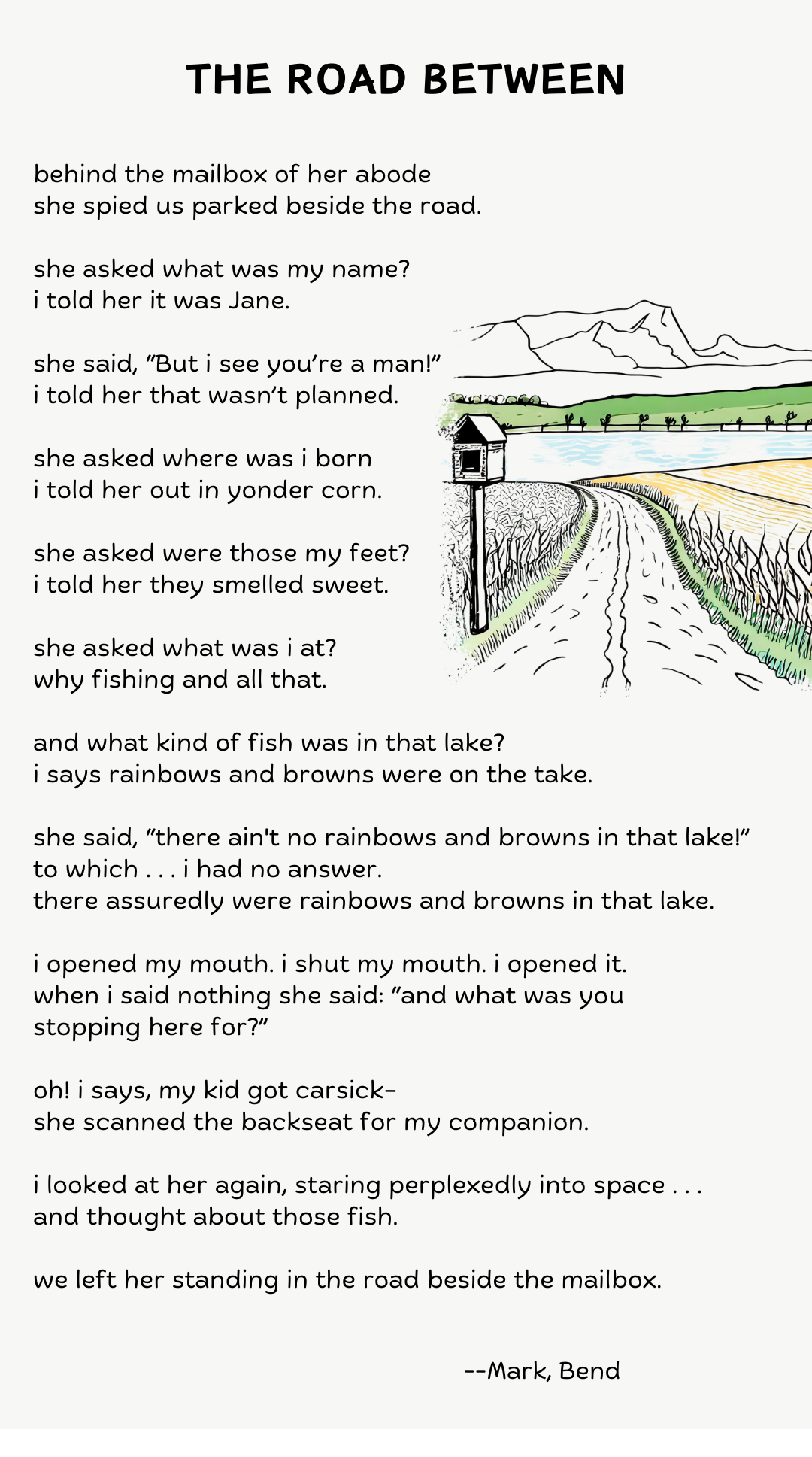
To celebrate National Poetry Month, we are again inviting readers to submit original poetry, some of which we will feature in future newsletters.
Last year we asked for poetry about mental wellness, and we are overwhelmed with gratitude at the volume and thoughtfulness of your submissions. This year we want to broaden the subject matter to health, in general, be it mental health or physical health.
This can mean so many things!
Doctor visits, insurance, medications, medical mysteries, injuries, therapy, work-life balance, healing, pain, birth, death, nutrition, loneliness, managing or overcoming an illness, aging, and on and on. We encourage you to explore all aspects and perspectives!
And while we doubt poetry can help mend broken bones, we know it’s good for your mental health. Expressing yourself through poetry (and reading it) is a form of mental healing that humans have practiced for centuries. Revisit Poetry Promotes Mental Healing, our story about the benefits of poetry therapy.
Please submit poetry by the end of April, and thank you!
|
|

After years being on a pandemic hiatus, a live music concert series at Oregon State Hospital (OSH) is reborn! The concerts are designed to build community, normalize gatherings and experiences that patients may be exposed to when they return to their communities, and yes, to entertain.
The shows feature musicians from across Oregon who connect with their audiences through their music and stories about how music has affected their own wellbeing. For example, Portland-based percussionist and flutist Papi Fimbres (pictured right) told the audience at OSH’s Salem campus in March how music changed his life after his mother encouraged him to play music at a very young age to steer him away from the gang culture of his older siblings in their Los Angeles community.
The concerts serve as an extension to the hospital’s music therapy program, which helps patients reach their personal goals through musical interventions such as learning or writing songs, playing instruments, or even just listening to and talking about music.
You can learn more about this story in the current issue of Recovery Times, the hospital’s quarterly online newsletter. Other stories featured in this issue include an interview with an OSHU psychiatrist who recently completed a six-week rotation at OSH, the 10-year anniversary of OSH’s Junction City campus, and a year-long fundraising “knitting drive” inspired by the “watch cap” style of hat worn by Jack Nicholson in the film One Flew Over the Cuckoo’s Nest.
|
|
|
 |
|
Health notes |
|
|
|
OHA is aware that some people ages 65+ are running into problems at pharmacies getting a second dose of the 2024-2025 COVID-19 vaccine if they haven’t waited a full six months after receiving their first dose.
For clarification, the recommendation from the Center for Disease Control and Prevention (CDC) states that people ages 65+ are eligible for a second dose of the 2024-2025 COVID-19 vaccine six months after receiving the first dose, but that it’s OK if someone wants to get it as soon as two months after. People are not required to have a prescription.
From the CDC: While it is recommended [for people ages 65+] to get 2024-2025 COVID-19 vaccine doses 6 months apart, the minimum time is 2 months apart, which allows flexibility to get the second dose prior to typical COVID-19 surges, travel, life events, and healthcare visits.
Although the Oregon Board of Pharmacy (OBOP) protocol (which every pharmacist licensed in the State of Oregon must follow) reflects the CDC’s recommendation, we have determined that some pharmacies in Oregon may be misinterpreting the protocol. As a result, they are not offering the second dose to some people, and in some cases requiring a prescription.
Rest assured the OBOP is aware of this issue and will work to increase awareness by reminding its licensees to follow board-approved protocols when providing vaccines, or patient care services.
We thank you, our readers, for sharing these and other problems you may encounter when trying to access health care. When possible and appropriate, we will try our best to help.
|
|
 |
|
OHA answers your questions |
|
|
Questions are answered by experts at OHA, other state agencies or community partners.
Q: If we drop significantly below herd immunity for measles in the coming years, what is the risk to older people, say, someone born about 1962 who never caught the measles, who was vaccinated only as a small child and has the typical risk factors of older Americans? Is there research that tells us whether these unexposed, older adults will need to be vaccinated again? – Mabel, Bend
A: A good question. Because measles was nearly universal at that time, we presume that people born before 1957 have had measles (whether they remember it or not) and are therefore immune for life. Someone born in 1962 who never had the measles, however, may have some vulnerability for a couple of reasons. One—when the measles vaccine was introduced in 1963, it was a one-shot deal, and the need for a second dose (boosting effectiveness from 93% to 97%) wasn’t recognized until around 1990. And two—one of the two measles vaccines available in those early years was not very effective, and the immunity it provided did not last very long. That vaccine was discontinued in 1968.
Although the CDC data don’t address this question head-on, of 338 cases reported in the U.S. from Jan. 1, 2020, to March 28, 2024, only four have been 50 years old or older. So the risk in middle-aged and older adults is very low indeed. At the same time, most of the cases during this time had either been traveling to regions of the world where measles had been spreading, or had a contact who had. So, if you’re an adult born during or after 1957 and planning to travel to such a region, we recommend you make sure you’ve received a total of two doses of the MMR vaccine at some point in your lifetime, given at least one month apart, before traveling. The same goes for if you’re exposed to measles here, in the U.S.
Certainly, if measles becomes endemic here again (occurring regularly), we’ll see more cases among older adults.
Q: Hello, I keep reading about the measles and different shots for different people ages and such. But nowhere have I seen it mentioned that adults who are presumed immune either through infection or vaccination should get their vaccine titers checked. My friend had hers checked with her primary care doctor for other reasons and found that she had no immune reaction to measles any longer. She is only 35! She had the two-shot series when she was a kid. What would be your recommendation for me? I also had the two-shot series when I was a kid. – Marie, Dallas
A: If your friend had two doses of measles vaccine as a child, she’s highly likely to be protected – even if she no longer has detectable antibodies in her blood. The vaccine will induce immune “memory” so that if she’s exposed, she’ll rapidly mount a response. So, we don’t recommend re-vaccination for her.
There aren’t many reasons to get your measles titer checked. If it’s positive, it means you’re protected, but as noted above, you may be protected even if your antibody levels have fallen off – so a negative result doesn’t really tell you much. If you’ve been exposed and you’re not sure whether you’ve been vaccinated, we’d usually recommend that you just get vaccinated now. The only people for whom we’d recommend checking a titer are those who have been exposed to measles, aren’t sure whether they’ve been vaccinated and can’t be vaccinated now (because they’re pregnant or severely immune compromised) or are under 6 months old.
If you have questions about health topics in Oregon, submit your question here. Although we are unable to answer every question, we try to address those of interest to a broad audience. Please understand that we are unable to provide specific medical advice for personal medical conditions.
|
|
|
|
|