|
Clinton's Story - Engaging Fathers in Home Visiting
Clinton Boyd, Jr., Ph.D., is a postdoctoral associate at the Samuel DuBois Cook Center on Social Equity at Duke University, where he studies fatherhood. He is also a former home visitor who worked with fathers in Atlanta, GA. In the videos linked below, he shares his personal experiences and knowledge on how home visiting programs can better engage fathers.
Introducing National Home Visiting Week
The inaugural National Home Visiting Week (NHVW) will take place April 21-25, 2025, an observance to celebrate and recognize home visitors and the positive impact they make on maternal and child health outcomes.
The Institute for the Advancement of Family Support Professionals, an organization focused on strengthening home visiting and human service programs across the country, is collaborating with nonprofit partners and elected officials to organize the event. NHVW garnered bipartisan support as U.S. Senators Chuck Grassley (R– Iowa) and Mark Warner (D–Virginia) issued a proclamation to highlight the importance of home visiting.
The last full week of April (Monday-Friday) is reserved for National Home Visiting Week for years to come!
New How-to Videos to Help People Manage Their ONE Online Accounts
The Oregon Department of Human Services released three new how-to videos for assisting individuals with identity verification and account access issues for their ONE Online benefits management account, available in English and Spanish. Read more here...
Upcoming Oregon Health Authority Sponsored Learning Series:
Caregiver Depression Screening
This session will provide an overview of perinatal mental health conditions, review the use of the PHQ-9 tool, describe resources and support home visitors to build skills and confidence to engage caregivers in depression screening and referral.
Intimate Partner Violence Screening
This session will provide an overview of intimate partner violence (IPV), describe resources and methods for supporting those experiencing or at risk of IPV and spend the bulk of our time supporting home visitors to build skills and confidence to engage caregivers in IPV screening and referral.
Introduction to Harm Reduction
This session will seek to increase knowledge of the fundamentals of harm reduction as a philosophy, social justice movement and a set of potentially lifesaving strategies. We will share state and local resources for accessing harm reduction supports and identify substance use-related issues unique to pregnant and parenting people.
Oregon Parenting Educators Training Academy
Spreading HOPE Healthy Outcomes from Positive Experiences
With Amanda Winn, Director of Training and Technical Assistance with the HOPE National Resource Center at Tufts Medicine
This workshop will offer practical guidance in implementing a strengths-based approach that identifies, celebrates, and promotes access to key Positive Childhood Experiences critical to the health and thriving of all children. We will review the research behind Positive Childhood Experiences, how that research led to the development of the HOPE (Healthy Outcomes from Positive Experiences) Framework, and what individuals can do to create a village that prioritizes equitable access to the Four Building Blocks of HOPE to promote resilience for all children.
The final 30 minutes of this special extended training will include sharing and Q&A with additional child abuse prevention resources.
Spanish interpretation is available during the live event.
Free Webinar: Fostering Preschoolers’ Focus and Attention: The Pre-Internet Mindset by Rebecca Rolland, EdD
In a world dominated by screens and constant digital stimulation, how can early childhood professionals help children—and themselves—reclaim the ability to focus, connect, and think deeply? Drawing on recent neuroscience research, clinical practice, and her work as a Harvard lecturer and speech pathologist, Dr. Rebecca Rolland explores the transformative power of the pre-internet mindset.
This webinar will provide actionable strategies for fostering deep presence, single-tasking, and meaningful engagement with children. You will learn how to create environments that nurture attention, creativity, and authentic connection, while balancing the realities of modern technology. Whether you’re an educator, caregiver, parent, or therapist, this session will equip you with tools to help children thrive in a distracted world—and to rediscover your own capacity for presence.
Free Webinar: Advocacy with Pregnant Survivors
The National Center to Advance Peace for Children, Youth, and Families presents the second webinar in a four-part series on child custody: Advocacy with Pregnant Survivors. This webinar, including speakers from Caminar Latino and the National Health Resource Center on Domestic Violence at Futures Without Violence, is designed for those supporting pregnant survivors and their families as they navigate the healthcare, child welfare, and legal systems.
2025 HOPE Summit
The HOPE Framework has transformed the way we are able to support children’s growth into healthy, resilient adults.
Join us at the 2025 HOPE Summit as we dive into the practical steps for reimagining care and driving real change!
Center for Coordinating Oregon Home Visiting Systems (CCOHVS) Updates:
2025 Oregon Parenting Educators Conference - CCOHVS Presentation
Title: Strengthening Oregon’s Early Childhood Home Visiting System through Family Leadership
Presenters: Beth, Callie, Kristin, Rebecca, Ron
Description: The CCOHVS will be presenting at the OPEC Conference on how we can build a more family-driven home visiting system. This session will explore ways to uplift family voices, from direct interactions to shaping statewide early childhood home visiting policies. We will share insights from our latest report, Oregon’s Early Childhood Home Visiting System Landscape highlight community-driven strategies, and engage in discussions on actionable recommendations for change. Participants will leave with a deeper understanding of the importance of family leadership and practical ideas for fostering meaningful family engagement in their work.
When: Monday April 28, 2025, from 1:15pm to 2:30pm
2025 Oregon Parenting Educators Conference - HV Wellbeing Session
Title: Examining the Wellbeing of Oregon's Home Visiting Workforce & How Organizations Can Improve Support
Presenters: Nicole Lauzus (PSU) and Nelda Reyes (AB Cultural Drivers)
Description: This workshop will share findings from two projects focused on understanding the well-being of Oregon’s home visiting workforce. The first is a statewide survey developed with input from home visitors and supervisors, while the second is a qualitative study exploring effective strategies to support Oregon’s Latin/o/x home visitors. We will highlight workforce strengths, including high job satisfaction driven by the passion home visitors bring to their work, as well as the need for greater support due to high levels of stress and burnout. Participants will learn about key factors influencing well-being, such as peer support, organizational climate, and leadership and engage in discussions on strategies to enhance workforce support.
When: Tuesday April 29, 2025, from 3:15pm to 4:30pm
Hub Directors - Presentation
The CCOHVS team met with Early Learning Hub Directors to express appreciation for their insights on their regional early childhood home visiting (ECHV) systems that greatly influenced Oregon’s Early Childhood Home Visiting System Landscape Report and shared next steps from the report’s recommendations. The directors shared how they see their role in state ECHV efforts and how the state can support their regional ECHV work.
Monitoring Federal Changes and Any Impacts on Oregon
Every change in federal administration carries potential impact on Oregon and, like other health agencies across the country, OHA is monitoring these changes closely.
At this time, no changes have been made to health programs OHA administers, including Oregon Health Plan and Healthier Oregon.
Visit this page to see updates on several key topics.
Civil Rights Sanctuary Promise Toolkit
This toolkit (Spanish version found here), created by the Civil Rights Unit of the Oregon Department of Justice, covers the essential information needed to understand, report, and combat violations of Oregon’s Sanctuary Promise Laws. It includes steps families can take to prepare themselves for encounters with federal immigration authorities, and a variety of ways home visitors can support immigrant community members. We recommend reviewing the resource and sharing it with your clients.
Parents helping parents: Reach Out Oregon Warmline
Reach Out Oregon is a warmline operated by the Oregon Family Support Network (OFSN). (These real-life stories are examples of ways the warmline supports Oregon families and are not the family members’ actual names.)
Liz is a single mother of two children. Although she has always faced challenges in managing bills, she now feels more anxious than ever about meeting the essential needs of her family.
Camila is raising two grandchildren with autism spectrum disorder and Attention-Deficit/Hyperactivity Disorder (ADHD). She believes she has accessed all available youth services, but she wonders if there are additional supports for her. Sometimes, she says, she just needs someone to talk to about how isolating and difficult her life has become.
Robert and Jocelyn are parents of a teenager whose behavior is becoming increasingly concerning. Recently, their son Cooper damaged the windshield of the family car with a baseball bat. He has also expressed thoughts of not wanting to be alive. The parents feel overwhelmed and frustrated, especially since they believe their concerns are not being taken seriously. “We’ve taken Cooper to the emergency department when he says he’s going to hurt himself or someone else. They send us home once he calms down, even though we tell them the behavior will continue as soon as we leave. What are we supposed to do if no one will listen to us?”
Liz, Camila, Robert, and Jocelyn all have something in common:
They reached out to OFSN’s Warmline, Reach Out Oregon, unsure if it was the right place to turn for support in their situations.
It was.
“At Reach Out Oregon, we provide support in both English and Spanish from parents who have lived through similar experiences and are trained as family support specialists. We believe every family has the right to be heard and respected. We’re here to listen, help connect you to resources, or simply walk alongside you through your parenting journey. We understand because we’ve been there,” says Wendy Warren, Warmline Specialist. “Whether you prefer to call, email, live chat, or text, let’s talk, parent-to-parent.”
To connect with Reach Out Oregon:
Practices for Promoting Home Visitor Wellbeing
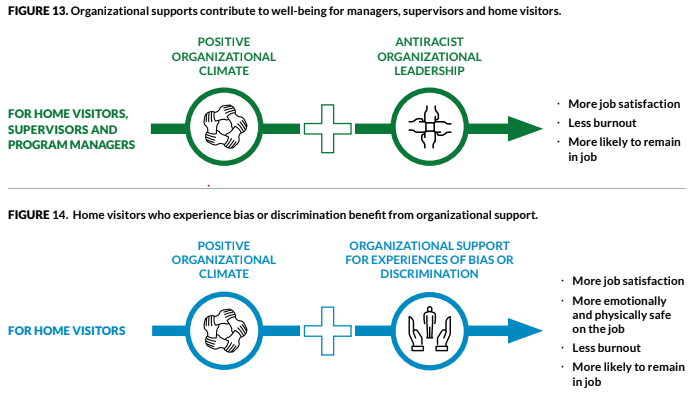
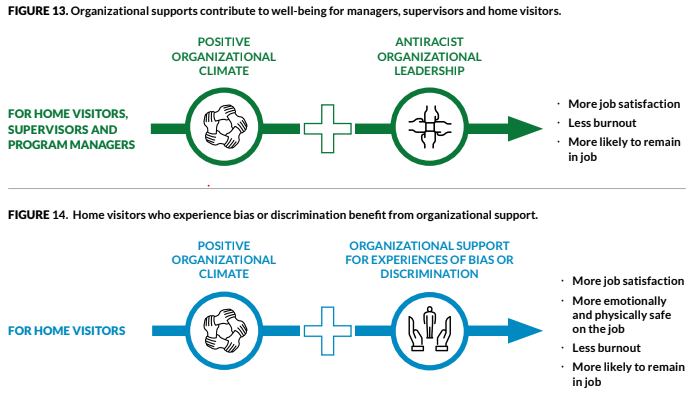
The excerpt below is from the PSU Learning Brief, "Supporting Well-Being for the Home Visiting Workforce: Organizational Supports for Experiences of Bias & Discrimination"
"First, for all survey respondents — including home
visitors, supervisors and program managers — it was
important to have strong antiracist leadership as well as
a positive organizational climate. Members of the home
visiting workforce who had experienced these supports
were significantly more satisfied with their jobs, less
burned out from their work and less likely to indicate
they intended to leave their positions (see Figure 13).
Second, for home visitors only, knowing where to go
for support if they experienced racism or bias from a
family member or coworker also added value to their
well-being. Those who reported a positive organizational
climate as well as feeling supported through experiences
of bias or racism were more satisfied with their jobs, less
burned out, and less likely to say they intended to leave
their jobs. These home visitors also reported feeling more
emotionally and physically safe on the job (see Figure 14)."
Access the full brief in English or Spanish.
Nurse Home Visiting and MIECHV teams, please help us keep our contact lists current by submitting any workforce updates using the link below. We use this when planning for professional development opportunities and communicating important messages. You may also share any staff vacancies you’d like us to promote in next month’s newsletter!

This month, we're highlighting Pamela Ferguson, Home Visiting Systems Manager, Public Health Division, OHA. Pamela's role is to lead/mentor/develop two teams: the MIECHV grant program team and our Babies First! and Nurse-Family Partnership State Nurse Consultant team.
-
What is one thing you love about your job: I love making a difference in our communities by the work we do to support children and families through home visiting!
-
What song are you playing on repeat? Down by the Water by Abigail Lapell (Album: Getaway)
-
Where is your happy place? Sitting outside on our back deck with the fire pit on, doggy by my side, blue skies overhead.
|
 |
- TAKE A MOMENT Look around and reflect on the day.
- IDENTIFY ONE THING Recall one thing that was difficult today. Let the feelings be present for a moment...then allow them to pass by you and be released.
- FIND THREE THINGS Think of three things to be grateful for about your workday. It can be a patient’s smile, a colleague’s help or a deep breath you took.
- ACKNOWLEDGE Today may have been hard, but it’s not forever. Breathe.
- ARE YOU OK? Really ok? Don't struggle in silence. Connect with someone.
- LOOK AT YOUR COLLEAGUES Are they ok? Don’t let them struggle either. Be their support.
- BREATHE With a renewed breath, head home to reset and recharge.
Find the printable Before You Go Checklist here.
Trees are good at networking because they know how to branch out! 
|
|