|
 |
|
In this issue: |
|
|
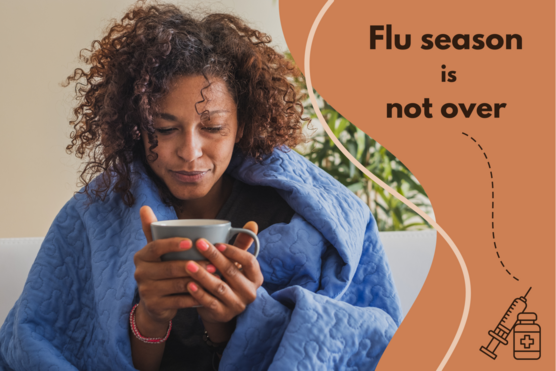
Oregon’s 2024-2025 flu season is the worst since OHA began tracking the seasonal virus 15 years ago, and it’s not over. People continue to be hospitalized with the flu, at a time of the year when Oregon flu activity traditionally begins to wind down. Late season surges are not uncommon, and Oregon's flu season usually lasts well into April, sometimes May or even June.
So if you haven’t gotten your flu vaccine yet this season, it’s not too late!
Everyone ages 6 months and older is recommended to get an annual flu shot, which can be found at your health care provider’s office, pharmacies, county health departments and many neighborhood clinics. There are also 87 School-Based Health Centers (SBHC) in 28 Oregon counties where students can be vaccinated at no cost, even if they don’t have insurance. Some SBHCs may also serve siblings, families and community members.
OHA data show that fewer people are getting flu shots; vaccinations are down 4% from last year and have been steadily dropping since 2022.
Certain groups, including older adults, young children, pregnant people and people with certain health conditions are at higher risk for serious complications from influenza. The hospitalization rate is highest for people 65 and older. Additionally, the Centers for Disease Control and Prevention (CDC) reports that, as of March 1, there have been 114 pediatric deaths associated with the flu in the U.S. during the 2024-2025 season. Two of those pediatric deaths occurred in Oregon.
Learn more about the flu and flu prevention here.
You can monitor Oregon’s flu activity on OHA's interactive Respiratory Virus Dashboard, updated weekly. You can also stay informed by subscribing to our weekly FluBites newsletter.
|
|
|
Click image to watch Xavier tell his inspiring story.
In May 2022, Xavier began to feel sick, and then became unexpectedly disabled. Unable to continue working, his debts piled up, including unpaid rent. He worked with AllCare, a coordinated care organization (CCO) that provides health care to Oregon Health Care (OHP/Medicaid) members in southern Oregon. Thankfully, Xavier qualified for new OHP housing benefits and, with help from other housing resources, he was able to get caught up on his overdue rent payments.
“Without this, I’m quite sure I would have been homeless,” said Xavier. “This program gave me a new lease on life.”
Four months ago, Oregon became the first state in the nation to begin offering rent assistance as a statewide Medicaid benefit. Rent assistance is one of several new housing benefits available for eligible OHP members with certain health conditions and who meet additional requirements.
Research shows that adults facing potential homelessness, including threat of eviction, are:
-
19% more likely to lack access to a primary care provider, and
-
35% more likely to postpone preventive health care even if they have chronic health conditions.
The new benefits are part of Oregon’s effort to test how addressing basic needs, such as housing and nutrition, can improve the health of Oregonians. OHA’s community partners throughout the state are already sharing success stories like Xavier’s.
Watch this video for more on Xavier’s inspiring story.
The new OHP housing benefits are not meant for emergencies, such as imminent evictions, and not all OHP members will qualify. Visit the housing benefits web page to learn more..
|
|
 |
|
Health notes |
|
|

OHA is pleased to announce that we are partnering with The Trevor Project during the spring months to offer allyship training for individuals working with youth, as well as family and friends interested in learning.
This training is designed to create dialogue around being an ally for LGBTQ+ young people. We will learn about common LGBTQ+ terminology, understand the "coming out" process, and the challenges LGBTQ+ youth face at home, in school and within the community.
The training is live and virtual, and there are three options for participating. People are welcome to attend more than one session.
To register, select the date below you would like to attend.
The training will be led by Kyle Teller, PhD, public training manager at The Trevor Project. If you have questions about this training, reach out to The Trevor Project's Public Training team at education@thetrevorproject.org.
|
|
|
 |
|
OHA answers your questions |
|
|
Questions are answered by experts at OHA, other state agencies or community partners.
Q: I know I need to wait six months for my next COVID-19 shot. In my case it will be the end of March. Will the COVID shots available be updated again, or will they be the same formula I received before? – April, Eugene
A: Sandra, the additional dose(s) of the 2024-2025 COVID-19 vaccine available to people ages 65+ or those with compromised immune systems are exactly the same as those available last fall and throughout the 2024-2025 respiratory virus season. However, we do expect COVID vaccines may be updated with a new formula next fall for the 2025-2026 season.
Q: I am a 67-year-old woman who, as a child, had mumps and was vaccinated for measles and rubella. Do I need an MMR booster (measles, mumps and rubella)? I am overweight, diabetic, asthmatic, and I just had open heart surgery. – Claudia, Gaston
A: Claudia, one dose of measles-containing vaccine is recommended for persons of your age. However, if you got it during 1963-1968, you might have gotten a formulation (“killed” or “inactivated” vaccine) that was less effective, and you can consider getting the current MMR vaccine. The other measles vaccine available to you at that time was very effective and should protect you for life. If you have your original vaccination records, you can show it to your provider who can tell you which version you got. Alternatively, if you want to play it safe, getting one dose of today’s MMR vaccine is perfectly fine.
We don’t recommend additional doses based on the underlying conditions you mention.
Q: Is the Texas measles outbreak “rubella” or the other measles? I had rubella in the 1970s here in Portland, as an 11 year old. I was immunized for the other during childhood. Which measles is this? – Jennifer, Portland
A: We know, it can be confusing! The scientific term for measles is actually “rubeola” (pronounced “roo-be-OH-lah”) which is circulating in Texas and New Mexico right now. Cases in the U.S. are imported from abroad regularly, and sometimes cause outbreaks.
Rubella, however, is the scientific term for German measles, which is pronounced “roo-BELL-ah.” Rubella is associated with birth defects and was eliminated from the Americas in 2009. We almost never see rubella in the U.S. anymore, and if we did, it would be a big deal.
If you have questions about health topics in Oregon, submit your question here. Although we are unable to answer every question, we try to address those of interest to a broad audience. Please understand that we are unable to provide specific medical advice for personal medical conditions.
|
|
|
|
|