|
|
Leer en español
Welcome to the newest edition of the Oregon Health Plan (OHP) 1115 Medicaid Waiver newsletter.
In this Issue:
|
|
|
In the October 14 newsletter we encouraged you to re-register for All Come and Para Todos webinars. We explained that due to staff changes the old links would no longer work. Unfortunately, those newsletters included the old links. If you re-registered using those links, please do so again with the links below. After you’ve registered with the corrected links, you’ll receive a confirmation email from Damaris Perez. If you have a registration from Trevor Stratz, you have the old registration.
Here are the latest registration links:
The 1115 Medicaid Waiver All Come and Para Todos webinars are monthly opportunities to get status updates related to the implementation of the waiver. They take place on the second Wednesday of each month. All Come will be hosted in English from 10 – 11 a.m., and Para Todos in Spanish from 2 – 3 p.m.
Here’s a list of upcoming webinar dates and topics:
- November 13 - Resources for Health-Related Social Needs (HRSN) housing benefits, general Waiver updates and discussion
- December 11 - HRSN nutrition benefits
Please let others who may be interested in attending know that they’ll need to re-register. We apologize for the confusion and inconvenience.
|
|
|
|
CCOs, open card contractors and people who represent members are invited
OHA is holding its third set of information sessions about the Oregon Health Plan (OHP) Benefit Update Project (BUP) in November. The BUP team is working with internal staff to share invitations with their networks.
November’s information sessions will give member proxies, coordinated care organizations (CCOs) and open card contractors the opportunity to learn more about what’s changing and offer feedback on potential impacts.
Session dates, times and registration
Member proxy sessions:
- English: Thursday, Nov. 7, 9:05 – 11 a.m. Register here.
- Spanish: Wednesday, Nov. 13, 9:05 – 11 a.m. Register here.
CCO and open card sessions:
- English only: Wednesday, Nov. 6, 2:35 – 4:30 p.m. Register here.
What is the Benefit Update Project?
The federal government has required Oregon to change how it organizes most OHP benefits. The Benefit Update Project is overseeing this change. Currently, Oregon bases most coverage on the Prioritized List of Health Services.
Starting in 2027, OHP benefits will be defined using service categories within the Medicaid State Plan, rather than a list of services (Prioritized List). The State Plan serves as an agreement between Oregon and the federal government about what kinds of benefits are covered.
BUP will work in partnership with coordinated care organizations (CCOs), providers and members to develop a transition plan.
For more information
|
|
|
|
In Oregon, one in five children under age 18 has a special health care need. When they turn 18, they frequently need more health and health-related social services than others of the same age.
Providing no-cost health insurance to these young adults with special health care needs (YSHCN) helps them get regular care as they transition to adulthood. But more than 80 percent of YSCHN enrolled in the Oregon Health Plan (OHP) don’t receive the proper tools to care for their health and social needs.
To support these members, OHP is working to expand benefits for YSHCN through the 1115 Waiver. Starting Jan. 1, 2025 YSHCN benefits will include:
Who qualifies for YSHCN benefits?
Young adults with special health care needs age 19 and 20 with a family income up to 205% of the federal poverty level.
Special health care needs include:
- Physical, intellectual and developmental disabilities
- Long-standing medical conditions like asthma, diabetes, or spina bifida
- Behavioral or mental health conditions like depression or substance use disorder
For more information, visit the OHP YSHCN web page.
|
|
|
|
In March 2024, Oregon Health Authority launched the first-in-the-nation Medicaid climate benefits to reduce health inequities. Oregon Health Plan (OHP) climate benefits provide some members with devices like air conditioners and heaters to help them stay healthy in extreme weather.
The benefits are part of a new group of OHP health-related social needs (HRSN) benefits. Other HRSN benefits include housing and nutrition support. Members must meet specific social and medical criteria to qualify.
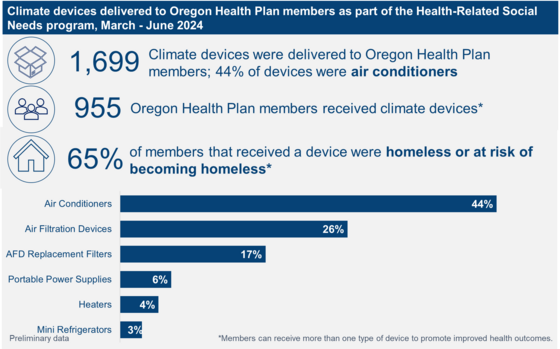
Preliminary data highlights that in the first six months, with support from coordinated care organizations (CCOs), OHP distributed almost 6,000 devices to eligible members experiencing specific health conditions and life transitions.
OHA’s analysis of the first four months of data (see graphic below) shows that 65% of members who received a device were technically homeless (living in temporary housing) or at risk of becoming homeless.
|
 Learn more on the HRSN webpage.
|
|
|
|