|
 |
|
In this issue: |
|
|
|
Click image to play video.
It’s easy to overlook our skin health, but it’s also easy to catch signs of skin cancer early. More importantly, it’s critical, especially when it comes to melanoma—the deadliest and most aggressive form of skin cancer. People with melanoma have a 99% survival rate when treated early. That drops to 30% when caught late, after it spreads to other organs.
And as we saw during the pandemic, when people delay routine skin cancer checks that can identify early-stage melanoma, rates of advanced melanoma increase.
It’s also the only cancer you can spot with your eyes.
Tips for preventing melanoma:
- Check your skin monthly for any marks that look new or different from other marks. If you see something, especially if it looks like it’s changing, get it checked out by a medical professional.
- Take this online quiz to learn your personal melanoma risk level. If you’re at high-risk, have your skin examined by a health care provider once a year. High-risk factors include light-colored skin, freckles, red hair, a lot of moles or moles that are big, a family history of skin cancer, having had severe sun damage or if you are immunocompromised. Men with light-colored skin or outdoor workers over age 55 are particularly vulnerable as well, including firefighters and farmers/ranchers.
- Never allow the sun to burn your skin.
- Avoid tanning beds. Using a tanning bed, even infrequently, increases your chances of developing skin cancer significantly.
- Clothing is the best protection, including hats and sunglasses.
- Use sunscreen, preferably with titanium dioxide and/or zinc oxide.
- Don’t expose yourself to unnecessary sunlight. Stand under a tree or other source of shade while you’re outside. Do outdoor exercises and activities in the morning or evening.
Learn more at Oregon Health and Science University’s (OHSU) website, Start Seeing Melanoma.
|
|
As Oregon experiences an increase in COVID-19 activity, we want to remind Oregonians how to access the COVID-19 antiviral medication Paxlovid.
There is no shortage of Paxlovid in the United States, but some people may have difficulty finding it, particularly in rural communities, because not all pharmacies and providers carry it.
People who are uninsured or have Medicare or Medicaid (Oregon Health Plan):
The PAXCESS program from Pfizer can provide Paxlovid at no cost, regardless of income or immigration status, through Dec. 31, 2024. It is also possible to have the medication delivered overnight to your home.
Before enrolling in PAXCESS, you must first get a prescription for Paxlovid from a health care provider or pharmacist. (State-licensed pharmacists may prescribe Paxlovid to people under certain conditions.) Paxlovid cannot be prescribed in advance, in case you get sick.
While a patient can enroll themself in PAXCESS, it may be easier for a health care provider or pharmacist to do so. A caregiver may also enroll the patient.
Eligible patients will then receive a voucher that they can take to a pharmacy to fill the prescription at no cost. It’s important to confirm your pharmacy of choice carries Paxlovid before trying to fill the prescription. Use this COVID-19 medication locator tool to find locations that carry Paxlovid. If there is no nearby pharmacy or provider that carries Paxlovid, ask the PAXCESS representative to have the medication delivered overnight to your home.
If your local pharmacy does carry Paxlovid but you’re unable to pick it up, it’s worth asking the pharmacy if they will deliver it to your door.
Enroll in PAXCESS here. Call 877-219-7225 to learn more.
People with private health insurance:
Most private plans cover Paxlovid, with possible out-of-pocket co-pays. The PAXCESS co-pay program can help people pay those co-pays. If your pharmacy does not accept or cannot process your PAXCESS co-pay voucher, use this rebate form to request co-pay reimbursement.
Paxlovid is not the only COVID-19 treatment option, but it is the most common. Learn more about all COVID-19 treatment options and how to access and pay for them here. For questions, contact the Oregon Immunization Program Help Desk, Monday through Friday, 9 a.m. to 4 p.m., at 1-800-980-9431 or alertiis@odhsoha.oregon.gov.
|
|
|
 |
|
Health notes |
|
|
|
In terms of people on Medicaid keeping their health care coverage since the federal public health emergency ended, Oregon is #1.
So far, 92% of Oregon’s 1.5 million Medicaid (Oregon Health Plan/OHP) members are keeping their benefits since the state began reviewing member eligibility in the spring of 2023.
Reasons for this success include:
-
OHP Bridge, a new category of OHP with higher income limits, launched July 1, 2024.
- Oregon gave people longer to respond to the letters we sent to members requesting information before closing benefits than any other state in the nation.
- Oregon’s robust network of community partners across the state, as well as widespread and targeted media campaigns, helped spread awareness of the renewal process.
Although most OHP members are keeping coverage during the post-pandemic renewals, approximately 232,000 people have or will need to consider other coverage options due to lost or reduced benefits. Learn more about those options here.
Extreme climate events such as wildfires, drought and heat waves continue to disproportionately harm marginalized communities in Oregon, and the communities hit hardest by the 2020 wildfires and 2021 heat dome are still recovering. The recently published 2023 Climate and Health in Oregon Report also shows there are many opportunities to help these communities build up resilience against future climate disasters.
Some of the report’s findings include:
- The number of nights warmer than 65 degrees is increasing across Oregon, meaning people without air conditioning can’t get relief from high daytime temperatures.
- In 2023, people sought emergency or urgent care at higher-than-expected levels during days when the heat index was at or above 80 degrees. (Heat index is how hot it feels when humidity is factored into the actual air temperature.)
- American Indian/Alaska Native, Black/African American and Native Hawaiian/Other Pacific Islander people in Oregon seek health care for air quality-related respiratory illness twice or nearly twice as often as the state population overall.
- Rural and lower income communities, as well as communities of color, are experiencing extreme climate effects more than other groups.
Local, Tribal and state agencies and community-based organizations are learning from the disasters and have “made investments in strategies to prepare for the uncertain future.”
|
|
 |
|
OHA answers your questions |
|
|
Questions are answered by experts at OHA and other state agencies or community partners.
Q: Some states are reporting a summer COVID wave. Is COVID increasing in Oregon? Where do I find updated information on COVID-19 transmission in Oregon since I no longer can find it on your website? – Diana, Portland
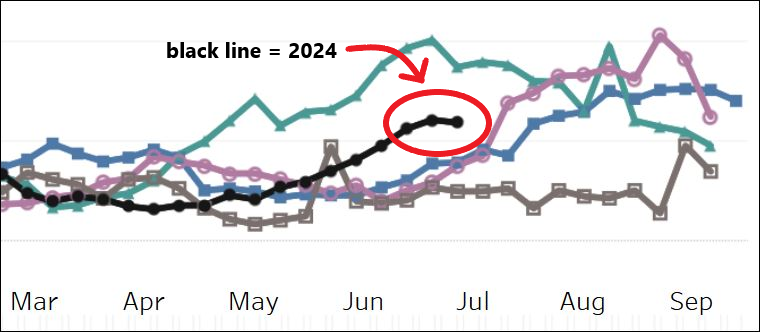
A: You can find updated COVID-19 information on OHA’s website through the Respiratory Virus Data homepage, which can also be found in the COVID-19 resources section at the bottom of this newsletter. The webpage offers a few ways to measure community transmission, including “test percent positivity”—the % of COVID-19 test results performed and reported by health care professionals that come back positive. The dashboard is updated each Wednesday and shows a graph like the one below. The black line represents COVID-19 test % positivity rates in 2024. (The other colored lines represent years 2020 - 2023.)
Click image to see COVID-19 test % positivity data in Oregon.
As of this week, test % positivity in Oregon is 11.8%, which represents “high” community transmission. In the spring, test % positivity dropped to 3.1% -- its lowest point since the summer of 2020. Since May, COVID-19 transmission has been increasing as new COVID-19 variants circulate and the population’s immunity from infection and vaccination wanes.
If you have questions about health topics in Oregon, submit your question here. Although we are unable to answer every question, we try to address those of interest to a broad audience. Please understand that we are unable to provide specific medical advice for personal medical conditions.
|
|
If you need mental health support for any reason, help is out there.
|
|
|
|
|
|