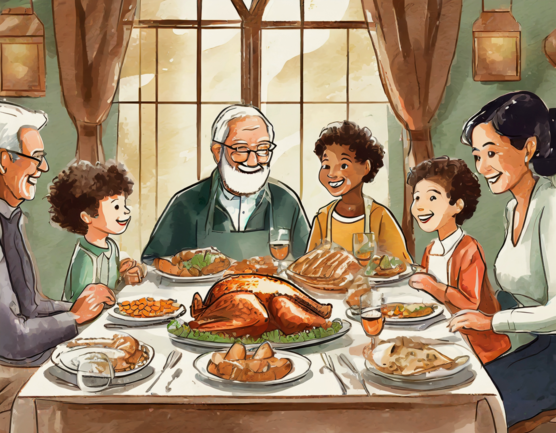
As families and friends gather to enjoy each other’s company this weekend, we’d like to offer tips on how to safely prepare, cook and store Thanksgiving turkey, stuffing and those delicious leftovers.
 Keep the turkey in the freezer (0˚F or below) until you’re ready to thaw it. Never store a turkey outside on a patio, in the trunk of a car or in the snow, no matter how cold the weather is.
 There are three ways to thaw a turkey safely.
- In the refrigerator (in original wrapping) for 24 hours for each four to five pounds of turkey. After thawing this way, the turkey can stay in the fridge for one to two days before cooking.
- Submerged in cold tap water (in original wrapping or leakproof plastic bag) for 30 minutes for each pound of turkey, changing the water every 30 minutes. Cook immediately after thawing.
- In the microwave, following microwave instructions for thawing a whole turkey. Cook immediately after thawing.
Never wash a raw turkey. Research shows that when you rinse raw meat and poultry, you're not simply washing bacteria safely down the drain, you're actually spreading bacteria around the kitchen. Also, never thaw a turkey by leaving it on the counter. Germs can grow rapidly, even when the center of the bird is still frozen.
Learn more about turkey thawing here.
 Raw turkey and its juice can contaminate anything they touch.
-
Wash your hands with soap and water for at least 20 seconds before and after handling turkey.
- Use one cutting board for raw turkey and a separate cutting board for produce, bread and other foods that won’t be cooked.
- Wash cutting boards, utensils, dishes and countertops with hot soapy water after preparing raw turkey and before you prepare the next item.
- Never place cooked food or fresh produce on a plate, cutting board or other surface that held raw turkey.
Learn more about safe food handling here.
 If using in a traditional oven, set the oven temperature to at least 325°F. Place the completely thawed turkey in a roasting pan that is 2 to 2-1/2 inches deep. Cooking times depend on the weight of the turkey and whether it is stuffed.
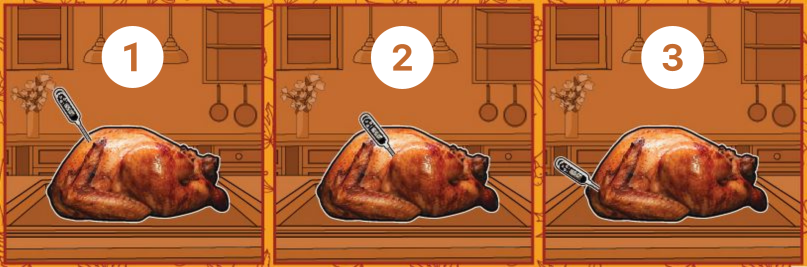
Use a food thermometer to make sure your turkey has reached an internal temperature of 165°F. Check by inserting a food thermometer into three places, avoiding bone: (1) thickest part of the breast; (2) where body and thigh join, aiming toward the thigh; (3) where body and wing join, aiming toward the wing.
Check internal turkey temperature in all three places.
Even if your turkey has a pop-up timer, you should still use a food thermometer to check that it is safely cooked.
Read about safe alternative turkey-cooking methods, such as grilling, smoking and microwaving here.

- The safest way to cook stuffing is in a casserole dish instead of inside the turkey.
- Use a food thermometer to make sure the stuffing’s center reaches 165°F. Germs can survive in stuffing that has not reached 165°F.
- If you do decide to cook the stuffing inside your turkey, wait 20 minutes after taking the bird out of the oven before removing the stuffing. This allows the stuffing to cook a little longer.
Learn more about stuffing safety here.
 The bacteria Clostridium perfringens grows in cooked foods left at room temperature. It is the second most common bacterial cause of food poisoning. The major symptoms are vomiting and abdominal cramps within six to 24 hours after eating. Clostridium perfringens outbreaks occur most often in November and December and are often linked to popular holiday foods, such as turkey and roast beef.
- Don’t leave leftovers out on the counter too long. Refrigerate them at 40°F or colder within two hours of cooking.
- Eat cooked turkey and dishes made with it, such as soup or a casserole, within three to four days. Freeze leftovers to keep them longer.
- Reheat all leftovers to at least 165°F.
Learn more about leftovers safety here.
|