|
 |
|
In this issue: |
|
|
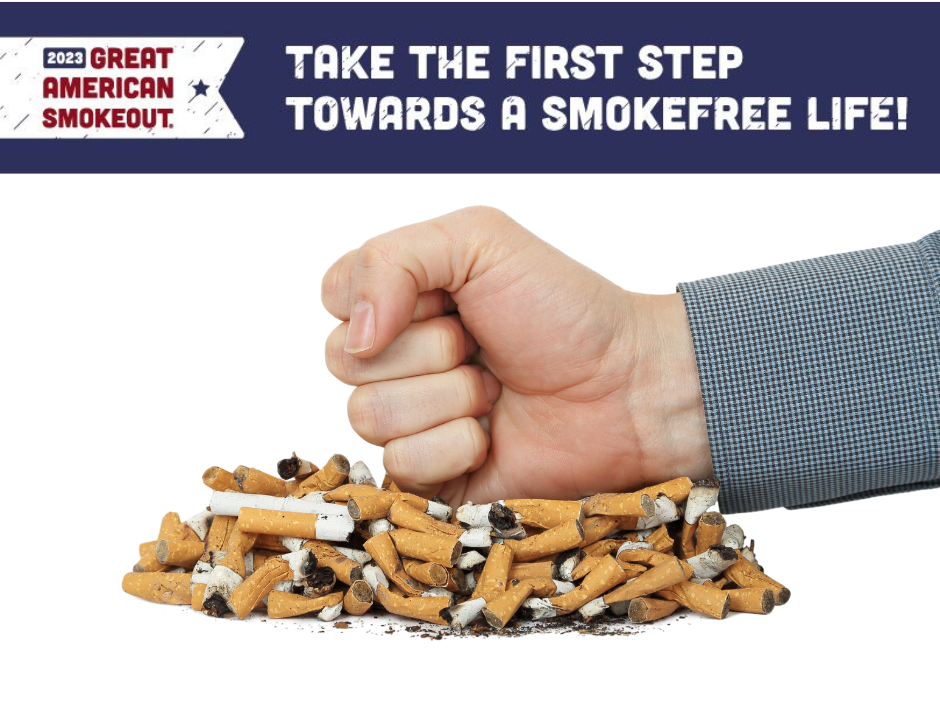
Today is the annual Great American Smokeout, a national challenge to those who smoke to commit to smoke-free lives. You don’t have to quit today, but we are here to help as you begin your journey to healthier living.
Nearly 8,000 people in Oregon die of tobacco-related diseases every year. Nationwide, more people die from tobacco than from illicit drug use, car crashes and guns combined. Additionally, a person who smokes a pack a day will save about $2,000 per year if they quit.
Quitting tobacco is difficult, but you don’t have to go through it alone! What works for one person may not work for another. Find help to quit your way through OHA’s Smokefree Oregon program.
Resources include:
-
Oregon Tobacco Quit Line offers free tips, information, one-on-one counseling and nicotine replacement therapy (NRT) to any person in Oregon over age 13, regardless of income or insurance status. Coaches will help you build a plan and get free nicotine gum or the patch. Call 1-800-QUIT-NOW (784-8669) 24/7, text “READY” to 34191 or get started online. They offer coaching in many languages and special services for youth, pregnant people, and members of the LGBTQ+ community.
-
Native Quit Line is a free 24/7 service that draws on Indigenous values and provides resources, coaching and support to help American Indians and Alaska Natives quit commercial tobacco. Call 800-QUIT-NOW and press 7.
-
This is Quitting is a texting program for youth and their parents that helps youth quit vaping e-cigarettes.
- Some pharmacies can prescribe medications to help quit smoking. Most health insurance plans, including Oregon Health Plan, cover medications like patches and gum for free with a prescription. Search for a participating pharmacy in Oregon here or ask your local pharmacist for help.
If you have questions, use this form to send your message to the Smokefree Oregon team.
|
|
|
Scan or click QR code to access Oregon State Hospital’s Amazon gift registry.
As the season of giving approaches, consider the nearly 700 patients at Oregon State Hospital (OSH). Each year, the hospital’s Volunteer Services Caring Tree program makes sure every patient receives a gift, and the effort will get a huge boost this year with a new Amazon gift registry.
The registry lists popular, useful and fun items such as fleece hoodies, socks, flannel shirts, blankets, trail mix and other snacks, games and puzzles, stuffed animals, stationary, Amazon gift certificates and more. Ordering through the registry will send items directly to the hospital’s Salem or Junction City campus in time for the holidays. Hospital volunteers will wrap and distribute the gifts.
The deadline for ordering from the Amazon gift registry is Dec. 5.
You can also:
- Drop off gifts at the reception area: 2600 Center St. NE in Salem, or 29398 Recovery Way in Junction City.
- Mail cash or check donations to OSH Volunteer Services, 2600 Center St. NE, Attn: #R20, Salem, OR, 97301. Make checks out to OSH Volunteer Services-Caring Tree Project.
- Give a gift of your time. Learn about opportunities by contacting OSH Volunteer Services via email or by calling 503-313-8479.
|
|
Join us in observing U.S. Antibiotic Awareness Week (USAAW) Nov. 18–24 as we recognize the importance of appropriate antibiotic and antifungal use.
- Antibiotics are an important tool for treating infections and can save lives, but taking them can also cause side effects and lead to antimicrobial resistance.
- Antibiotics do not treat viruses, such as those that cause colds, flu or COVID-19. There are, however, ways to feel better while your body fights a virus. Ask your health care provider about over-the-counter remedies.
- Antibiotics can treat infections caused by bacteria, but even some bacterial infections get better without antibiotics.
- Preventing infections (and their spread) is one of the best ways to reduce antibiotic use and fight antimicrobial resistance. Do your best to stay healthy by avoiding close contact with people who are sick, getting recommended vaccines such as flu and COVID-19 vaccines, preparing food safely, and keeping your hands clean by washing with soap and water for at least 20 seconds or using hand sanitizer that contains at least 60% alcohol to help stop germs from spreading. If you do get sick, stay home, cover your coughs and sneezes with a tissue, avoid touching your face, and use antibiotics and antifungals only as prescribed.
Individuals, organizations, and communities will be showing support for Antibiotic Awareness Week by wearing purple. You may even notice some Oregon landmarks going purple over the next week, including the Union Street Railroad Pedestrian Bridge and Gerry Frank Rotary Amphitheater in Salem, and the I-5 Overpass Bridge in Woodburn. Join in and tag your photos #USAAW23!
|
|
|
 |
|
Health notes |
|
|

As of Nov. 15, investigations by local public health officials have found a total of six cases of elevated blood lead levels in Oregon children who ate WanaBana Apple Cinnamon Fruit Purée. The children live in Lake, Lincoln, Multnomah and Washington counties. WanaBana announced its voluntary recall of this product late last month, and the U.S. Food and Drug Administration (FDA) issued an advisory to parents and caregivers.
The affected product is sold in Oregon at Dollar Tree stores, Amazon and other online retailers. It is also sold under other brand names at markets that are not located in Oregon. Details of the products and stores, including pictures, can be found here.
Oregon consumers who have purchased these WanaBana products are urged to stop consuming them immediately. They should throw the products away or return them to the place of purchase for a full refund.
A collaborative federal investigation into the contaminated products is ongoing.
|

Time is running out to apply for new community grant funding. If you’re part of a community-based organization (CBO) in Oregon that offers services aimed at achieving health equity in your community, the Public Health Equity Grant will fund up to $10.25 million for CBOs addressing the needs of their communities in the following areas:
- Climate adaptation.
- Communicable disease prevention.
- Public health emergency preparedness.
- Domestic wells.
Although not exclusively, OHA is seeking applicants in rural communities; have a mission or program serving people with disabilities (including CBOs with leadership staff or board members who identify as having disabilities); or have a mission or program that addresses the public health needs, concerns and priorities of people with disabilities.
More information (in English and Spanish), applications and a list of free upcoming webinars about this grant funding can be found here. OHA is accepting applications through Dec. 1 at 3 p.m. Email questions to Community.PublicHealth@odhsoha.oregon.gov.
|
OHA is seeking applicants for the new Behavioral Health Crisis System Advisory Committee. The 18-member committee will advise OHA on implementation and operation of the statewide behavioral health crisis response system, as well the 988 Suicide & Crisis Lifeline in Oregon. Committee members will include representatives from Oregon’s 988 and 911 call centers, Oregon Department of Emergency Management, local public health authorities, Tribal members, hospitals, telecommunications providers, members of the public with certain lived experiences and more.
OHA is looking to fill two seats representing:
- Certified peer support specialists
- Consumers of behavioral health services, including youth and families
Members may be eligible for a $166 stipend for each day of work on the committee. OHA plans to schedule virtual meetings throughout 2024 starting in January, approximately monthly.
Applications are due by 5 p.m., Friday, Dec. 8. Apply online in English or Spanish, or email a fillable PDF application in English or Spanish to 988.BHCS@oha.oregon.gov.
|
|
 |
|
OHA answers your questions |
|
|
Questions are answered by experts at OHA and other state agencies or community partners.
Q: A nurse at a clinic told me after contracting COVID, any test will indicate positive for a month. Is this accurate? – Anonymous, Newport
A: No, this is not accurate. It is true that individuals with COVID-19 may continue to shed the virus for days to weeks resulting in positive tests. How long an individual sheds the virus varies from person to person. Individuals are more likely to continue to test positive when tested with a laboratory-based PCR test because these are more accurate than at-home tests. OHA recommends individuals with COVID-19 infection stay home until fever-free for 24 hours and all other symptoms are improving, mask for 10 days after you become sick or test positive, and avoid individuals at increased risk for severe COVID-19 illness.
Unless instructed by your health care provider, there is no reason to continue testing following the first positive test.
Q: Where can we get both PCR COVID-19 tests and at-home COVID-19 tests that are covered by OHP? Do I buy my tests at, say, Walmart? How do I get reimbursed for the costs? – Yvonne, Yachats
A: If you are covered by Oregon Health Plan (OHP), whether you want an at-home COVID-19 test or a PCR test administered by a health care professional (including pharmacists), you must go to a provider or pharmacy that bills OHP and offers those products or services. Most pharmacies have at-home COVID-19 tests on the shelf for the public, but you must take it to the pharmacy counter for the transaction and confirm they bill OHP. If you take it to the regular cashier and pay for it, you won’t be able to get reimbursed for it.
If you have a question related to COVID-19 or other public health topics, submit your question here. While we are unable to answer every question, we try to address questions that may be of interest to a broader audience. Please understand we are unable to provide specific medical advice for personal medical conditions.
|
|
If you need mental health support for any reason, help is out there.
|
|
|
|
|
|