|
Letter from the Editor
Hello partners in Urban and Community Forestry! Hot, dry summer not only take a toll on we humans, it can be very taxing on trees. This issue will remind you on hot-weather care for your trees. We're also excited to bring you the latest news and resources from around the urban forestry community this month. In this issue of the newsletter, I will cover:
- Most urban trees are going to need watering to help them through this dry summer
- Registration is now open for nursery symposium on trees for future urban forests
- EAB has been found now in three more northern Willamette Valley towns
- Free tree inventory software at a July 9 ODF webinar
- Three schools in La Grande planted ODF grant-funded trees this spring
- Webinar on how to get diverse, low-cost urban trees is available
- Upcoming events
Stay safe and hydrated this summer! Your friend in Forestry, Alison Herrell
|
|
|
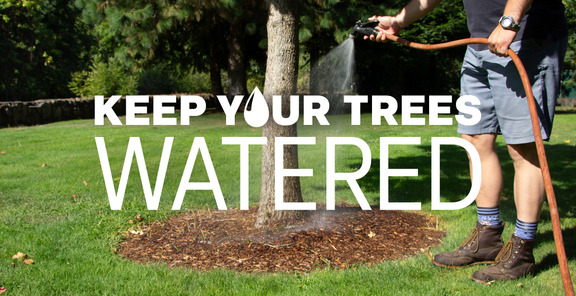 Most urban trees are going to need water to get through this hot, dry summer
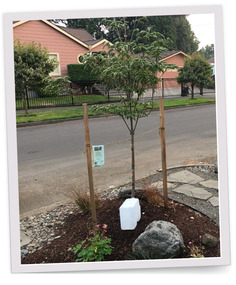
Oregon is again experiencing a hot, dry summer. What makes this one particularly hard on trees is that it follows a very warm winter and spring with long stretches of rainless days. As a result, summer started with soil moisture already quite low in many places.
Urban trees often feel the effects more than trees in natural forests due to reflected heat from buildings, pavement and cars. Urban soils are also often compacted, reducing the ability of rain to soak deeply.
Some trees may not need or even want to be watered in summer, such as Oregon white oak and certain very drought-tolerant trees. But most urban trees, even established ones, benefit from getting summer water. It can help them get through the hot, dry days of July and August with less stress.
 |
|
Once temperatures hit the high 90s or above, trees start to close the openings in their leaves to conserve water. This shuts down photosynthesis, meaning trees aren’t making food for the winter during hot spells. It’s best to water in the cool of the morning or at dusk when temperatures are cooler. This also cuts down on evaporation and gives trees more time to absorb water you do give them.
ODF Community Assistance Forester Alison Herrell says, “We recommend weekly watering for the first three years after planting. Consider watering deeply at least a couple times a month for trees 4 to 10 years old, particularly drought-sensitive trees and those native to summer rainfall areas. But even older trees that appear to be becoming drought stressed should be watered.” Learn more here.
|
|
|
2026 Urban Forests of Tomorrow Symposium |
|
 Growing the Urban Forests of Tomorrow
symposium is set for July 15 at OSU
Registration is now open for “Growing the Urban Forests of Tomorrow: A Nursery Symposium” on Wednesday, July 15, 8:30 a.m. to 3:30 p.m.
This one-day symposium will bring together nursery growers, urban foresters, and tree professionals for a day of conversation and collaboration focused on resilient tree production. From best management practices to climate-ready species and supply challenges, this symposium is designed to spark ideas, share knowledge, and strengthen connections across the nursery and urban forestry communities.
Who’s invited? Who’s invited includes nursery professionals such as growers, technical specialists, specialty nurseries, and production nurseries, along with arborists and urban forestry professionals. It also includes landscape professionals in design, installation, and architecture roles, as well as people in the utility industry and others working across the tree care and production industry.
Hosts: The symposium will be hosted by the Oregon Department Forestry and Oregon State University in partnership with the Oregon Association of Nurseries.
Location: LaSells Stewart Center at Oregon State University, 875 SW 26th Street, Corvallis.
Register now! Registration is $25 (scholarship options available upon request); student registration is $15. Breakfast, lunch, snacks and refreshments will be provided. The link will prompt you to sign in via Google or Microsoft, or you can click “Password login” where you will be prompted to create a username (email address) and create your own password.
Questions? Email UCF.Program@ODF.oregon.gov with any questions about the symposium. Please put "Nursery symposium" in the subject of your email.
|
|
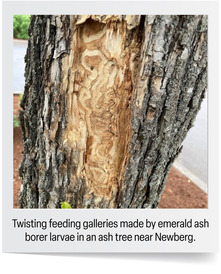
Emerald ash borer is now confirmed from Silverton, Tualatin and Newberg area
In a single week in early June the Oregon Invasive Species (OISC) Hotline received reports of emerald ash borer (EAB) from new communities in three different counties – Yamhill, Marion and Washington.
Private individuals reported to the online OISC Hotline ash trees with signs of EAB infestation or EAB adults themselves from:
- A parking lot just outside of Newberg
- A parking lot in Tualatin near I-5 and Nyberg Road
- A residential neighborhood on the north side of Silverton
Oregon Department of Forestry EAB Support Specialist Matt Mills said, “We have long known that EAB would spread from infested sites to nearby areas, so these new detections are not unexpected. Experience from other states shows that four to five years or so after first being detected EAB spreads from pockets of infested ash trees and becomes much more widespread over an entire county or metropolitan area.
EAB was first confirmed in Oregon four years ago in 2022 when EAB was found in several trees in Forest Grove. The new detections are within the existing EAB quarantine zone covering the five counties where this pest has been found so far. Counties within the quarantined zone are Clackamas, Marion, Multnomah, Washington and Yamhill.
By order of the Oregon Department of Agriculture, tree material from ash, olive, and white fringetree must remain within quarantined counties, along with firewood from any hardwood tree.
|
Learn about free tree inventory software as a planning tool at a July 9 ODF webinar
The Urban and Community Program at ODF is pleased to announce our upcoming TreePlotter Canopy webinar on Thursday, July 9th from 9 a.m.-10:30 a.m. Pacific.
In this webinar, we will introduce the state’s free to use TreePlotter Canopy software tool to cities and other partners managing urban forests. Join us to learn how this tool can help you to make data –informed decisions on:
- Expanding access to the benefits of trees in your city
- Strengthening climate resilience
- Prepareing for emergency management
- Improving forest health, and more.
A healthy urban forest doesn’t happen by chance – it takes thoughtful planning, community investment, and effective management. Please join us for an introduction to this tool and a question-and-answer session at the end to support the important work you do! To sign up, please fill out the TreePlotter Canopy Registration Form.
Unavailable to attend the live event? No problem, please register, and we will record the webinar and share out the recording for those unable to make it.
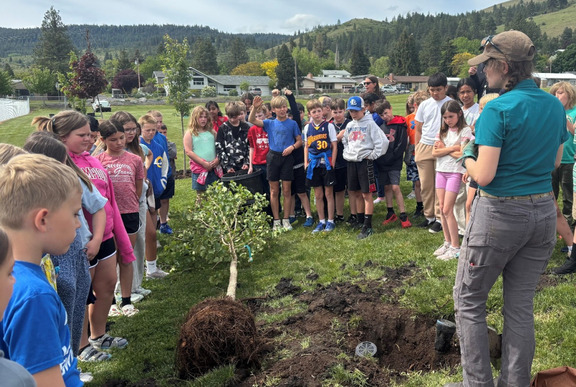 Three La Grande schools get grant-funded trees
from Oregon Community Trees
The City of La Grande’s new Urban Forester Anna Lindquist was quick to take the non-profit organization Oregon Community Trees up on its offer of free trees earlier this year. Lindquist was able to get 17 trees from OCT and plant them at three local schools with high percentages of students coming from low-income households.
“The schools were all in neighborhoods with low tree canopy,” said Lindquist. “These plantings not only benefit the students in their immediate environment, but when fully grown the trees will also help provide a cool-air reservoir for the surrounding community.”
The trees were a mix of pines, disease-resistant elms, oaks, Turkish hazels, a Chinese hardy rubber tree and a ginkgo. The schools receiving trees were:
- Central Elementary – 5 trees
- Greenwood Elementary – 8 trees
- Island City Elementary – 4 trees
OCT received the grant last year from funds ODF obtained through a competitive application to the USDA Forest Service. The organization has also given three trees to Prineville and 10 to Baker in eastern Oregon to plant in local parks and a public cemetery.
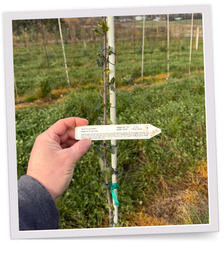
Low-cost trees for planting in disadvantaged areas of Oregon are now available
If you missed the June 23 webinar by OUR Community Forestry on how to get low-cost, climate-resilient trees grown in southern Oregon you can still access it online here.
Trees for All helps subsidize the cost of large, climate-resilient trees for planting organizations working in disadvantaged communities throughout Oregon. Trees are available on a sliding price scale based on species and size, with prices starting at less than $80 for a 1.5–2-inch caliper tree grown by Plant Oregon Nursery. The program is funded through ODF's Urban and Community Forestry Program, which provided a grant to OUR Community Forestry to increase the supply of climate-resilient trees.
“Offering high-quality trees at subsidized cost can help community organizations and municipalities stretch their budgets and plant more trees in disadvantaged parts of the state,” said Scott Altenhoff, Manager of ODF’s Urban and Community Forestry program.
Additional information about the program can be found on the OUR Community Forestry website.
|
 |
|
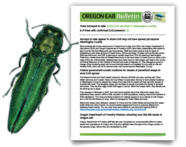
Oregon Tree Health
Threats Bulletin
The Oregon Department of Forestry produces a monthly online newsletter about emerald ash borer (EAB) and other threats to tree health in Oregon. To subscribe please visit OregonEAB.com.
|
|
|
Urban & Community Forestry Events
|
|
About the Community Tree Connections Newsletter
Community Tree Connections (CTC) is a periodic publication by the Oregon Department of Forestry, Urban and Community Forestry Assistance Program. Our mission is to help Oregonians improve their quality of life by promoting community investment in our urban forests. CTC is published in cooperation with the USDA Forest Service. The USDA is an equal opportunity provider and employer. Subscriptions to Community Tree Connections are free. Sign up to receive the newsletter.
|
|
|
|
|