|
Letter from the Editor
Deciduous trees are leafing out this month after their winter sleep. Flower buds are bursting into vibrant colors, painting our cities and towns in pastel shades. I hope you take time to notice and celebrate the trees in your community. All of April is designated as Oregon Arbor Month, so check to see what your city or town is planning to commemorate. You might be able to join a local tree planting, enter a tree-related art contest, or visit displays at your local library or city hall.
In this issue of the newsletter, I will cover:
• Salem is named Oregon Tree City of the Year
• Fairview becomes Oregon’s newest Tree City USA community
• Registration is now open for Oregon’s largest urban forestry conference
• Warm winter signals likelihood of more intense spruce aphid outbreaks
• It could be a dry spring so don’t forget to start watering your trees!
• Upcoming Events
Stay safe and enjoy Oregon Arbor Month!
Your friend in Forestry, Alison Herrell
|
|
 ODF Names Salem as Oregon Tree City
of the Year for 2026
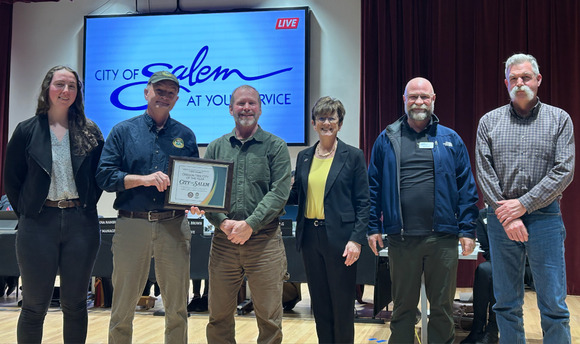
ODF’s Urban and Community Forestry Program has chosen Salem as the state’s Tree City of the Year.
Scott Altenhoff who manages ODF’s Urban and Community Forestry Program, said Salem was the perfect choice in 2026 both for its vigorous response to the threat from the tree-killing pest emerald ash borer and because it is marking 50 years as a Tree City USA.
“Salem has the distinction of being the first community in Oregon to meet the four criteria needed to become a Tree City USA, a national program of the non-profit Arbor Day Foundation that ODF administers in Oregon,” said Altenhoff. “They have been leaders, working to meet the many challenges facing Oregon’s urban forests using recommended best practices.”
Altenhoff said Salem earned the honor through:
- Diversified tree plantings in natural areas, parks, and along streets
- Maintaining professionally credentialed arborists to manage the city’s public trees
- Working to increase its tree canopy (the percent of land area in the city covered by trees) to 28 percent
- Hosting an annual cherry blossom festival each spring (Salem is known as the Cherry City for its many ornamental cherry trees)
- Providing in 2025 opportunities for the next generation of urban foresters to develop their skills via Salem's Urban • Forestry Internship program, which also accomplished great work in updating Salem's tree inventory.
- Salem’s Planning & Development Department implementation and enforcement of the Significant Tree Code, which protects Oregon white oaks over 20” and other tree species over 30” and has increased funds for tree planting through enforcement and fines
“Salem’s updated tree ordinance and increased tree planting show Salem's commitment to both protecting existing canopy and growing the city’s urban forest,” said Altenhoff.
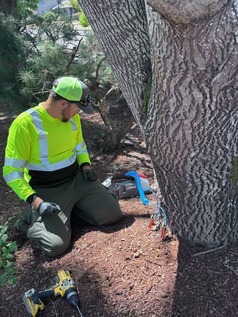
When Salem learned that emerald ash borer had been found barely 25 miles east in Woodburn, staff took immediate action to survey their street and park trees to find out how many were ash and what shape they were in.”
Photo at right: Salem is treating ash trees in good condition to protect them against emerald ash borer.
|
Fairview is Oregon’s Newest Tree City USA Community
Located in eastern Multnomah County just east of Gresham, the City of Fairview has become Oregon’s newest Tree City USA community. Fairview has about 10,400 residents. Incorporated in 1908, the community has transitioned from farming to mainly residential and commercial. Almost one in four residents speaks a language other than English at home. About one resident in eight is foreign born.
The Tree City USA program, is sponsored by the Arbor Day Foundation and in Oregon is administered by ODF. The program recognizes cities that manage public trees according to best practices and work to improve their urban canopy. To qualify, towns must meet four core standards: maintaining a tree board, having a tree care ordinance, spending at least $2 per capita, and celebrating Arbor Day. Over 3,600 communities nationwide are recognized, including 69 in Oregon.
|
|
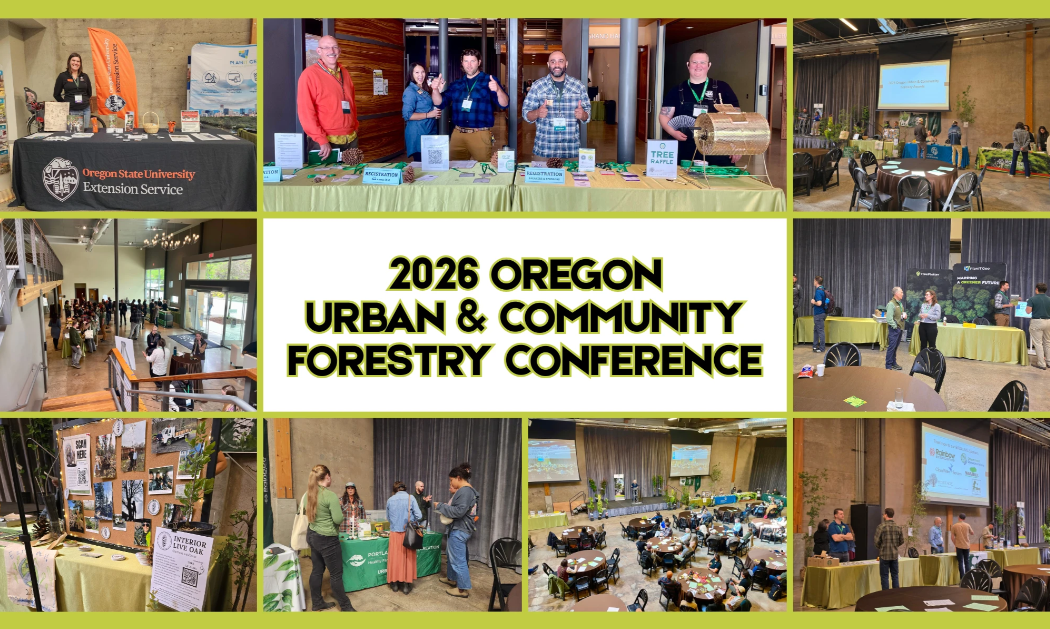 Registration is Now Open for Oregon’s Largest
Urban Forestry Conference
Downtown Eugene will again be the site of this year’s Oregon Urban Forestry Conference, being held Thursday, June 4. Early-bird pricing of $150 or $85 for students is available through April 30. Ticket price includes lunch and a social hour following the conference. Parking is free.
The conference theme for 2026 is We Thrive When Trees Thrive. Keynote speaker is Geoffrey Donovan, PhD, who will share his ground-breaking research into the connections between human health and changes in tree canopy. CEU credits will be available through International Society of Arboriculture.
A limited number of scholarships are available for those expressing a financial need. Apply by April 17 here.
Read more about the conference.
|
|
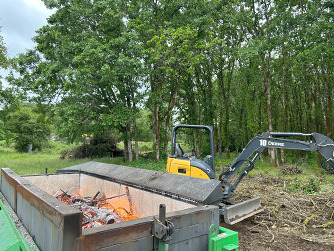
ODF to hold Air Curtain Incinerator Demonstration Burns in April and May
ODF’s Urban and Community Forestry Program is holding a series of air curtain incinerator (ACI) demonstrations in central and eastern Oregon, and the upper Willamette Valley in April and May. If you are unfamiliar with ACIs, here is a brief introductory video.
These events are for land managers, conservation organizations, tree-care companies, municipalities, and anyone having to deal with wood waste and biomass on private or public land in Oregon. Staff will demonstrate how ACIs can be used as a tool for biomass reduction and carbon sequestration in wood sanitization, wood waste utilization, and fuels reduction projects. Using ACIs reduces smoke and air pollution compared to pile burning. Join one of these events and participate in a discussion on how ACIs can be used throughout Oregon. Please share this information with others in your network who may be interested.
Space is limited, so sign up today. If you have any questions, please reach out to InvasivePests@odf.oregon.gov
To sign up, just click on the link after the event you’d like to attend:
• Friday, April 10th, 11am – 1 pm. John Day
• Saturday, April 11th, 11:45 am – 1:30 pm. Prineville
Part of the Prineville Wildfire Preparedness Fair:
• Thursday, April 30th, 11am – 1 pm. Salem
Includes a tour of the Marion County Juvenile Diversion Program wood waste utilization lot:
• Wednesday, May 6th, 12:30 pm – 2 pm Portland
• Wednesday, May 12th, 10:30 am – 2 pm. Polk County
|
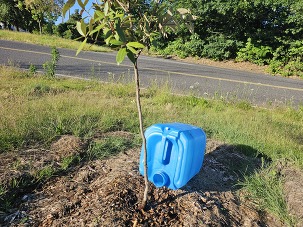
Watering Trees Earlier than Usual May Be Needed in Wake of a Dry, Warm Winter
Winter rains largely bypassed Oregon this year. That means soils are drier than normal. Unless significant rains fall soon, people may need to start watering young trees sooner than expected.
“As soon as young deciduous trees leaf out they will need to start being watered,” says ODF Community Assistance Forester Alison Herrell. “We recommend weekly watering for the first three years after planting. In dry years, consider watering at least a couple times a month for trees less than 10 years old, particularly drought-sensitive trees and those native to summer rainfall areas.”
|

Oregon Legislature gives $1.8 Million to Battle Japanese Beetle
Oregon House Bill 5204 allocated $1.8 million to allow the Oregon Dept. of Agriculture (ODA) to continue its Japanese beetle (Popillia japonica) program over the 2026 and 2027 crop years. During the 2025 legislative session funding was not allocated for the program.
Although present in Oregon since the 1980s, the largest infestation of Japanese beetle was found in 2016 in the Cedar Mill, Bonny Slope, Oak Hills, and Bethany areas of Washington County. Smaller populations were later found in Clackamas and Multnomah counties. In 2025 one beetle was found in each of Marion and Union counties. The beetle is a concern to farmers and homeowners, attacking more than 300 different species of plants, including many urban trees, especially lindens, Japanese maples, Norway maples, crabapples, cherry trees, birches, and elms.
Pictured above is a Japanese beetle (Popillia japonica). Photo courtesy of ODA.
ODA’s persistent work to eliminate Japanese beetle from the state reduced beetle numbers by 65% from last year and by 92% since 2016. Recent survey data for 2025 showed that 1,918 beetles were trapped across Oregon, with most captured at a single site in Washington County. Learn more here.
|
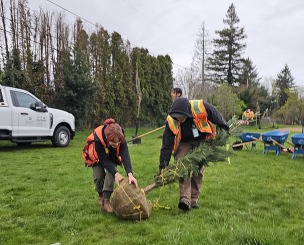
Oregon Community Trees Plants First of Grant-Funded Trees in East Portland
The non-profit Oregon Community Trees (OCT) in partnership with Portland Urban Forestry planted 13 trees from six different species at a Title 1 school in Portland’s Centennial neighborhood on March 31. OCT purchased the trees with a grant from ODF targeted to help build canopy in historically disadvantaged parts of the state. The Centennial neighborhood’s tree canopy is around 22 percent, well below the citywide average of 29 percent. About two thirds of students who attend the school are considered to be from disadvantaged households, with much higher percentages of Latino, African American, Asian American and Pacific Islander than the Oregon average.
Portland Urban Forestry provided stakes and mulch for the trees and the first three years of establishment watering. More OCT-funded trees are heading to La Grande, Baker City, and Prineville later this month.
|
|
|
Urban & Community Forestry Events
|
|
Oregon Tree Health
Threats Bulletin
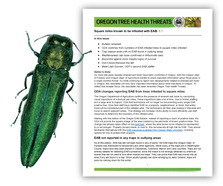
The Oregon Department of Forestry produces a monthly online newsletter about emerald ash borer (EAB) and other threats to tree health in Oregon. To subscribe please visit OregonEAB.com.
|
|
 |
|
|
About the Community Tree Connections Newsletter
Community Tree Connections (CTC) is a periodic publication by the Oregon Department of Forestry, Urban and Community Forestry Assistance Program. Our mission is to help Oregonians improve their quality of life by promoting community investment in our urban forests. CTC is published in cooperation with the USDA Forest Service. The USDA is an equal opportunity provider and employer. Subscriptions to Community Tree Connections are free. Sign up to receive the newsletter.
|
|
|
|
|