ODF provides critical support to help wildland firefighters maintain physical and mental health
SALEM, Ore.—When the Oregon Department of Forestry (ODF) deploys its people to a wildland fire they battle more than just the flames.
“It’s not hard to imagine the typical challenges that firefighters face – long shifts, hot and dry conditions, working in steep and brushy terrain, snags, poison oak, blisters - the list goes on,” said Chet Behling, Assistant District Forester for ODF’s Western Lane District. “Firefighters have been accustomed to these conditions and have found creative ways to mitigate the physical challenges in order to focus on the job, and the mission of the assignment. However, there are mental strains to the work as well, and although they may be harder to see or imagine, we’re learning ways to better recognize, understand, and mitigate them.”
Firefighters’ work requires a sense of urgency, performance at high levels for long periods of time, and often includes high-stress environments such as mitigating hazards, protecting homes and communities from fire, and working around large fires’ unpredictable behaviors.
“All those elements add to the mental stressor component of the job,” said Behling. “Mental stressors combined with the physical challenges can certainly have a cumulative impact on a person’s mental or physiological health, especially on longer assignments or during lengthy fire seasons.”
To help staff navigate through these cumulative effects, Behling and fourteen other ODF employees were selected to be part of the department’s Peer Support Team. The team is an official internal resource with a focus on mental health awareness, better understanding and mitigating its effects, and ultimately building employee resiliency. Each team member receives in-depth training and is required to maintain confidentially in all their interactions.
The Peer Support Team was officially launched before the 2022 fire season but had its beginnings in 2020, in the aftermath of the massive and destructive Labor Day fires, a non-fire related ODF employee death, and the impacts of the COVID pandemic.
There was no formal contact or program at ODF to help employees mentally process and navigate their recovery from these on-the-job traumatic experiences. There is now.
“Don Everingham, who worked closely with those impacted by the Labor Day fires, and Teresa Williams along with her coworkers in Klamath who had to overcome the unexpected death of a coworker, were instrumental in forming the group,” said Bob Arnsmeier a Peer Support Team member and the training coordinator for the Southern Oregon Area.
All Peer Support Team members receive Critical Incident Stress Management training, and training specifically tailored to ODF by Responder Life. The department also covers travel costs for team members to talk with employees about the help available and respond to any area of the state after a critical incident. All team members are covered under Oregon statue to maintain confidentiality.
“The training, travel and confidentiality allows us to be more effective when helping our peers,” said Arnsmeier. “However, a main component to success is trust. We are naturally more comfortable with people we know, people who have similar experiences and people who have survived and then thrived after overcoming something really bad.”
The Peer Support Team gets most of its contacts and employees seeking help through word of mouth.
“Even though the group is relatively new, people know we are here to help,” said Arnsmeier. “But if you aren’t familiar with us there is a great website with all our bios and backgrounds and you can find one of us that can not only relate to your situation but be there for you and likely have had a similar experience.”
Arnsmeier, who is in his 13th year at ODF, also mentions in his bio on the website he worked for a county.
“I was a deputy sheriff for 10 years,” said Arnsmeier. “Unfortunately, I experienced a lot of deaths—suicides, crashes, children, and no one really wants to talk about those, but I will if it helps someone deal with their incident. The one that impacted me the most was an in the line of duty death of one of my coworkers in a car crash. After the incident we all kind of looked at each other with an implied ‘now what do we do?’ I think a lot of folks ask that ‘now what do I do’ question and this group can help.”
The Support Team is there to help anyone who needs it including full-time, seasonal, and those from other agencies and states battling an Oregon wildfire.
“Our seasonal firefighters work hard to keep fires small and are a valuable component to the program. They are highly valued in the agency and by the communities they serve, and are often part of a tight-knit group of firefighters with good camaraderie at their local office,” said Behling. “Come fall when fire season ends, they’re laid off and life may look drastically different having less daily structure and lack of a tight-knit work group. This could be a tough adjustment, and we are here for them.”
Others work through the impacts of life-changing events in addition to or apart from wildfire challenges: divorce, substance abuse, domestic violence, step-parenting, children with disabilities, and they often just need someone to talk to.
“We are here for you,” said Behling. “I’ve had personal or someone close to me experience in battling anxiety, panic attacks, stress management/feeling overwhelmed and more. No issue is too small if it impacts your work and personal life. I would look forward to understanding where you are, and how I could assist you to get you back on track. There is value in knowing you have someone to reach out to, and an even higher value in actually reaching out. If more is needed, we help with referrals to all sorts of resources and professionals.”
For those involved with firefighting the ODF has a contract with the Responder Life for additional support. There are also contacts for the employee assistance program and the ODF employee health insurance providers that have mental health benefits on the Peer Support Team webpage.
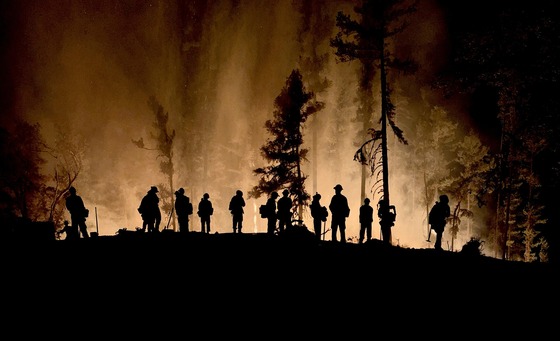 The Oregon Department of Forestry’s Peer Support Group helps its wildland firefighters mitigate the physical and mental challenges of their important, challenging and sometimes dangerous work.
|