|
Letter from the Editor
Hello Partners in Urban and Community Forestry,
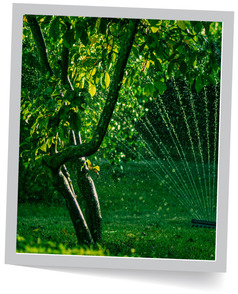
When the hot, dry days of summer come, most of us like nothing better than kicking back in the shade of trees in a backyard, park or natural area with a glass of something cool to drink. While we can quench our thirst just by going to the tap or the fridge, trees depend entirely on rainfall and moisture in the soil. When the rains peter out in a typical Oregon summer, the soil quickly dries out. Trees can then experience drought stress, especially trees under five years of age whose root systems aren’t well developed yet. As heat waves intensify and dry periods seem to start earlier in spring and last longer into fall, even older trees and native trees can begin suffering the ill effects of too little water. That’s why I’ve included a lot of info in this issue about tree watering. It’s become more essential than ever to helping our urban trees get through Oregon’s increasingly hot, dry summers in reasonably good shape.
In this issue I cover:
• New faces at ODF Urban and Community Forestry
• Summer Tree Care
• Urban and Community Forestry Grant Opportunities
• Emerald Ash Borer (EAB) Information
• Upcoming Events
Stay safe and water your trees! Your Friend in Forestry, Brittany
|
|
|
New Faces Join the Team
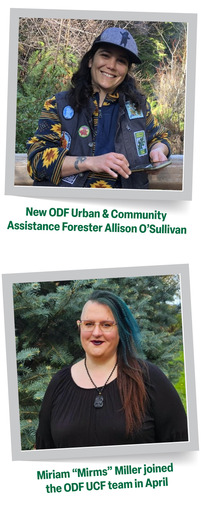
With Jennifer Killian taking a faculty position at Oregon State University earlier this year, ODF is welcoming Allison O’Sullivan as a Community Assistance Forester. Allison has a Bachelor’s Degree from Stanford University in Anthropological Sciences and an associate’s degree equivalency from Clackamas Community College in Arboriculture and Horticulture. She is an ISA-Certified Arborist, a Qualified Tree Risk Assessor, and a Certified Permaculture Designer. For the past 20 years Allison has worked across the environmental sector with community organizations, nonprofits, businesses, and government, to connect people with land in a mutually beneficial and ecologically healthy way.
Most recently Allison spent the last 7 years working with Portland Parks and Recreation in both the Urban Forestry division and Land Stewardship division. During this time she managed tree planting and establishment programs, implemented sustainable stewardship of hundreds of acres of Portland Parks, including the 200-acre Hoyt Arboretum, and served on the Portland Parks and Recreation Diversity and Equity Committee, working to provide equitable and accessible services.
Allison stewards an orchard at her farm in Damascus, and loves exploring the outdoors, river swimming, playing in waves, and cooking on the grill.
“I’m thrilled for the opportunity to work across the state of Oregon to unveil the value of our urban forests in order to build a more resilient community,” she said.
Miriam “Mirms” Miller has worked with ODF since 2022. Mirms joined the ODF Urban and Community Forestry Program in April. Born and raised in the Willamette Valley, her love of the outdoors has continued to grow while supporting Forest Resources events across the state. In her new position, Mirms will continue to provide excellent customer service and admin support to the Forest Resources Division, but will now also assist ODF’s UCF team as they administer two new Subaward Grant Programs (The Tribal Governments Subaward Program and the All Entities Subaward Program).
Mirms is thrilled to join the UCF team and looks forward to the experiences and new relationships ahead! In her free time she finds joy in cooking, crafting, creating, and foraging.
“We had great applicants and are pleased with the outstanding two candidates who were selected to join our team,” said Scott Altenhoff, ODF Urban and Community Forestry Program Manager.
|
|
|
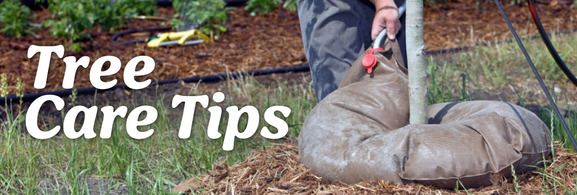 Care Tips from the Arbor Day Foundation
Pruning: Avoid heavy pruning in the summer. This time of year, prune lightly only to remove dead/broken branches and other corrective pruning. Elms should not be pruned between April 15 and October 15 to prevent the spread of Dutch elm disease.
Watering: Watering is key to help Oregon’s urban trees make it through our increasingly hot and dry summers, but it is difficult to recommend an exact amount of water due to the variety of environmental conditions and species’ drought tolerances. Here are a few guidelines to help you water your trees properly this summer. It is important to note that while it is especially important to water newly planted trees, during periods of drought you may also need to water mature trees to help them through the hot and dry weather. Check soil moisture levels and weather regularly to help you decide when to water.
Watering Trees During First Five Years: During the first three to five years after planting, young trees are using a lot of energy growing their roots. Until their root systems are well developed, young trees will have a difficult time dealing with heat and drought. You can make this easier by providing water and covering the soil with mulch. Deep watering can help speed root establishment. Deep watering means keeping the soil moist to a depth that includes all the roots.
How Much Water and When: Not getting enough water is harmful for trees, but too much water is bad as well. Please note that moist is different than soggy. You can judge this by feel. A damp soil that dries for a short period will allow adequate oxygen to permeate the soil. You can check soil moisture by using a garden trowel. Insert the trowel into the ground to a depth of 2”, and then move the blade of the back and forth to create a small, narrow trench. Then use your finger to touch the soil. If it is moist to the touch, then they do not need water. Deep soakings spaced a week or more apart allows soil to dry out in between watering.
Mulching: Mulching around trees in the summer insulates the soil, providing a buffer from the heat. It also increases water retention, suppresses competition from weeds, and prevents soil compaction and lawn-mower damage. Make sure to keep mulch two to three inches away from the tree’s trunk to avoid rot.
Additional Summer Tree Care Reading:
• Six Tips for Keeping Trees Well Watered in any Season
• Arbor Day Blog - Tree Care
• Arbor Day Organization - Tree Tips
 |
|
Soak-It-Week is July 26-31
and August 25-31
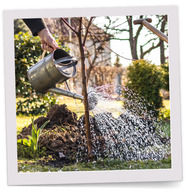
Soak-It-Week is a reminder to deeply water your trees to help them get through Oregon’s increasingly hot and dry months. The last week in July and in August are the perfect times to remember to water your trees. Watering in the early morning or later at night reduces evapotranspiration and ensures more of the water you provide soaks into the soil. Watering both newly planted trees and older trees reduces drought stress and encourages better growth.
|
|
|
URBAN & COMMUNITY FORESTRY GRANTS |
|
ODF Urban and Community Forestry Grants
ODF staff have been kept busy helping recipients of urban and community forestry grants finish their paperwork. Most have done so and are now encouraged to start working on their projects as soon as possible and to submit requests for reimbursements promptly.
|
|
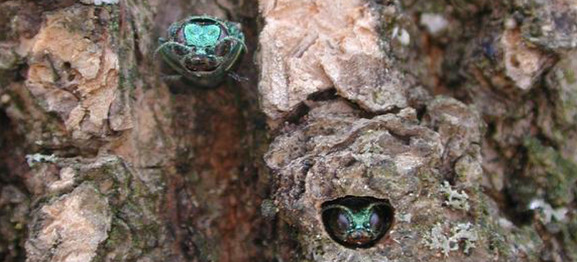 Adult EAB beetles emerge from infested ash trees in summer | Debbie Miller, Bugwood.org
EAB Adults are emerging!
Adult emerald ash borers in the northern Willamette Valley began emerging in June. Peak emergence is usually in July, with a few stragglers emerging as late as September. Adults live about three weeks. During that time they mate, then females look for ash trees on which to lay their eggs.
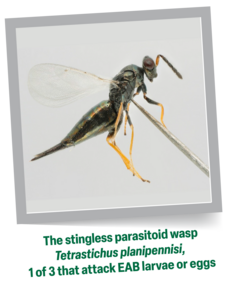
EAB biocontrol agents are being released in Yamhill, Marion and Clackamas counties for the first time
The Oregon Dept. of Agriculture (ODA) has added Marion, Clackamas, and Yamhill counties to its biological control program against emerald ash borer. Biological control is a pest management strategy that uses naturally occurring predators and parasites to control invasive species. ODA has been working with the United States Department of Agriculture (USDA) to release three species of “stingless” parasitic wasps in Washington County in 2023 and 2024 after EAB was detected in Forest Grove in 2022. These parasitoid wasps can’t sting people or animals and are harmless to Oregon’s native wildlife.
Marion, Clackamas, and Yamhill counties have now been added to the program since EAB was confirmed in all three of those counties last summer. As of June 1st, releases have already started. There will also be two release sites in the Forest Grove area in Washington County. Releases will continue through October.
In eastern states the wasps have been shown to reduce EAB populations anywhere from 20 percent up to 80 percent, helping slow EAB’s spread. The wasps can be used in conjunction with some insecticide treatments, but caution and planning is needed.
The wasps were produced and supplied by the United States Department of Agriculture’s Animal and Plant Health Inspection Service (USDA APHIS), Plant Protection and Quarantine (PPQ) EAB Parasitoid Rearing Facility in Brighton, Mich. For parasitoid information please call 866-322-4512.
|
Canadian study supports value of slowing ash mortality early on but then phasing out treatment in favor of replanting with non-ash species
Up till now, most cost-benefit analyses of emerald ash borer management choices have focused on early infestations. Now a new study published in the April 2025 Journal of Economic Entomology has tested the options for late-stage EAB management based on ecological and economic objectives. Canadian researchers evaluated tree counts, basal area, and urban forest value under seven different management scenarios. They considered variations in if and when ash trees were treated, removed, and replanted with non-ash species.
The simulation was applied to the remaining ash population in Ontario, Canada, where tree coring and yearly assessments found that injected ash trees have reduced growth rates and are declining in condition.
The results demonstrate that injections help preserve the ash population for a time, maximize basal area, minimize spikes in annual costs, and reduce cumulative costs early in the 20-year study period. However, long-term cost reduction comes from eventually winding down basal injections, removing ash as they die from EAB, and replanting with non-vulnerable species.
|
|
Get the latest news on tree health threats each month
The Oregon Department of Forestry produces a monthly online newsletter about emerald ash borer (EAB) and other threats to tree health in Oregon. To subscribe please visit OregonEAB.com.
 |
|
Are you going to the State Fair?
If you plan to attend the Oregon State Fair in Salem (Aug. 22-Sept. 1) be sure and stop by the ODF booth on weekends for kids’ activities and information on how you can protect your trees and community from invasive insect pests. Experts will be on hand to help answer your questions.
|
|
|
Urban & Community Forestry Events
|
|
About the Community Tree Connections Newsletter
Community Tree Connections (CTC) is a periodic publication by the Oregon Department of Forestry, Urban and Community Forestry Assistance Program. Our mission is to help Oregonians improve their quality of life by promoting community investment in our urban forests. CTC is published in cooperation with the USDA Forest Service. The USDA is an equal opportunity provider and employer. Subscriptions to Community Tree Connections are free. Sign up to receive the newsletter.
|
|
|
|
|