|
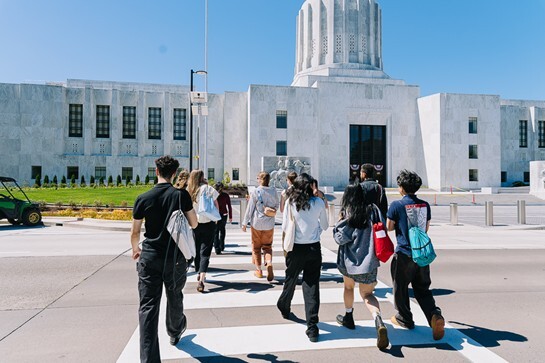
OHA Youth Advisory Council members going to the State Capitol to speak with legislators in June 2026.
Welcome to the launch of the
Statewide Surveys newsletter!
You'll hear from us quarterly throughout the school year with updates on
Oregon's statewide surveys and what they mean for your school or district.

This September update includes:
-
Understanding the surveys
- Launching SHPPS 2027
-
See it in action – example questions right from the surveys, plus how to use them to build community agreements with students.
-
New data is here – 2025-26 results from SHS, EVE Workforce, and SVSS, along with new resources to help you analyze them.
-
What's next – key dates for survey administration
|
Understanding Oregon's statewide surveys and why they matter
Test scores only tell part of the story. They don't tell you if students feel safe, if they feel like they belong. They also can't tell us what our educators' needs are. That's what these surveys are for.
When students and educators respond, they're shaping how the state and community leaders understand what's actually happening in schools. That data informs real decisions, like where support goes or what gets prioritized.

Before a student can learn, they need to feel like they belong, feel safe, and feel well. Educators need that too – it can be hard to support students when you don’t feel heard or supported yourself. Our statewide surveys are how we find out if that’s actually happening in our schools.
|
Oregon state law currently requires three surveys for students and education workforce staff:
- Student Educational Equity Development (SEED) Survey
- Student Health Survey (SHS)
- Elevating Voices in Education (EVE) Workforce Survey
While the SEED and SHS surveys are about student experiences, the EVE Workforce survey is the only survey that gives educators and school staff a direct way to tell the state what is working and what isn’t. That input shapes real decisions about the kinds of support districts and the state can provide.
To learn about the parameters of each 2026-27 survey, check out the Summary and Comparison chart on the ODE Statewide Surveys webpage.
Student Voice Summer Survey
Districts receiving a State Summer Learning Grant or federal 21st Century Community Learning Centers (21st CCLC) funds are required to offer the Student Voice Summer Survey (SVSS). The SVSS is a student perception survey designed to help leaders better understand students’ experiences in summer programs. The survey measures key elements of quality summer programming, including provision of enriching environments that elevate relationships, engaging students by offering opportunities for student voice and choice, and integrating well-rounded learning and social-emotional supports through purposeful planning.
Capturing a Fuller Picture of Oregon School Health:
Launching SHPPS 2027
Get ready! In spring 2027, Oregon Health Authority is replacing the CDC’s School Health Profiles Principles Survey with the Oregon School Health Policy and Program Survey (SHPPS). The SHPPS was designed by state and local subject matter experts based on feedback received from school administrators regarding school health priorities.
The survey asks school-level questions about policies and programs to School Administrators of middle and high schools. Survey results will be used to capture a fuller picture by monitoring issues, developing technical assistance, and prioritizing school health resources at the state and local level.
See it in action:
Building community agreements with student voice
Starting the school year by asking students to co-create classroom agreements? Use results from the Student Health Survey and the SEED Survey to jumpstart the conversation. Teachers can share what students have to say in response to survey questions.
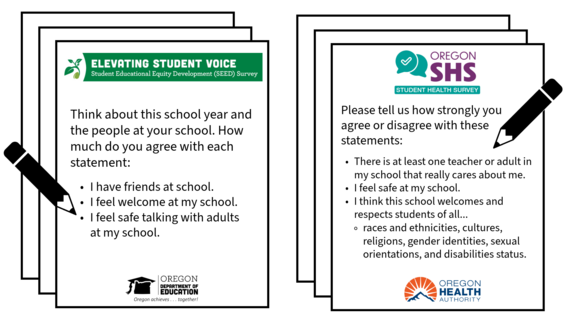 For subject-specific classes, teachers can share how students across the state describe their class activities, and use those results to discuss what types of community agreements would support those types of learning activities:
- Think about what you did in your language arts class this year. How often did you do the following:
- Have a class discussion about what was read.
- Work in pairs or small groups to talk about something you have read.
- Think about what you did in your math class this year. How often did you do the following:
- You got help with math when you needed it.
- Your classmates gave you helpful comments on a math test or assignment.
You can find state-level survey results by item on the SEED Survey and Student Health Survey webpages. For your district’s survey results by item level, reach out to your Superintendent for access to the privately-shared district data.
2026 Data Release:
2025-26 Results from the SHS, EVE Workforce, and SVSS
Results from the 2025-26 surveys are available at the following locations:
|
New Resources for Analyzing Survey Results
Looking for direction about how to efficiently and effectively explore results from multiple surveys and other data collections? ODE developed a “how-to” guide that supports equity-centered, strengths-based data use and responsible interpretation of school survey results to inform community engagement and planning processes.
The Integrated Data Analysis Toolkit for School Districts (PDF) is full of resources – such as data review protocols – for district and building administrators, classroom teachers, school boards, and district equity committees.
What's next:
Survey administration checkpoint
Throughout the school year, several key survey activities take place across Oregon schools. These include the release of public results from multiple student surveys, the launch and close of seasonal surveys, and the publication of statewide reports.
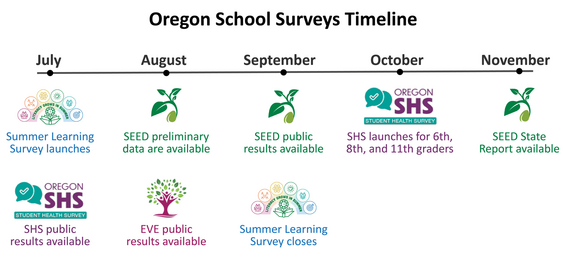
Below is a month‑by‑month outline of major milestones:
- July: Summer Learning Survey launches; SHS public results available.
- August: SEED preliminary data available; EVE public results available.
- September: SEED public results available; Summer Learning Survey closes.
- October: SHS launches for 6th, 8th, and 11th graders.
- November: SEED State Report available.
|