
-
CIP Budget Narrative Supporting Documents (prerequisites) Due
-
CIP Budget Narrative Application Due
-
REMINDER: 2026-2027 CIP Budget Narrative Supporting Documents Due
- Don’t Forget to Reconcile CIP Budget Narratives
- Annual EGMS Shutdown
- Update to the Indirect Rate Calculation in CIP Budget Narrative
- 10 Tips for Federal Program Directors
- ESSA Quick Reference Brief: Time and Effort
- Division 22 Professional Learning Series
- No FST Newsletter in July
To be considered substantially approved the following assurance forms must be signed by the School District’s Superintendent or Designee:
- ESEA Statement of Assurances
- ESEA School Prayer Certificate of Compliance
- General Education Provisions Act (GEPA) Statement
These documents must be completed and signed within the district’s secure OneDrive folder and are required to ensure your district can begin obligating ESEA funds on July 1, 2026.
-
Pilot Districts – April 30, 2026
-
Non-Pilot Districts – June 30, 2026
Reconciliation refers to the process of ensuring that actual spending aligns with the approved CIP Budget Narrative. Reconciliation is required at least annually but recommended quarterly. This process is important because it allows a district/consortium to:
- demonstrate that the award has been used as intended,
- identify transaction errors,
- ensure that award expenditures are complete, and
- plan for remaining funds as carryover.
CIP Budget Narratives should be revised and resubmitted any time a new activity is added, or if the change to an approved activity exceeds 10% in cost.
If you have any questions about this process, please reach out to your regional contact for support.
-
Jen Engberg: Clackamas, Columbia Gorge, Linn-Benton-Lincoln, Multnomah, and Northwest Regional ESDs
-
Sarah Martin: Douglas, Lake, Lane, Malheur, South Coast and Southern Oregon ESDs
-
Amy Tidwell: Grant, Harney, High Desert, InterMountain, Jefferson, North Central, Region 18, and Willamette ESDs

This is a reminder that EGMS will be shut down to external users July 20 – July 21, 2026 for end-of-fiscal-year claim processing. This means no claims can be submitted and only the claims submitted by July 19, 2026, will be paid during this timeframe.
Grantees must submit any grant claims by midnight on Sunday, July 19, 2026, if those claims need to be paid in this current fiscal year and/or included on the annual Schedule of Expenditures of Federal Awards (SEFA).
Grantees who use the cash basis of accounting must submit any grant claims by midnight on Sunday, June 21, 2026, to ensure they receive payment by June 30, 2026, to be included on the annual SEFA for the closing fiscal year.
Please contact us at ode.egms@ode.oregon.gov if you have questions.
|
The Indirect Rate calculation for the 2026-27 CIP Budget Narrative has been updated as part of the Unified Application Pilot. The new Indirect Rate calculation is aligned to the calculation outlined in the Indirect Cost Plan.
The previous calculation used in past iterations of the CIP Budget Narrative was simplified for budgeting purposes; however, this caused confusion when aligning budgeted amounts with final expenditures. The updated calculation should help districts and ODE staff better track amounts between budgets and expenditures moving forward.
The following example has a district using an Indirect Rate amount of 3.5% and no Direct Admin Rate for a grant award of $2,000,000.
Previous Simplified Calculation:
- Award Amount x (Indirect Rate % + Direct Admin Rate %) = Indirect/Direct Admin Cost Set-Aside
- Example: $2,000,000 x (0.035 + 0) = $70,000
New Calculation:
- Award Amount ÷ (1 + (Indirect Rate%/100) + (Direct Admin Rate%/100)) = Direct Costs
- Example: $2,000,000 ÷ 1 + (0.035 + 0) = $1,932,367
- Award Amount - Direct Costs = Indirect/Direct Admin Cost Set-Aside
- Example: $2,000,000 - $1,932,367 = $67,633
If you have any questions regarding the new Indirect Rate Formula, please reach out to your regional contact. Our team appreciates any feedback regarding this change to the system.
There are many moving parts to track as a Federal Programs director. Whether you are new to the position or a seasoned veteran, 10 Tips for Federal Program Directors highlights key practices to follow. From accessing the CIP Budget Narrative, tracking timelines, to learning more about program requirements, this document is designed to help you get started, stay informed, and feel supported.
|
Time and Effort refer to the process of documenting when any part of an employee’s salary is charged to a federal program. Time and effort reports should be prepared by all certificated and classified staff whose salary and benefits are charged to federal funds. In ESSA Quick Reference Brief: Time and Effort learn more about the requirements for district systems for Time and Effort as well as identifying and documenting cost objectives.
Check out other ESSA Quick Reference Briefs here
|
|
 |
The next session in the Division 22 Professional Learning series will be held from 9 - 10:30 am (PT) on Tuesday, June 23, 2026. Participants must register in advance to receive the meeting link and be able to add the session to your calendar. All registrants will have access to the meeting materials and session recordings. Join us to explore the following topics:
Questions? Contact Susan Payne, ODE’s Education Standards and Systems Specialist at Susan.Payne@ode.oregon.gov or (503) 580-6814.

The FST Newsletter will be on vacation during the month of July, but below are just a few of the things we intend to communicate in our August edition:
- Posting of Final SY 2026-27 Allocations
- CIP Budget Narrative/Spending Updates
- FST trainings and resources for SY 2026-27
|
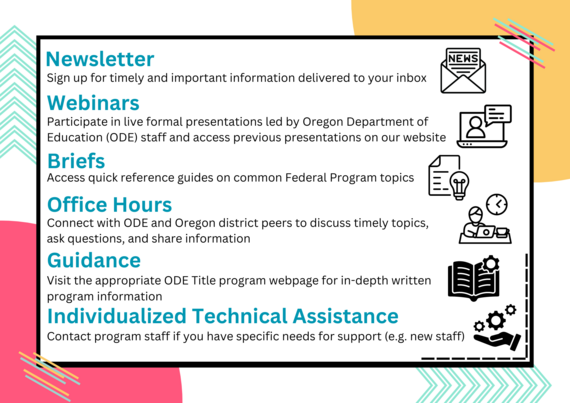
Federal System Team's "Framework of Support"
Our goal is to provide differentiated support and strengthen the partnership between districts and ODE federal program staff. Check out the resources and support below and reach out to let us know how we can support you!
|