|
Social Science Newsletter- May 2026 - JAHM and APIDA Celebrations
|
|
Thank You, Teachers — Happy Teacher Appreciation Week!
This week, May 4-8, we celebrate the educators who show up every day with dedication, creativity, and care for their students. From kindergarten classrooms to high school hallways, teachers deliver lessons, build confidence, spark curiosity, and create spaces where every student can grow.
Social science teachers play an especially vital role in this work. By helping students understand history, culture, civics, and the diverse communities that make up our world, they equip young people with the critical thinking and empathy needed to be engaged, informed citizens. In this newsletter you will find classroom resources and local events for Jewish American Heritage Month and Asian Pacific Islander Desi American Heritage Month, a book review connecting civics education to Oregon's standards, news about Oregon students competing on a national stage, and professional development opportunities this summer and fall, including workshops, free online conferences, and the 2026 Ethnic Studies Summer Institute hosted by OHS.
Thank you for all you do for Oregon students!
Amit Kobrowski
Social Science Specialist
Jewish American Heritage Month
May is Jewish American Heritage Month (JAHM), a time to recognize the rich history, culture, and contributions of Jewish Americans to the social, cultural, and civic life of the United States. Jewish Americans have shaped American literature, science, law, civil rights, and public service in ways that remain underrepresented in most standard curricula. Teaching Jewish American history offers students a meaningful opportunity to explore themes of immigration, identity, religious freedom, and the American promise of pluralism.
Connections to the Classroom:
Jewish American Heritage Month connects to multiple Oregon Social Science Standards across grade levels. For younger students, it offers entry points into community, identity, and cultural contributions. For older students, it opens inquiry into U.S. immigration history, the experience of historically marginalized communities, and the ongoing tension between assimilation and cultural identity. Essential Disciplinary Practice V and the Civics Concept Identity, Roles and Responsibilities (C.IR) support exploration of how identity shapes civic participation and belonging in a pluralistic democracy.
Online Resources for K-12 Educators
-
Jewishamericanheritage.org is the official national hub, run by the Weitzman National Museum of American Jewish History. It includes filterable lesson plans and professional learning opportunities searchable by subject, theme, and grade level. There's also a dedicated educator toolkit.
-
Jewishheritagemonth.gov is a portal with resources from The Library of Congress, National Archives, National Endowment for the Humanities, National Gallery of Art, National Park Service, and U.S. Holocaust Memorial Museum.
-
ADL Education has a JAHM-specific resource collection that includes lesson plans, videos, an educator Q&A guide, and a recommended book list for elementary and middle school covering Jewish culture and antisemitism.
-
Institute for Curriculum Services (ICS) offers virtual trainings, mini-lessons, and a video on Jewish American identity, history, and experience, all available through a special JAHM webpage and a ICS virtual workshop on: May 6, May 13, and May 20, 2026. Educators receive compensation upon completion.
-
Center for Jewish-Inclusive Learning just launched this week. The Jewish Education Project unveiled a new digital portal just ahead of JAHM, housing curated curricula from multiple content providers so educators have a centralized place to find materials about Jewish history, people, and identity.
-
Prizmah includes resources on Antisemitism for Schools and Students curated to support school professionals address and teach about modern antisemitism.
-
Videos, articles and additional classroom resources on Jewish Americans by UnPacked for Educators.
|
Asian Pacific Islander Desi American (APIDA) Heritage Month
May is also Asian Pacific Islander Desi American Heritage Month, honoring the histories, cultures, and contributions of Asian Americans from the Asian continent and the Pacific islands of Melanesia (New Guinea, New Caledonia, Vanuatu, Fiji and the Solomon Islands), Micronesia (Marianas, Guam, Wake Island, Palau, Marshall Islands, Kiribati, Nauru and the Federated States of Micronesia) and Polynesia (New Zealand, Hawaiian Islands, Rotuma, Midway Islands, Samoa, American Samoa, Tonga, Tuvalu, Cook Islands, French Polynesia and Easter Island). The diversity in national origin, language, religion, experience, and stories are essential for a more complete understanding of Oregon and American history. Oregon educators will find strong connections to the Social Science Standards through themes of immigration, identity, civil rights, and community resilience.
Connections to the Classroom:
APIDA Heritage Month connects naturally to Oregon Social Science Standards addressing immigration history, the experiences of historically underrepresented communities, and the ongoing work of building an inclusive democracy. The Japanese American Museum of Oregon's educator workshop this summer offers a deeper dive into one of the most significant civil liberties stories in American history.
Oregon/Local Events (In-Person)
-
Lan Su Chinese Garden is running AANHPI Heritage Month programming all of May. Events include Cultural Immersion Saturdays (May 10, 17, 24 & 31), each spotlighting a different AANHPI culture, and Family Fun Sundays on May 4, 18, and 25 with interactive games, crafts, and art for all ages.
-
Oregon Rises Above Hate coordinates AANHPI events across Portland throughout May, including community performances and free admission days at local cultural institutions.
-
Japanese-American Museum of Oregon (Old Town, Portland) runs special programming and exhibits during Heritage Month.
Online Resources for K-12 Educators
- Smithsonian, Library of Congress, National Archives, and National Park Service all share AAPI resources, podcasts, and collection items. It also includes a K-12 Teacher's Guide.
- APIDA resources from NCSS.
-
AAPI History Hub is specifically built for educators. It includes K-5 and 6-12 planning guides showing where AAPI history fits into existing curricula, plus professional learning opportunities and tools for families.
-
Share My Lesson has a free AANHPI Heritage collection. Resources are designed for social science, ELA, and SEL integration, covering leaders in politics, science, sports, and the arts.
- ADL has a compiled K-12 AAPI Heritage Month resource list with classroom-ready materials.
|
Professional Development

2026 Belfer National Conference for Holocaust Education
United States Holocaust Memorial Museum | Free Online Conference for Educators in June
The 2026 Belfer National Conference for Holocaust Education is taking place June 22-24. At this free, online professional learning conference, educators will explore the latest practices for delivering accurate and meaningful Holocaust education to all students. Get questions answered by Museum historians and experienced educators through more interactive sessions. Plus free books and resources (while supplies last). Register
|
Oregon Historical Society
2026 Ethnic Studies Summer Institute -- July 28-29, Eastern Oregon University, La Grande. Expand the narrative of Oregon history using Integrated Ethnic Studies. Sessions hosted by the Oregon Historical Society, the Japanese American Museum of Oregon, Oregon Black Pioneers, the Oregon Jewish Museum and Center for Holocaust Education, the Portland Art Museum, and ODE. Leave with classroom-ready resources supporting the Social Science Standards.
Open to K-12 social science and ELA educators and TOSAs teaching in 2026-2027. PDUs available; $600 stipend for rural educators.
Application deadline: May 29. Learn more and register. 2026 Ethnic Studies Summer Institute.
|
Oregon Black Pioneers
Educator Workshop: Oregon's Black History
Friday, June 19, 9am-3pm, Portland.
A full-day professional learning experience including a guided walking tour, a modeled OBP lesson, and direct connections to curriculum. Participants receive a $100 stipend and free classroom-ready resources .Workshop Application
|
Confederated Tribes of the Grand Ronde
2026 CTGR Education Summit
Save The Date: Friday, August 21, Spirit Mountain Casino.
This year's theme: "Rooted in Community, Growing Through Education." Registration opens in May. This year’s theme celebrates learning that is grounded in community, culture, and doing.
|
Western History Association
Teaching and Public Education Opportunities -- October 21-24, 2026, Portland. Highlights include a Teacher-Author Luncheon, Teacher-Scholar Collaboration, and a Lesson Plan Contest with a $1,000 prize. Submission deadline: June 15, 2026. Learn more and register
|
ICS Virtual Professional Development:
ICS Summer Institutes -- Two tracks: Jewish History (2 days) and Teaching the History of the Arab-Israeli Conflict Using Primary Sources (3 days). Stipends available.
Apply
|
Case Method Institute: Two Opportunities
- CMI Boston 2026 (July 6–7, Harvard Business School): combines a fully-funded in-person event led by Professor Moss with independent preparatory coursework on our online platform. The event will likely include a live case discussion and a preview of David Moss’s eagerly awaited book on case method pedagogy. Space is limited. Applications will be accepted on a rolling basis.
-
Online PD program: a fully online course available on demand through CMI’s learning platform, allowing teachers to begin at any time.
Teachers may apply for either program.
|
|
|
Book Review
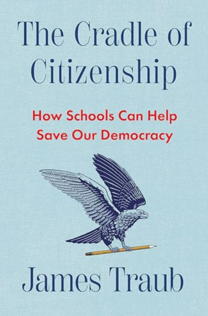
Cradle of Citizenship by James Traub
"With great power comes great responsibility." -- Ben Parker to Peter Parker
James Traub's Cradle of Citizenship arrives at a moment when civics education has returned to the center of public debate. Traub reminds us that few experiences are as nearly universal or as formative as public schooling, and that the power of public education carries a responsibility to teach both about and for democracy. This conviction, central to 19th and early 20th century educators like Horace Mann, Booker T. Washington, Jane Addams, and John Dewey, is revitalized today among educators like Danielle Allen and Diana Hess.
The book opens by revisiting public education in the early 20th century, a useful reminder that civic polarization, cultural conflict, and anxieties about preparing students for "the real world" are not new. Traub injects fresh urgency to the discussion about why we teach civics as young Americans appear to be losing faith in democracy, and polarization has made substantive civic conversation increasingly difficult. He argues for a thoughtful, sustained commitment to civic education throughout K-12 to help rebuild a common foundation for everyone living in the United States.
Visiting schools across the country, Traub notices a sharp difference between classrooms focused on transferable skills like critical thinking and those that ground civic education in history to build a shared foundation of content knowledge and cause and effect reasoning. This is well-trodden ground in social science education and Traub joins E.D. Hirsch’s case for shared content knowledge, Sam Wineburg's argument for disciplinary historical thinking, and Gholdy Muhammad's framework for equity-centered learning, along with the National Council for Social Studies statement. Traub also raises concerns about the drift toward skills instruction and personal relevancy in many non-AP and non-IB classrooms as an equity consideration along with the discussion on the purpose of social science and civic education.
The 2024 Oregon Social Science Standards and the supporting Instructional Framework encourage educators to move beyond the either/or framing of skills vs. content. For example, a quick look at the eighth grade civics standards reveals a deliberate balance of content requirements rooted in skills for analysis of primary sources, the examination of specific historical events, the ability to connect current events to past examples, alongside guidance for teachers through the Essential Practices to address disciplinary thinking, equity, and civic action.
Traub's review of current civic revival projects and examples of 'best practices' in social science classrooms encourages social science educators to reflect on our own classroom practice and approaches to civic education. Perhaps most unexpectedly, Traub pulls the civic education discussion into the larger conversation on literacy. He insists that students spend more time reading and discussing challenging grade level text and less on technology and personal points of view. In a point that echoes Danielle Allen's work, Traub argues that the vocabulary built through social science content is itself a boost to literacy, and this 'linguistic empowerment' is the foundation for a new generation of civic engagement. For Oregon educators, Traub's book carries both a challenge and an invitation: how to use the power of education to build a more pluralistic democracy for all.
|
Oregon Students Shine at National Civics Competition
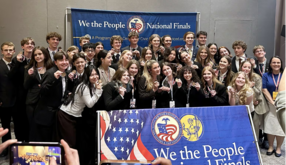
Two Portland high schools brought Oregon into the national spotlight this spring. Grant High School placed third and Lincoln High School placed sixth at the national "We the People: The Citizen and the Constitution" finals, held in Maryland in April. The competition challenges student teams to demonstrate deep knowledge of the U.S. Constitution, government, and Supreme Court decisions. Read the full story at OPB.
|
|
|
|
|
|