|
Updates from the Oregon Department of Education
1. Informational Update: Item Skipping on the ELPA Summative (Follow-Up)
2. Upcoming Deadline: May OSSB/M Scheduled Release
News and Resources for Multilingual and Migrant Education
1. Advanced Community Helper Suicide Prevention Training – Community Input Requested (English and Spanish)
2. 2026 Art & Essay Contest for Farmworker Youth
Upcoming Events, Training & Conference Opportunities

1. Informational Update: Item Skipping on the ELPA Summative (Follow-Up)
Earlier in the 2025-26 testing season, some district personnel expressed concerns to ODE regarding “item skipping” on the in-person fixed form ELPA Summative. ODE investigated the concern using available data and indicated that the topic would be revisited later in the window.
In the 2025-26 testing year, Oregon moved from a semi-adaptive English Language Proficiency Assessment (ELPA) Summative to a fixed form version of the test that is delivered as four individual domain tests. On the fixed form, students are able to leave items unanswered and submit tests with unanswered items. Unanswered items are scored as incorrect.
ODE reviewed testing data from January, February, and March 2026, and reaffirmed conclusions from the initial investigation:
- No change to the test is warranted at this time.
- It appears that local action can be effective in addressing item skipping.
Context
ODE’s original message about item skipping on the ELPA was disseminated to the DTC listserv on 2/25/26 and reproduced in the MME Newsletter on 3/5/26. Please refer to those messages for full context.
Data Analysis
ODE examined data for tests taken from 1/13/26 to 3/26/26. Analysis revealed patterns such as the following:
- Item skipping rates were highest near the beginning of the test window, and decreased as more students tested.
- Most students skipped 0 items.
- In the domain with the most skipping (Grade K Reading), 88.89% of students completed the entire domain test (skipped 0 items). Another 10.7% skipped at least one item but fewer than half the items. 1.41% skipped half the items or more.
- In all other grade band/domain test combinations, 90%+ of students completed the entire domain test (skipped 0 items), with twelve combinations exceeding 95% “entirely complete”.
- Item skipping was not significantly present for any grade band or domain test.
- “Significant” 2%+ of students left at least half the items unanswered.
- Very few students are skipping all or most of the ELPA Summative.
- Six students statewide skipped at least half the items on exactly 4 domain tests. (Up from two students as of 2/16.)
- Twelve students statewide skipped at least half the items on exactly 3 domain tests. (Up from seven as of 2/16.)
- 860 students statewide skipped at least half the items on one or more domain tests. This constitutes 1.53% of the 55,845 ELPA tests (i.e. all non-exempt domains) that were completed as of 3/26. If we factor in the 2,660 ELPA tests that were in progress (i.e. one or more non-exempt domains unfinished) as of 3/26, the rate decreases to 1.47%.
- Item skipping continues to vary across districts and domains.
- As in the 2/16 data, the rate of item skipping is not proportional to the number of students tested across districts. Some districts tested many students and saw proportionally little skipping. Other districts saw proportionally more skipping even though they tested comparatively fewer students.
- Listening saw the lowest skipping rates. Speaking saw the highest skipping rates.
Conclusions
These testing data include nearly all students that will test in 2025-26. Based on data analysis and district reports, ODE has reaffirmed the following conclusions (some repeated from 2/25 message):
- The test is functioning as intended.
- Item skipping is an allowable and designed test behavior (and has been present on the remote ELPA Summative for three years).
- It is not clear that item skipping is higher in 25-26 than random guessing was in 24-25 and prior years.
- Item skipping rates decreased from observed rates as of 2/16. Item skipping will likely have little measurable impact on On Track to ELP (OTELP) rates.
- If item skipping is an issue for a given school or district, ODE recommends pursuing local measures, such as:
- Exposing students to the Sample Test to increase familiarity with the test platform and item selection processes.
- Familiarizing staff with the intended behavior and function of the test (including the possibility of item skipping).
- Item skipping likely has different causes. For example:
- It is possible that lack of familiarity with testing equipment or the testing platform may explain some item skipping in Grade K or with some students new to the Oregon school system.
- Low skipping rates in Listening and higher skipping rates in Writing and Speaking may suggest the influence of a high affective filter (cf. this article by Stephen Krashen).
On Track to ELP
(repeated from 2/25 message) The most important aspect of ELP testing is accurately measuring what a student knows and can do. This equips districts to provide effective instruction and ensures that students who need language services receive those services, while students who no longer need language services exit EL status.
That being said, a student’s OTELP baseline is established by their first ELPA Summative test. For item skipping to negatively affect OTELP, the student needs to be taking at least their second ELPA Summative test and would need to demonstrate a significantly different testing behavior from the prior year.
For more information about On Track to ELP, contact Stephanie Evers.
In Closing
Thank you for your patience as we waited for further testing data to help confirm or adjust conclusions from our 2/16 investigation. ODE believes that no state-level action is needed regarding item skipping at this time, but will remain alert for concerning patterns or shifts in testing data.
Contact the ODE Assessment Team with further questions or concerns.
|
2. Upcoming Deadline: May OSSB/M Scheduled Release
Pending Seal of Biliteracy awards will begin processing on the first working day after 5/1/26.
- ODE will begin processing pending Oregon State Seal of Biliteracy/Multiliteracy (OSSB/M) awards on the first working day after 5/1/26. Any OSSB/M requests submitted after 5/1/26 will be processed during the June scheduled release.
- ODE will notify submitters of any errors that prevent processing. Submitters will have the opportunity to correct their submission.
For more information, consult the OSSB_M Manual.
Contact Ben Wolcott, OSSB/M coordinator, with questions or concerns.

The test window for the English Language Proficiency Assessment (ELPA) Summative and the Alt ELPA closed on 4/10/26. It is no longer possible to test students on these two instruments, but it is still possible to correct domain exemption errors by adding domain exemptions. If a student tested in a domain that should have been exempted, that error may be corrected at any time prior to the ELPA test status change deadline of 6/5/26. Submit such requests via ODE’s Test Impropriety and Irregularity Initial Report Form (found in the Forms accordion on the Assessment Administration page).
Contact Ben Wolcott, ELPA Specialist, with questions regarding ELPA testing.
|

4. Youth Advisory Council Applications Now Open for the Next Cohort
Applications are now open for the next cohort of the Oregon Department of Education’s Youth Advisory Council (YAC). This statewide council brings together youth leaders who are passionate about using their voices to shape education policy and programs that impact Oregon’s students.
YAC members have contributed to efforts such as improving state surveys, informing implementation of the Governor’s Executive Order on Personal Electronic Devices, shaping college credit in high school priorities, and providing feedback on instructional materials. Applications are open through May 31, and additional information is available online. Click here to apply and to learn about this opportunity; applications close May 3.
Contact Youth Advisory Council Coordinator, Amy Hodge, for more information.
|

1. Advanced Community Helper Suicide Prevention Training – Community Input Requested (English and Spanish)
In 2026, the Oregon Health Authority (OHA) will partner with Community Connections Psychological Associates (CCPA) to launch the Advanced Culturally‑Infused Suicide Prevention Community Helper Training. This initiative is designed to strengthen community helper skills through culturally responsive, practice‑based learning across Oregon. As curriculum development, pilot trainings, and the first Trainer Academy cohorts move forward, the work is intended to be informed by the insights and needs of the Spanish‑speaking communities it seeks to serve.
An invitation is extended to individuals interested in participating in this effort. A brief survey in Spanish is being used to gather information regarding preferred levels of engagement, including early feedback, participation in focus groups, involvement in pilot trainings, or future trainer certification.
The first community engagement opportunity will be a focus group to gather input and ideas for the training. Registration is open for the Advanced Community Helper Training (ACHT) Focus Group, scheduled for Wednesday, April 15, 2026, from 6:00 p.m. to 7:30 p.m. PST. The session will be conducted virtually via Zoom.
Participant perspectives will help ensure the training is meaningful, culturally infused, and relevant to Oregon’s diverse communities. Contributions of all levels are welcomed, whether through limited participation or exploration of opportunities to become a trainer.
Contact community.connections.psych@gmail.com with questions.
---
Capacitación Avanzada en Prevención del Suicidio para Ayudantes Comunitarios – Se Solicita Participación Comunitaria
En 2026, la Autoridad de Salud de Oregón (OHA) se asociará con Community Connections Psychological Associates (CCPA) para lanzar una capacitación avanzada en prevención del suicidio, diseñada con un enfoque culturalmente sensible y orientada a fortalecer las capacidades de los ayudantes comunitarios en Oregón. Este objetivo se alcanzó mediante un enfoque de aprendizaje práctico centrado en la capacidad de respuesta cultural hacia comunidades de habla hispana en el estado. A lo largo del desarrollo del plan de estudios, las capacitaciones piloto y las primeras cohortes de la Academia de Entrenadores, se buscó que este trabajo estuviera informado por las perspectivas y necesidades de las comunidades hispanohablantes a las que está dirigido.
Con este propósito, se extiende una invitación a manifestar interés en participar. Una breve encuesta permitirá conocer las modalidades de participación de preferencia, incluyendo la provisión de comentarios iniciales, la participación en grupos focales, la colaboración en programas piloto o la certificación futura como formador o formadora.
La primera reunión comunitaria consistirá en una discusión en formato de grupo focal, cuyo objetivo será recopilar ideas y aportes sobre la capacitación. Se invita a registrarse en el Grupo Focal de Capacitación Avanzada para Ayudantes Comunitarios (ACHT) que se llevará a cabo el miércoles 15 de abril de 2026, de 6:00 p. m. a 7:30 p. m. (PST). La sesión se realizará de manera virtual a través de Zoom.
Las perspectivas compartidas contribuirán a garantizar que la capacitación sea significativa, culturalmente integrada y relevante para las diversas comunidades de Oregón. Toda forma de participación será valorada, ya sea mediante una contribución puntual o a través de la exploración de oportunidades para la formación como entrenador o entrenadora.
Comuníquese con community.connections.psych@gmail.com si tiene preguntas.
|
2. 2026 Art & Essay Contest for Farmworker Youth
The Children in the Fields Campaign invites migrant and seasonal farmworker youth ages 10–18 to share their voices through the annual Art & Essay Contest. Running April 1–July 31, 2026, the contest encourages original artwork and essays inspired by the theme From Farmwork to Powerful Futures, celebrating resilience, dreams, and possibility. Entries are accepted in English or Spanish and provide a powerful opportunity for youth stories to be seen and heard nationwide. Click here to learn more.
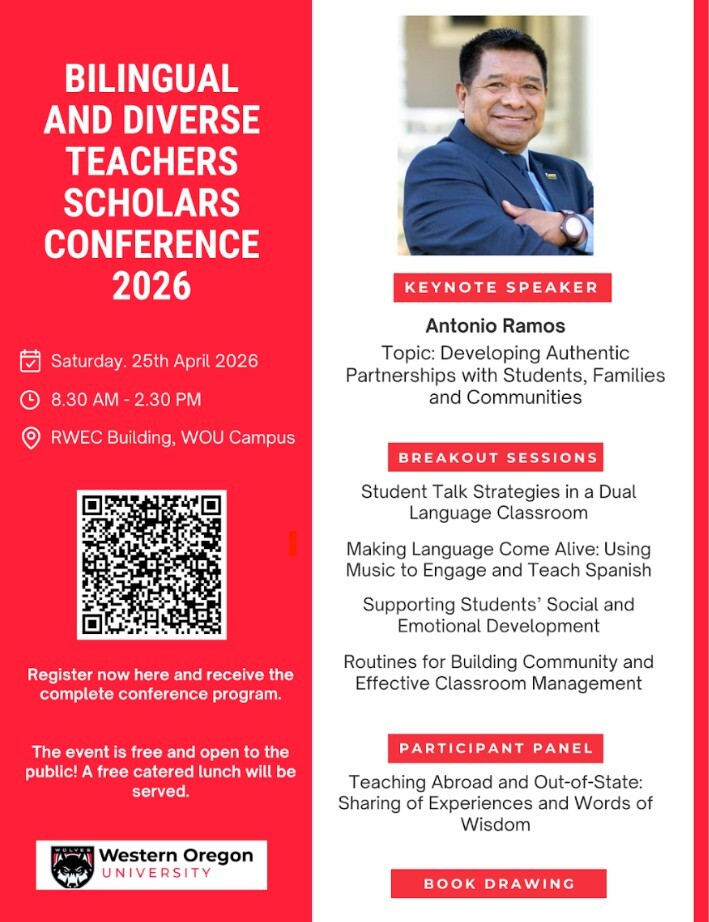
1. WOU Bilingual and Diverse Teacher Conference, April 25, 2026
Western Oregon University will host the Bilingual and Diverse Teacher Conference on Saturday, April 25, from 8:30 a.m.–2:30 p.m., in person on the WOU campus (RWEC Building). This free, public conference brings together bilingual and diverse scholars, educators, aspiring teachers, and community members from across Oregon to connect, network, and share effective classroom practices.
The conference will feature a keynote address, breakout sessions led by teacher educators and K–12 practitioners, a participant panel, and a book giveaway. Breakfast refreshments and a catered lunch will be provided. Click here to register for this event.
Contact Dr. Maria Dantas-Whitney with questions.
 Back to top
2. A Spanish-Language Support Group for LGBTQ+ Families
Rainbow Families Support Group / Grupo Arcoíris de Apoyo Familiar, hosted by Oregon Family Support Network, is a Spanish-language virtual support group for parents, caregivers, and allies of LGBTQ+ youth. The group provides a safe and inclusive space to connect, learn supportive strategies, and build community across all stages of gender identity and sexual orientation. Meetings are held monthly on the second Wednesday of each month. Click here to register.
Back to top

3. Conexión Familiar: A Monthly Support Group for Spanish‑Speaking Families
Conexión Familiar, by Oregon Family Support Network, is a safe online space for parents and caregivers of children and youth facing emotional, behavioral, and mental health challenges. The group meets on the first Wednesday of each month from 5:00–6:00 PM and offers support, learning, and community connection. Click here to register.
Back to top
|

If you have content or stories you’d like featured in our newsletter, we want to hear from you! Whether it’s an article, event, or an inspiring story, your contributions add depth to our discussions. Please send your submissions and ideas to Estephany Membreno, Administrative Specialist, and you may see your content in an upcoming publication.
|

For questions or assistance, the Multilingual and Migrant (MME) team is available to support you. Please contact us via email for further information.
|
|
Hector Aguirre, Migrant Education Title IC Specialist
|
|
Diego Contreras-Medrano, Migrant Education Research Analyst
|
|
Jennifer Fontana, Multilingual Education Specialist
|
|
Kelly Kalkofen, English Learner Outcomes Program Education Specialist
|
|
Yuliana Kenfield, Migrant Education Title IC Specialist
|
|
Mary Martinez-Wenzl, Director of Multilingual & Migrant Education Team
|
|
Estephany Membreño, Administrative Specialist II
|
|
Kim Miller, Title III Education Specialist
|
|
Myrna Muñoz, English Learner Outcomes Program Education Specialist
|
|
Reza Norouzian, Multilingual Education Research Analyst
|
|
Natalia Piar, Multilingual & Migrant Education Team Coordinator
|
|
Marisol Rodriguez, Administrative Specialist II
|
You were added to this newsletter if you are part of the Migrant Education Program and/or the Title III English Learner listserv. Migrant Ed and Title III leaders, staff, and interested members of the public may subscribe to this newsletter through ODE's QuickSubscribe portal at any time. We thank you for serving Oregon's multilingual and migrant students.
|