April Newsletter
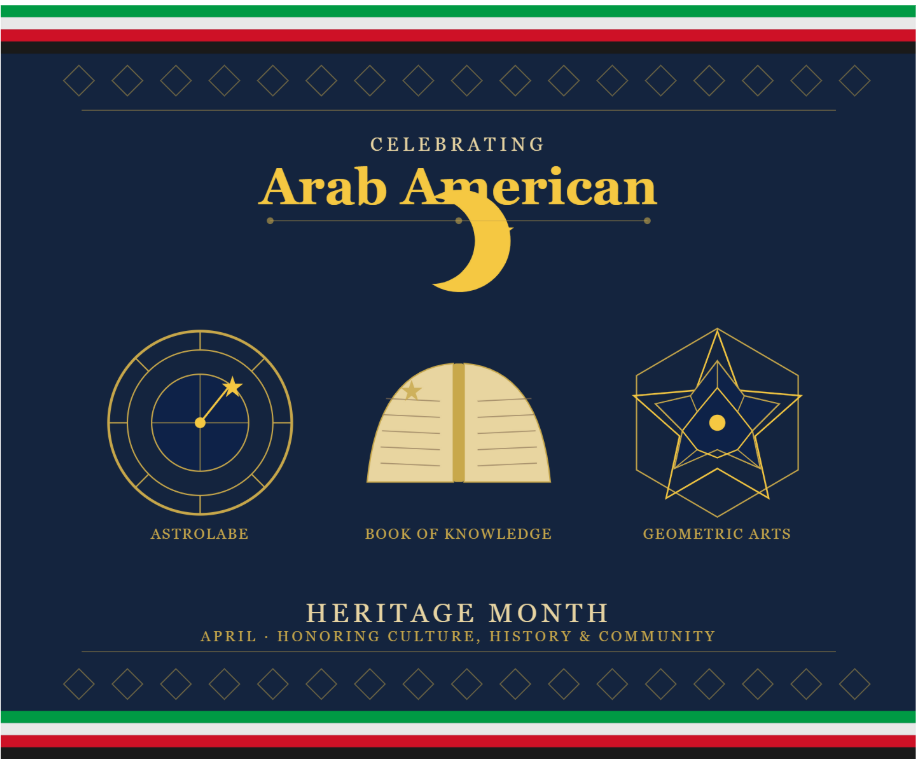
Arab American Heritage Month
April is National Arab American Heritage Month, a time to recognize and celebrate the rich cultural heritage, history, and contributions of the more than 3.7 million Arab Americans and 31,000 Arab Americans in Oregon who have shaped the social, economic, and cultural fabric of the United States and Oregon. Arab Americans trace their roots to more than 20 countries across the Middle East and North Africa, representing enormous ethnic, religious, and linguistic diversity. Arab Americans have made extraordinary contributions to science, literature, the arts, medicine, public service, and civil rights advocacy, contributions that remain underrepresented in most standard curricula. Oregon was one of the first states to have permanently designated April as Arab American Heritage Month by state law, making this observance a matter of state policy as well as national recognition.
Connections to the Classroom:
Exploring heritage celebrations aligns to many Oregon Social Science Standards. For younger students (K-5), Arab American Heritage Month provides an opportunity to build foundational understanding of cultural diversity, family, and community, exploring how people from many backgrounds contribute to shared American identity. For older students (6-12), the month opens deeper inquiry into U.S. immigration history, the experiences of historically marginalized communities, the role of stereotyping and media representation, and what it means to be an American. Essential Disciplinary Practice VII, the Civics concept Identity, Roles and Responsibilities (C.IR), and the History concept Communities and Pluralism (H.CP), requires exploration of perspectives, beliefs, and practices that support a more complete understanding of our pluralistic democracy.
Resources:
Arab American Foundation- Ways to celebrate throughout the month
Alif Institute- Programs and events
Arab American National Museum- a resource for Arab American history, arts, culture and contributions
Teach MidEast-Background and classroom resources on the history, art, culture of the region
Learning for Justice-Article on Arab American Heritage Month significance
K-5 Books -Read aloud and read along books for elementary school
Genocide Awareness
April is Genocide Awareness Month with several pivotal commemorative dates: the start of the Rwandan Genocide against the Tutsi, Yom HaShoah/Holocaust Remembrance Day, the beginning dates of the Cambodian and Armenian Genocides. Teaching the history of genocide supports students in understanding how ordinary societies can collapse into mass violence, what warning signs look like, and what individuals and institutions can do to prevent and intervene.
Connections to the Classroom:
For younger students (K-5), the Oregon Social Science Standards offer grade level entry points focused on foundational democratic values: fairness, inclusion, and standing up for others. For older students (6-12), genocide education builds analytical tools to examine how prejudice escalates and to grapple with the roles of bystanders, upstanders, perpetrators, and rescuers. Oregon's Senate Bill 644 (2019) mandates Holocaust and genocide education across K-12. Essential Disciplinary Practices V and VIII, requires students to evaluate how discrimination shapes history and to demonstrate empathy for communities facing systemic barriers. Use the Oregon Social Science Framework to explore resources on Genocide and the Holocaust.
Additional Resources:
Teaching the Armenian Genocide Through Survivor Voices
April 7, 2026 at 1 PM PT
Registration
Bringing a Young Voice to Life: Explore a Vilna Ghetto Diary Through Interactive Online Museum
Explore the newly redesigned Bruce and Francesca Cernia Slovin Online Museum. This webinar connects to Units 4, 5, and 7 on the Echoes & Reflections website.
April 20th, 2026 at 1 PM PT
Registration
 Earth Day — April 22
Recent legislation in Oregon highlights the significance of climate education. While HB 3365, signed into law in 2025, requires that future revisions to Oregon's academic content standards in science, health, and social science address the causes and effects of climate change and strategies for building community resilience, there are already many connections in the current standards to teach about climate, the environment, and civic engagement.
Oregon's 2024 Social Science Standards weave human-environment interaction and civic action through every grade band. Geography domain's G.HE (Human Environmental Interaction) and G.HI (Human Interaction and Interconnections) concepts span across grade levels. Climate education also connects to C.CE (Civic Engagement) and the Essential Disciplinary Practice of applying social science knowledge to take informed civic action. Similarly, the 2022 Science Standards flag dozens of climate-proximal performance expectations from kindergarten through high school. Health standards connect environmental conditions to personal and community wellness at nearly every grade level. In addition to the TSEL Framework and Standards, ODE offers a guide for Integrating Oregon’s Transformative SEL and K-12 Science Education. This guide offers tools for supporting students in processing climate-related emotions and developing the agency to take action, including a dedicated Youth Climate Action Toolkit for Educators.
Resources
EarthDay.org Education Library- Lesson plans, environmental history timelines, a Climate Civics Toolkit, and a host-a-teach-in guide.
SubjectToClimate 2026 Teacher Guide- Flexible, grade-differentiated materials (K–12) that can fit a single class period, a full week, or the whole month.
Current Events
Supreme Court Cases: Birthright Citizenship
Trump v. Barbara is more than another Supreme Court case in the news. It has the potential to fundamentally alter the longstanding application of the 14th Amendment definition of citizenship. While the executive order at the center of the case applies only prospectively to children born more than 30 days after it takes effect, students across Oregon may have concerns about how the argument in the court and the discussions of immigration and citizenship creates uncertainty about status and belonging.
As with many social science topics, it is important to approach discussion with care:
- Establish clear norms for respectful dialogue
- Avoid cold-calling students
- Be prepared to connect students and families with school counselors or support staff if needed.
The goal is to deepen civic learning while building and maintaining community. The case was heard on April 1st with a ruling expected by late June or early July.
Resources
Oral arguments April 1st- All Supreme Court oral arguments are available on webpage.
Trump V. Barbara- American Bar Association reviews facts of the case in front of the Supreme Court of the United States on April 1st, 2026.
National Constitution Center- Background readings on 14th Amendment and previous cases
The Immigrant Learning Center - Overview of concept of Birthright Citizenship
Federalist Society- Panel discussion on "What's Next for Birthright Citizenship?"
Executive Order on Citizenship- January 20th, 2025 Proclamation from President Trump
SCOTUS Blog Coverage- Numerous articles and amicus briefs from constitutional scholars on Birthright Citizenship and current case.
New York Times- Kate Masur and Martha Jones review history of 14th Amendment
EdWeek- “Birthright Citizenship Case Raises Stakes for Schools and Undocumented Students”
Professional Development
2026 Ethnic Studies Summer Institute
Tuesday and Wednesday July 28 & 29
9am–4pm
Eastern Oregon University, La Grande
Application Deadline: Wednesday, May 29
Expand the narrative of Oregon history using Integrated Ethnic Studies! Attend sessions hosted by the Oregon Historical Society, the Japanese American Museum of Oregon, Oregon Black Pioneers, the Oregon Jewish Museum and Center for Holocaust Education, Oregon Department of Education, and the Portland Art Museum, collaborate and lesson plan with fellow educators, and leave with classroom-ready resources that support the Social Science Standards in teaching about the contributions and perspectives of Black, Chinese, Japanese, and Latine Oregonians; tribal history and Native nations; and Holocaust, genocide, and human rights education.
The Ethnic Studies Summer Institute is open to K–12 social science and English language arts educators and TOSAs teaching during the 2026–2027 school year. PDUs are available to all participants and a $600 stipend is available for rural educators.
Learn more and register here: 2026 Ethnic Studies Summer Institute.
|
NCSS Summer Leadership Institute (SLI),
July 13–15 in Washington, D.C. This is an opportunity to strengthen your advocacy skills, deepen your leadership practice, and connect with a national network of passionate social studies educators, all while the nation's capital is alive with the celebration of America 250.
SLI is designed for classroom teachers, curriculum and building leaders, and leaders from NCSS affiliated state councils, special interest communities, and associated groups who are ready to build their capacity for advocacy and leadership in social studies education.
Registration
|
OJMCHE Panel Discussion
Between Antisemitism and Activism: Discussing the History of the Jewish University Experience
Sunday, April 12 | 2 – 3:30 pm
Join OJMCHE for a panel discussion addressing the history of Jewish university experiences through the Nazi era to today. Panelists will discuss Jewish experiences of antisemitism and involvement in activism on college campuses, and will specifically dive into what this means for Jewish college students today.
RSVP
|
Japanese American Museum of Oregon
Teacher Workshop
July 1-6, 2026 • Portland, OR and Klamath Falls, OR
Apply now for the Japanese American Museum of Oregon’s 6-day teacher workshop in Portland and at the Tule Lake Monument. This in-depth learning experience includes travel from Portland to the Tule Lake area outside of Klamath Falls, Oregon. Participants will gain knowledge of Japanese American history in Oregon, a variety of resources for teaching Japanese American history in the classroom, and the opportunity to hear directly from Japanese American community members, scholars, and local educators about the forced removal and incarceration of Japanese Americans during World War II.
A group of 8 educators (K-12) will be selected to participate. Priority will be given to Oregon educators, but Washington educators are also welcome to apply.
The application period ends on Friday, May 1, 2026.
APPLY NOW
|
Institute of Curriculum Services
LEARN AND EARN THIS SUMMER WITH ICS
The Institute for Curriculum Services (ICS) is accepting applications for our Summer Institutes. This year, ICS is offering two different summer learning tracks:
Track 1: Jewish History. Track 2: Teaching the History of the Arab-Israeli Conflict Using Primary Sources.
Space is limited and priority will be given to K–12 educators and leaders (particularly in Social Studies and ELA) who are seeking to explore a new area of study. Our goal is to provide this learning opportunity to those who have not yet covered the content offered in each track. Stipends and certificates of participation will be provided to those who are accepted and complete the requirements of their track.
APPLY TODAY!
APRIL’S VIRTUAL PD EVENTS
Jewish Americans
April 22nd - 3 pm-4 pm PT over Zoom
Get ready for Jewish American Heritage Month (JAHM) with a workshop designed to help you teach the unique identity, history, and contributions of Jewish Americans.
Link to registration
Push, Pull, and Policy: The Jewish Experience in America’s Melting Pot (1880-1924), presented by ICS and The Olga Lengyel Institute for Holocaust Studies and Human Rights (TOLI)
April 30th - 3:30 pm-4:30 pm PT over Zoom
ICS and TOLI present an interactive exploration of Jewish immigration to the United States from 1880 through the post–World War II era, situating it within America’s broader immigration history. Participants will analyze primary sources to understand the push and pull factors of early Jewish migration, Jewish American life in New York, and the repercussions of the 1924 Immigration Act. Register now to gain critical inquiry tools for your history or social studies classroom.
Link to registration
|
Social Science Events
Join the Oregon Historical Society in Medford for an Educator Dinner and Rick Atkinson Lecture
With gratitude to the Keller Foundation, the Oregon Historical Society is excited to bring Hatfield Lecture Series speaker Rick Atkinson to audiences in Medford!
Educators are invited to a special event featuring complimentary dinner and drinks, a free copy of The Fate of the Day, and access to an evening lecture with Rick Atkinson. The pre-lecture dinner will include a social hour and presentation on the Oregon Historical Society’s free, standards-aligned K–12 educational resources.
Thursday, May 14: 5:30pm to 8:30pm Rogue Valley Country Club
Learn more and register here: Educator Dinner and Rick Atkinson Lecture.
World Oregon: An evening of conversation with former Secretary of Defense, Gen. James Mattis, USMC (Ret.)
Explore the importance of a principled leadership grounded in civic education and public service and shaped by the values of integrity, authenticity, trust, and humility —offering a clear-eyed roadmap for how to lead in a chaotic world. Foundational to his unique brand of leadership is Mattis’ core ethos of service — whether that be in the military, being a teacher, diplomat, volunteer, or public servant: “Listen, learn, help, and then lead…that’s how you build trust.”
Thursday, June 11, 7pm The Old Church (1422 SW 11th Avenue, Portland, OR 97201)
Information and Tickets
|