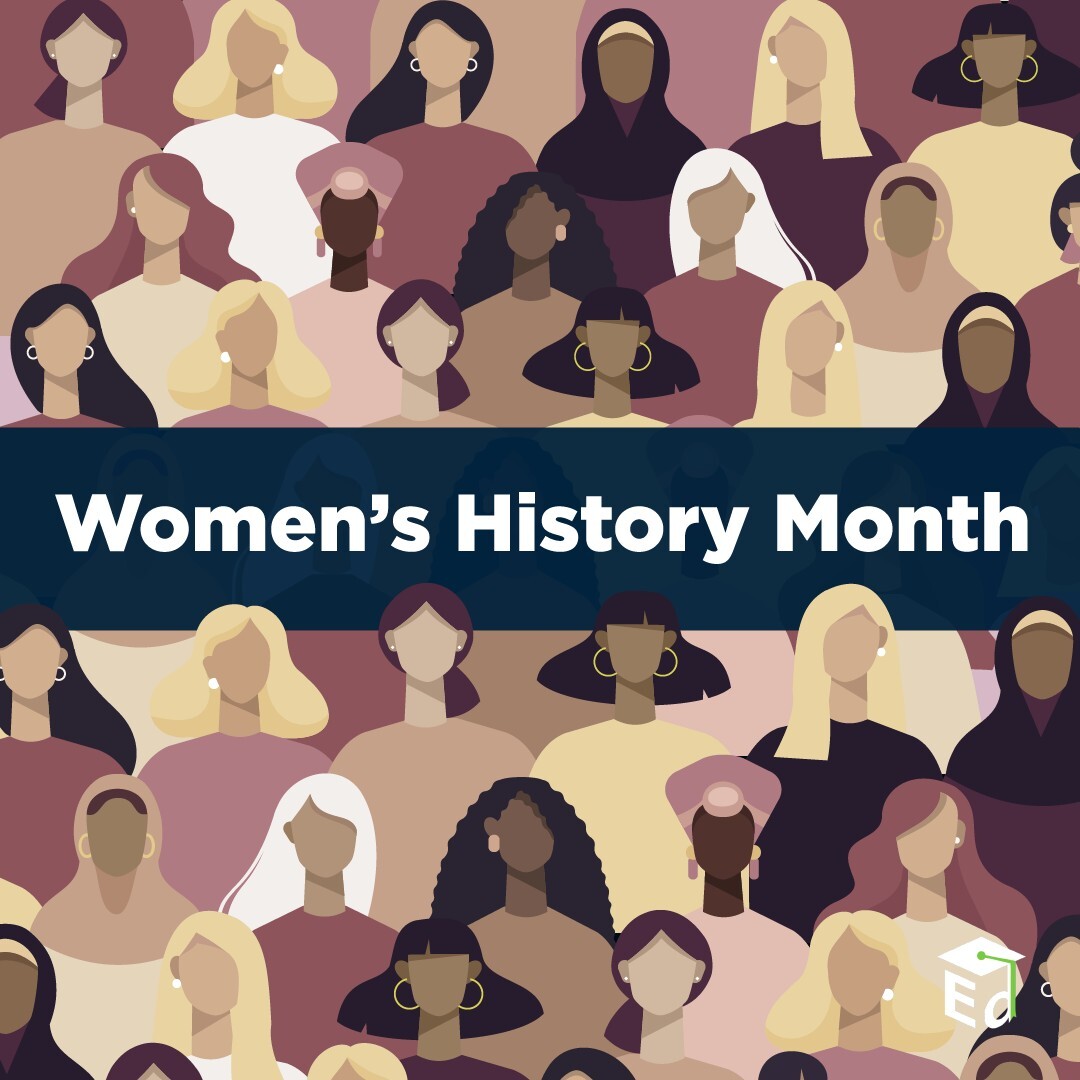
 March is Women's History Month, and this year's theme, Leading the Change: Women Shaping a Sustainable Future, invites us to expand our understanding of sustainability. For classroom educators, this month is an opportunity to go beyond the familiar names and to analyze and evaluate the full, rich diversity of women's experiences and contributions across race, class, culture, and time.
In addition to resources for Women’s History Month, this newsletter also includes student opportunities, professional learning events, ways to explore Civic Learning Week, and resources for addressing the war in Iran and the Middle East.
Women's History Month Resources
K–5 Resources
National Women's History Alliance (NWHA) The official organization that coordinates Women's History Month offers educator resources including lesson plans, book lists, and classroom activities designed for younger learners. They also announce each year's official theme.
Smithsonian Learning Lab – Women's History The Smithsonian has curated K–5 collections featuring primary sources, images, and interactive activities tied to notable women in American history. Teachers can access and remix collections for free.
ReadWriteThink (ILA/NCTE) – Women's History Month Offers literacy-based lesson plans and activities appropriate for elementary students, connecting children's literature about women to reading and writing standards.
6–12 Resources
Library of Congress – Women's History Teaching Resources The LOC provides primary source sets, lesson plans, and document-based activities highlighting women's contributions across U.S. history and are particularly strong for middle and high school research projects.
Facing History Produces classroom resources highlighting the history and contributions of women in past and contemporary moments.
PBS LearningMedia – Women's History (also K-5) Features documentary clips, primary sources, and standards-aligned lesson plans for middle and high school students covering figures like Susan B. Anthony, Harriet Tubman, Ruth Bader Ginsburg, and many others.
Rebel Girls from History Celebrates Women's History Month by focusing on the amazing, mostly forgotten women from the late 19th and early 20th century whose lives, actions, and sacrifices helped shape today’s America. They are educators, organizers, fighters, adventurers, and so much more.
Oregon Historical Society Educational resources related to women’s history, includes curricula, units, lessons, and other resources that are sorted by grade level and resource type. Some resources may relate to more than one theme.
Civics Resources
 March 9-13 is Civic Learning Week intended to highlight civic education’s important role in sustaining and strengthening constitutional democracy in the United States.
iCivics engaging resources, from videos and games to lesson plans, build critical thinking and content knowledge—all while having fun!
Center of Civics Education’s Project Citizen is a civic education program for middle, secondary, and post-secondary students, as well as youth and adult groups. Its practical, first-hand approach promotes student interest and the ability to participate competently in state, local, and federal government. The curriculum actively engage people in the process of monitoring and influencing public policy.
Civics Learning Project has created a guide to help explore Oregon-specific learning opportunities that highlight experiencing civics firsthand in real world situations. This guide is packed with events, resources, and scholarship opportunities to help make the most of Civic Learning Week!
Bob & Marilyn Ridgley Civics Learning Project Scholarship Apply by March 30th.
Honoring the legacy of CLP co-founders Bob and Marilyn Ridgley, this scholarship supports Oregon high school seniors committed to civic learning. The recipient is selected each spring to receive $2,500 per year for four years ($10,000 total). The scholarship is open to any Oregon high school senior who has participated in a CLP program. Questions? Reach out to Chris Parrucci, cparrucci@civicslearning.org
CLP offers a bi-weekly newsletter to provide analysis, pedagogical resources, and key readings on topics straight from today's headlines.
Subscribe to the Current Events newsletter here, or view previous Current Events resources.
Current Events Resources
 Resources for War with Iran
Essential Disciplinary Practice I in the 2024 Social Science Standards is for students to "Seek and analyze diverse perspectives to develop a more complete understanding of past and current events." This requires Instruction that includes multiple diverse perspectives to provide nuance and complexity when investigating and understanding current events.
Teaching a war that is actively unfolding is fundamentally different from teaching historical conflicts. The situation changes daily, confirmed facts are scarce, and students may have personal connections to the region, including family members who are affected. Before diving into maps, timelines, and primary sources, consider the following:
- Establish ground rules first. Active conflicts are emotionally charged. Set clear expectations for respectful discussion before introducing the topic.
- Acknowledge uncertainty. Information is incomplete and sometimes contradictory. Model intellectual humility; it is appropriate to say "we don't know yet."
- Separate facts from analysis. Help students distinguish between what is reported (events) and why it is happening (interpretation). Different sources will emphasize different explanations.
- Check in with your students. Some students may have family in Iran, Israel, or the broader Gulf region. Create space for students to opt out of specific discussions if needed.
- Use media literacy as a lens. Comparing how different outlets cover the same event (Al Jazeera, BBC, Times of Israel, CNN, ) is itself a powerful and relevant lesson.
- Take care of yourself. Teaching difficult current events takes emotional energy. Debrief with colleagues and give yourself permission to set appropriate limits on class time devoted to the topic.
Teaching Current Events Toolkits
Grades 3–8
Grades 6–12
-
Facing History and Ourselves Structured frameworks for teaching difficult current events including discussion guides and age-appropriate materials with strong on human rights framing.
Staying Up to Date:
-
UN News Real-time updates from across the UN system.
-
Reuters Fast, fact-focused wire reporting without heavy editorial framing.
-
BBC News Middle East Clear, measured journalism with helpful explainers. Good for classroom-appropriate summaries.
-
Al Jazeera Live Coverage Active live blogs with strong regional perspectives and voices from the Middle East.
-
Times of Israel English-language Israeli news with active live blogs. Provides essential perspective from within Israel.
Historical and geopolitical context:
-
Council on Foreign Relations — Iran Deep explainers on US-Iran relations, the nuclear program timeline, and Iran's regional role. Free. Includes the Global Conflict Tracker.
-
Wilson Center — Middle East Program Scholarly but accessible. Covers the 1979 Revolution, Iran-Iraq War, JCPOA, and modern Iranian politics.
-
The Economist — Middle East & Africa Concise, high-quality analysis. Briefing-style articles are especially useful for teacher preparation. Subscription may be required.
-
Foreign Affairs — Iran Long-form policy analysis from leading experts. Best for understanding competing strategic frameworks.
-
Vox Explainers — Iran Clear, accessible explainer journalism specifically designed to give readers context before current events.
-
NPR — Middle East Free, audio-friendly, and consistently solid on background explainers. Past episodes of Throughline and Embedded cover Iranian history in depth.
-
Retro Report Short video and lesson plans exploring the complicated history behind the 1953 C.I.A.-led coup that removed Prime Minister Mohammad Mosaddegh from power and led to years of repressive rule by Shah Mohammad Reza Pahlavi.
News Outlet Maps (Updated Daily)
-
Reuters Maps and Charts Clean, regularly updated visual journalism on strike locations and regional impact.
-
CBS News Conflict Map Shows strike locations across Iran and Iranian retaliatory strikes across the region. Clear and classroom-friendly.
-
CNN Maps and Charts Visual explainers including maps of the Strait of Hormuz. Useful for economics discussions.
|