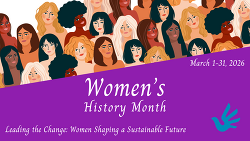
March is Women’s History Month a time to celebrate the women who have transformed health and physical education. From early advocates for girls’ access to PE, to athletes who expanded perceptions of women’s capabilities, to today’s leaders advancing research in fitness and well‑being, women have driven progress in inclusion, equity, and physical literacy.
Their contributions strengthened Title IX protections and inspired generations to build confidence through movement. To explore more stories and classroom-ready activities highlighting women’s impact, visit the National Women’s History Museum and its Digital Classroom Resources, which showcase barrier‑breaking women in sports and beyond.
|
National Nutrition Month
During the month of March, everyone is encouraged to learn about making informed food choices and developing healthful eating and physical activity habits. The Academy of Nutrition and Dietetics provides free resources to assist teachers in highlighting nutrition facts and tips. Nutrition.gov also has resources to help celebrate nutrition month.
Hip Hop Public Health provides lessons for grades 3-5 that help students learn how and why to include a variety of fruits and vegetables into their meals. With student-centered discussion and activities that celebrate personal preference, Eat the Rainbow encourages young people to try new foods in ways that are accessible to them.
|
OPEN Instant Activities
Get ready to bring a little luck of the Irish to Physical Education from OPEN! This St. Patrick’s Day themed collection of instant activities is designed to keep K–5 students moving with shamrock speed and gold-level teamwork while building important fitness and skill concepts. These activities can be taught together as a themed mini-unit or integrated into any existing unit for festive, high-energy fun.
|
Movement and Transformative Social and Emotional Learning
Hip Hop Public Health creates research-based educational resources by harnessing the power of music and culture to improve health in communities that are underserved. Expression is good for your health! Open Up, Level Up is a lesson for grades 3-5 that supports students in sharing their feelings as they discover the importance of opening up and strategies for asking for help. Using the HYPE Break Open Up, Level Up, they also learn about the value of movement for expression. Activity blended with socio-emotional skill-building makes this lesson more than just a classroom activity— it’s a movement!
|
Safe Routes to School
It’s spring and more students are walking and biking to school. Safe Routes to School provides no cost curriculum for teaching students walking and biking safety education. Find ODOT Safe Routes’ Jump Start Curriculum and Drill Guides as well as other curriculum resources from around the country. Pedestrian Curriculum; Bicycle Curriculum; Additional Pedestrian Resources; Additional Bicycle Resources
Solicitation for Safe Routes to School Education, Construction, and Technical Assistance grants are expected to open for applications in spring 2026. Stay tuned for more information about the next round of solicitations.
|
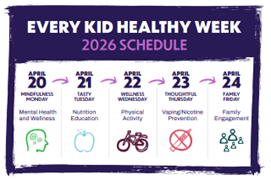
Every Kid Healthy Week!
Registration is now open for Every Kid Healthy Week® (EKHW), happening April 20-24, 2026, and your school or district can sign up today!
Every Kid Healthy Week (EKHW) is a national celebration that helps schools and districts advance student wellness through simple, meaningful activities that fit into the school day. Across the country, participants use EKHW to build on what they’re already doing, or try something new, like movement breaks, taste tests, or family wellness activities.
EKHW is a week-long celebration focused on:
- Mental health and wellness
- Nutrition education
- Physical activity
- Vaping and nicotine prevention
- Family engagement
All registered schools and districts are automatically entered for a chance to win one of three $1,000 mini-grants to expand future whole-child health efforts. Winners are selected through a random drawing. Register your school here!
|

Coming Soon: Student Voice Survey on Cell Phones and Learning
The Oregon Department of Education invites students in grades 6-12 to participate in a 15 minute survey to share feedback on the current cell phone and personal electronic device policy at your school.
This survey will run March 16–April 8. Student input will help shape future guidance and improvements. For more information, click here.
|
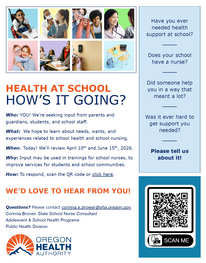
Oregon Health Authority - Seeking Student, Family, and Staff Perspectives about School Health and School Nursing
The State School Nurse Consultant from the Oregon Health Authority is seeking information about needs, wants, and experiences related to school health and school nursing. Information may be used in trainings for school nurses.
Please give your input here.
Questions? Please contact corinna.e.brower@oha.oregon.gov.
|
|
 |
-
Access to Physical Activity Opportunities Before and After School
SHAPE America recently published a position paper that recommends all schools provide before- and after-school physical activity opportunities as part of their Comprehensive School Physical Activity Program (CSPAP). Share with your administrators to increase physical activity for all students.
-
Patterns of Oral Nicotine Pouch use among U.S. adolescents and young adults
A recent article from the National Library of Medicine reports a rising interest in oral nicotine pouches but highlights the need for more national research on how young people are using these products. In the study, it explored who is using oral nicotine pouches among U.S. youth and young adults and examined how usage patterns have changed over time.
Stanford Medicine reports that 5.4% of U.S. high schoolers have tried products like Zyn in 2024, up from 3% in 2023. Flavored options and their discreet, smokeless design make them easy to hide at school. Health experts warn that these pouches are highly addictive and can harm adolescent brain development.
-
Adolescent Cannabis Use and Risk of Psychotic, Bipolar, Depressive, and Anxiety Disorders
A new longitudinal study published in the JAMA Health Forum found that adolescent cannabis use is associated with increased risk of psychiatric disorders in adolescence and young adulthood, highlighting the importance of early prevention efforts, effective public health messaging, and policy development to limit youth exposure as cannabis legalization expands. Read more here.
-
New Report says Screen Time Limits for Children are No Longer Enough
We know that students are growing up in an increasingly digital world that affects sleep, learning and mental health, making screen-time limits alone no longer enough, according to new guidance from the American Academy of Pediatrics.
-
Could This be a Simple Solution to Reducing Childhood Obesity?
A UCF research team is partnering with pediatricians and summer camp leaders to investigate an often-overlooked opportunity to improve children’s health. They believe a surprisingly simple intervention could make a big impact—and the National Institutes of Health agrees.
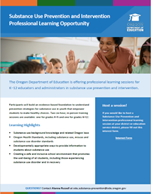
New Substance Use Professional Development Resources from ODE
Two new training packages are available on the ODE website and include all of the materials needed to deliver two, full-day, in-person professional learning sessions designed to support educators’ understanding of substance use prevention strategies and confidence in implementing the ODE K-12 Substance Use Prevention Lessons. The sessions are designed for delivery by regional or district professional learning providers. Training packages are available for both Elementary and Secondary audiences.
For technical support and additional professional development requests, please contact ode.substance-prevention@ode.oregon.gov
|
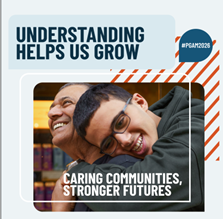
March is Problem Gambling Awareness Month
Gambling‑like behaviors can show up in youth activities such as dares, games of chance, loot boxes, betting on sports, and digital features that mimic gambling. These experiences can influence how young people view risk and reward.
Educators can support students by: building healthy decision-making and critical-thinking skills, encouraging safe activities, and promoting balanced screen time.
To learn more about problem gambling warning signs or available resources, contact the Oregon Health Authority’s Problem Gambling Services at pgs.support@oha.oregon.gov. You can also watch our new video “How Gambling Hijacks the Brain” to explore the science of gambling addiction.
Access the PGAM 2026 Toolkit from the National Council for Problem Gambling
|
|