Because ODE CNP develops and publishes proxy data to get an approximation of eligibility/near-eligibility for sites and districts; and also performs the calculations to determine actual eligibility for CEP participation, Local Educational Agencies (LEAs) need only be concerned with the dates below.
- April 1, 2026: Data snapshot date. LEAs submitting data to ODE CNP must collect enrollment data reflective of April 1.
- May 1, 2026: ODE will publish April 1-based eligibility lists.
- June 30, 2026: Deadline for LEAs to elect CEP for the following school year.
The Community Eligibility Provision (CEP) is a non-pricing meal service option for schools and school districts in low-income areas. CEP allows the nation’s highest poverty schools and districts to serve breakfast and lunch at no cost to all enrolled students without collecting household applications. Instead, schools that adopt CEP are reimbursed using a formula based on the percentage of students categorically eligible for free meals based on their participation in other specific means-tested programs, such as the Supplemental Nutrition Assistance Program (SNAP) and Temporary Assistance for Needy Families (TANF).
Federal Eligibility Changes and the 2026 CEP Election Cycle
Recent changes to federal SNAP and Medicaid eligibility requirements are expected to affect direct certification counts in Oregon public schools in the coming years and this section is intended to provide guidance for making informed decisions during this election cycle.
HOW OREGON REACHED 97% CEP PARTICIPATION
Oregon's near-universal CEP participation is the result of three significant drivers:
- Mid-year of SY 2023-2024, the reduction of the identified student percentage (ISP) eligibility threshold from 40% to 25% qualified many schools for eligibility that would not have previously qualified.
- Concurrently in SY 2023-2024, Oregon's approval to participate in the USDA Medicaid Direct Certification Demonstration Project, which automatically links students to free meal eligibility using Medicaid enrollment data (without requiring a household application) has also been a significant contributor to increasing ISPs statewide.
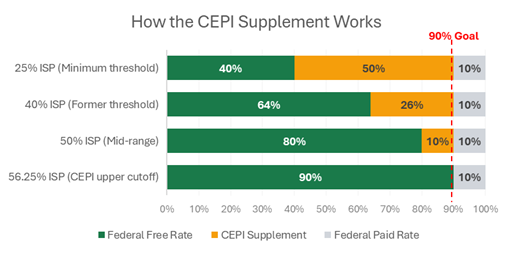
- Lastly, Oregon's CEP Incentive (CEPI) Reimbursement Program, which supplements the federal free reimbursement rate up to 90%, has made CEP financially viable for many LEAs who would not have elected the program based on federal reimbursement alone.
Together, these made CEP both accessible and financially sustainable across Oregon's diverse public school districts. Understanding how Oregon got to 97% participation matters now, because recent federal policy changes work directly against two of these three drivers.
FEDERAL ELIGIBILITY CHANGES NOW IN EFFECT
Federal legislation enacted in July 2025 introduced changes to both SNAP and Medicaid eligibility that are expected to reduce enrollment in those programs over the coming years. The primary mechanisms relevant to school meal programs are:
These new requirements will, indirectly, compress ISPs across the state, most significantly for schools whose current ISP is close to the 25% eligibility threshold.
IMPLICATIONS FOR CEP ELIGIBILITY AND REIMBURSEMENT
CEP reimbursement rates are calculated directly from each school's ISP. As ISPs decline, federal reimbursement rates decline with them, widening the gap that the Oregon CEP Incentive currently covers. For schools whose ISP is close to the 25% threshold, declining direct certification could affect CEP eligibility in future election cycles.
THE CEP ELECTION CYCLE AND THE FOUR-YEAR LOCK-IN
Because of the April 1 enrollment requirement, the CEP election window runs from April 1 through June 30. ODE CNP will publish eligibility “proxy” data and currently participating schools prior to April 1 around mid-March 2026. Federal rules allow LEAs to elect or renew CEP and lock in their ISPs for up to four years using April 1 enrollment data. If an LEA’s ISP increases in a future cycle, the LEA may reelect CEP early to lock in the higher rate.
Note: The eligibility “proxy” list is based on unverified direct certification data available to ODE CNP at the time of publication and should be treated as an approximation of SY 2026-2027 ISPs, not a final determination. LEAs cannot elect CEP using pre-April 1 data.
This year's April 1 data reflects current enrollment levels prior to the full effect of the federal eligibility changes described above. Renewing CEP this cycle and locking in for four years can protect your program's eligibility and reimbursement rate through SY 2029–2030, before the impact of declining SNAP and Medicaid enrollment is fully realized in your ISPs.
ODE CNP encourages all currently participating LEAs to review their ISP data (eligibility proxy data to be published soon) and go through CEP renewal this cycle.
|
 |
Per ODE’s annual process requirements, LEAs currently participating in CEP are strongly encouraged to communicate their intent to continue, discontinue, or change their CEP agreement by submitting an annual survey form. LEAs not participating in CEP, and are considered ‘near eligible’ to participate, are encouraged to apply and submit an annual survey form.
Survey form link: Annual CEP Election Review : SY 2026–2027
CEP Resources
CEP Data Collection Instructions
As in recent years, ODE CNP has adopted a more streamlined approach to data collection to reduce the burden on LEAs and to ensure uniformity in ISP calculations. Student enrollment data and lists of categorically eligible students (McKinney-Vento, Homeless, Migrant Education Program, Head Start) from their respective district liaisons will be submitted to ODE. The ODE CNP team will perform the matching and calculations to determine CEP eligibility.
The most important part of the CEP election process is the submission of accurate membership lists (enrollment and other programs) which ODE will use to calculate your ISPs. ODE CNP has developed CEP Data Collection Instructions to walk you through the entire process step by step. Submitting data in the format as prescribed in the instructions will allow a quicker turnaround of ISPs being calculated.
Personally Identifiable Information (PII)
REMINDER: State agency emails are open to public records requests and cannot contain Personally Identifiable Information (PII). Please send files containing PII using ODE's secure file transfer system.
 How CEP Eligibility is Determined
After data has been submitted, ODE CNP will perform all the matching and as much data validation as possible. ODE CNP may need an LEA to validate data matches with more supporting documentation. Once all matching and data validation has been performed, ODE CNP will return a workbook listing all sites eligible for participating in CEP.
To be eligible for CEP, an entire LEA, group of schools, or school must:
- Ensure that at least 25% of enrolled students are identified students;
- Participate in both the NSLP and SBP; and
- Serve lunches and breakfasts to all enrolled students at no charge.
LEAs may elect the provision for all schools (i.e., district-wide), a group of schools, or an individual school. This may include any public, private, and charter schools, but not Residential Child Care Institutions (RCCIs). RCCIs are not eligible to participate in CEP.
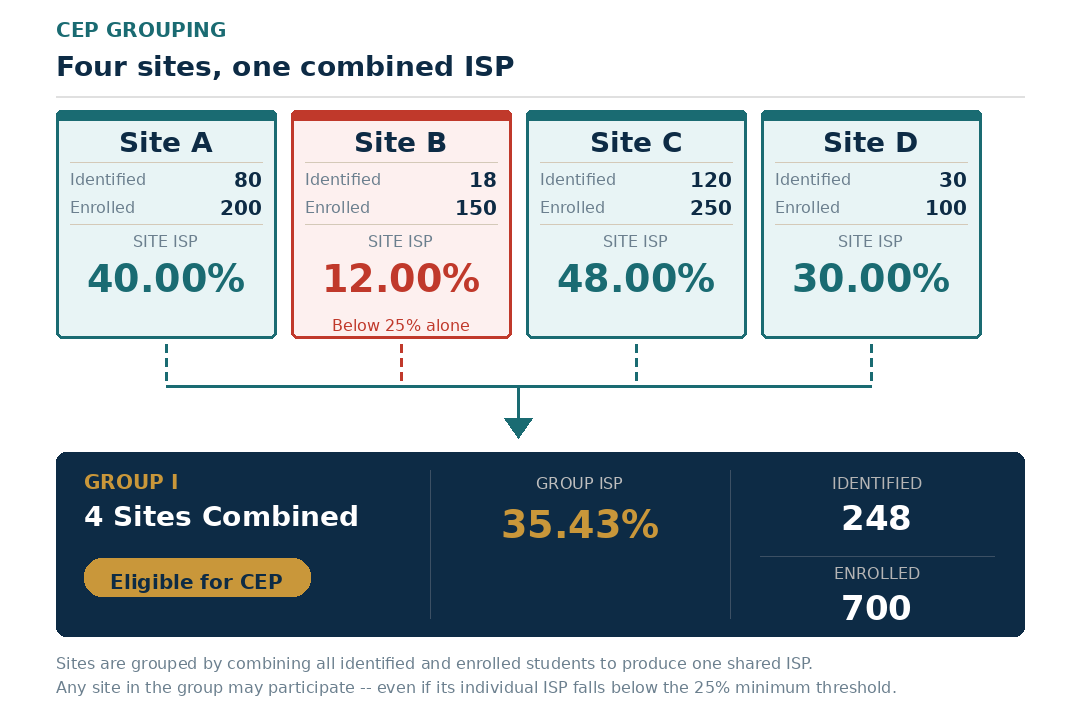
The electing entity, as a whole, must meet the eligibility criteria listed above. The ability to elect CEP for all schools or a group of schools allows some individual schools that are below the 25% identified student threshold to participate in CEP as long as the aggregate percentage of the group of schools electing together meets the 25% threshold. CEP is elected in 4-year cycles. Participating schools can end CEP participation at any time or can begin a new 4-year cycle early after the original election, if the Identified Student Percentage (ISP) increases.
Enrolled Students
Enrolled students are students who are enrolled in and attending schools and have access to at least one meal service (SBP or NSLP) daily. The number of enrolled students includes all students with access to the SBP or NSLP, and not just those students participating in the programs. For schools participating in CEP, the ISP multiplied by 1.6 equals the percentage of meals claimed at the free rate. The remaining meals served, up to 100%, are reimbursed at the paid rate. The ideal ISP is 62.5% - this will earn that site a 100% free claiming rate. However, Oregon’s CEP Incentive (CEPI) Reimbursement Program will benefit LEAs who have an ISP of less than 56.25%. CEPI will provide additional state-funded reimbursement to reach 90 % of the federal free rate. See section Oregon’s CEP Incentive (CEPI) Reimbursement Program.
Identified Students
CEP is available to LEAs and schools with 25% or more “identified students” as of the most recent April 1 enrollment. The term identified students refers to children who are directly certified for free school meals based on their participation (or a household member’s participation) in other means-tested assistance programs, such as:
- The Supplemental Nutrition Assistance Program (SNAP);
- Temporary Assistance for Needy Families (TANF);
- The Food Distribution Program on Indian Reservations (FDPIR); or
- Medicaid, in states approved for USDA's Direct Certification with Medicaid Pilot Project (only students directly certified for free meals are included; reduced-price Medicaid certifications do not count toward the ISP).
Identified students are also children who are categorically eligible for free school meals without an application, and who are not subject to verification, including:
- Homeless children as defined under section 725(2) of the McKinney-Vento Homeless Assistance Act [42 U.S.C. 11434a(2)];
- Runaway and homeless youth served by programs established under the Runaway and Homeless Youth Act (42 U.S.C. 5701);
- Migrant children as defined under section 1309 of the Elementary and Secondary Education Act of 1965 (20 U.S.C. 6399);
- Foster children certified through means other than a household application;
- Children enrolled in a Federally funded Head Start Program or comparable State-funded Head Start or pre-kindergarten program; and
- Administrative Application students: approved by local education officials, such as a principal, based on available information.
Students who are categorically eligible based on information, such as a case number, submitted through an application may be included in the identified student count if LEA staff can verify the case number with the appropriate agency and convert the student to “directly certified” in the LEA’s certification system.
Oregon’s CEP Incentive (CEPI) Reimbursement Program
The Oregon Community Eligibility Provision Incentive (CEPI) Reimbursement Program is a state-funded initiative that supplements federal school meal reimbursements. It covers the difference between federal free and paid reimbursement rates, up to a state-determined annual goal.
The CEPI supplement rate is evaluated annually to ensure the program remains sustainable within its legislatively approved budget and is published by ODE CNP before each election cycle. For SY 2026-2027 the supplement goal will remain at 90%. This means, identified student percentages (ISPs) less than 56.25% (multiplied by 1.6 = 90% federal free rate) will be receiving the supplemental funding.
How CEP Benefits Your Nutrition Program
Schools implementing CEP have experienced great success, allowing them to make numerous improvements to their nutrition program. CEP has benefited schools, communities, and children in many ways.
Schools:
-
Eases administrative burden:By leveraging existing data from other federal programs, CEP schools can operate more efficiently. This results in less paperwork and lower administrative costs. Schools experience administrative relief from:
- Processing household applications for free/reduced price meals.
- Needing to conduct verification at the beginning of the school year.
- Needing to submit the Paid Lunch Equity analysis; and
- Counting and claiming processes that rely on student eligibility.
-
Eliminates unpaid meal balances:Unpaid meal balances can be a significant financial burden. By providing meals at no cost, this burden is alleviated.
-
Facilitates implementation of innovative breakfast service models:Since schools don’t have to collect school meal fees or count each meal served by fee category, it is easier to implement breakfast in the classroom and “grab and go” service models that can boost breakfast participation further.
Students:
-
Increases student participation:CEP eliminates the need for families to submit paperwork which increases meal access for students who may not submit a household application. Providing all students meals at no cost also incentivizes participation, which may increase program revenue.
-
Improves the learning environment:Providing children with well-balanced breakfast and lunch ensures students come to class well-nourished and ready to learn.
-
Eliminates the stigmaassociated with being on free/reduced meals.
-
Financial benefits to families:This can be a significant financial benefit for families. Especially families that fall just short of qualifying for meal benefits.
Is CEP Right for Our School?
When evaluating the benefits of CEP, there are other factors to consider before applying:
- How will we gather household income information for compensatory revenue and Title 1 funding?
- Do we have the proper staffing to support increased breakfast and lunch participation?
- Are there other effects to increased breakfast and lunch participation?
- Will we need to modify bus schedules to provide time for breakfast?
- Do we need to add cafeteria space and meal service times?
- Do we need to consider alternate serving locations?
- Does CEP make financial sense? Can we cover any additional costs?
To Group or Not to Group
What are the rules for grouping?
A common question that arises when ISP results are returned to LEAs is the question of grouping. LEAs may participate in CEP for all schools, a single school, or in only a certain group of schools, depending on eligibility and financial considerations. Grouping is a flexible characteristic of CEP that may be used to maximize federal reimbursements, qualify schools that are below a 25% ISP, and create administrative efficiencies. Grouping represents a strategic decision for some LEAs. LEAs have discretion in how to group schools to optimize CEP benefits and administrative ease.
Grouping could allow some sites with an ISP below 25% to participate as long as the group’s ISP is at least 25% . The ISP for a group of schools is calculated by taking the sum of the identified students for the entire group of schools divided by the sum of the total student enrollment for the entire group of schools.
 What happens with changes in grouped schools?
When a school or schools (and the attending students) are added to or removed from a CEP group, the ISP must be recalculated. The distinction in this requirement is intentional, because grouping is a flexible strategy that LEAs may choose to use. As such, the USDA has a strong interest in making sure that grouped schools are electing CEP using data that accurately reflects overall poverty and enrollment. Requiring a recalculation when a school is added or removed from a CEP group, or a grade level is added or removed from a school in a CEP group, helps to:
- Safeguard the grouping mechanism.
- Preserve the integrity of the grouping strategy; and
- Ensure grouping will continue to be an option for districts in the future.
However, if students are moved or reorganized among schools within a CEP group (e.g., a grade moves from one CEP school to another and both schools are in the same CEP group), an ISP recalculation is not required because the group’s total identified student and total enrollment numbers are the same. This logic applies to all CEP group changes, including school closings, schools merging, and one school splitting into two schools.
Other Programs that CEP May Impact
In addition to CEP impacting the school meals program, there are a number of other federal programs that are impacted either directly or indirectly by free and reduced lunch data.
- Title-I Funding: Distribution guidance is offered in the US DOE CEP Guidance.
- E-Rate: Individual school ISP × 1.6 is used as input to a district-wide E-Rate discount calculation. Additional guidance is offered in the USDA Updated E-Rate Guidance for Schools Electing CEP.
- Educational Reporting: Free/Reduced eligibility % reported from the last year applications were collected.
- Teacher Loan Forgiveness: Since CEP schools do not collect household meal applications, alternative methods are used to determine low‑income school eligibility. Teachers and HR personnel should reach out to their loan servicer or review guidance on the Federal Student Aid website and the ODE Teacher Loan Forgiveness Program
- Family requests for Free/Reduced Letters (for Community Programs - reduced fees for cable, internet, after school care, etc.):
- Provide student specific information if the family has other students in non-CEP schools and eligibility has been established.
- May also use the Household Income Survey, on the ODE CNP Special Provisions webpage, which collects the same information and can use the same guidelines.
- Other food and nutrition service programs - Sites may qualify based on individual site ISP × 1.6 multiplier for:
- Child and Adult Care Food Program
- Summer Food Service Program
- Seamless Summer Option
- Fresh Fruit and Vegetable Program
- NSLP Afterschool Snacks
- Special Milk: If a school operates CEP but also operates the SMP for half-day students who do not have access to the NSLP or SBP, then the school must process school meal applications for any students being served under the SMP.
CEP Recordkeeping Requirements
LEAs and sites participating in CEP must retain the source documents used to establish their ISP for an extended period of time. The standard record retention period is three years plus the current year. With a 4-year Provision cycle, the CEP Primary Supporting Documents are what "prove" the free and paid CEP claiming percentages. That means you may need to access them for SNP review or state audit for up to 7 years. The best practice is to keep a copy of everything you sent to ODE for ISP calculation and your final, approved CEP election spreadsheet. That includes any additional documents supplied throughout the process. That may include:
- The election spreadsheet.
- All primary source documentation saved to your CEP election folder. This includes the clean enrollment list downloaded from the student database.
- The On-Demand Upload list (Working Enrollment List).
- The completed ODE CEP Matching Workbook.
- The highlighted and saved non-match list downloaded from the ODE match system.
- Any homeless, migrant, or other agency information used to certify students.
What is a Grace Year?
An LEA or site in the fourth year of CEP who evaluate their April 1 ISP to be less than 25% but at least 15% may continue participating in CEP for one grace year (i.e., a fifth year). This gives LEAs the opportunity to restore their eligibility status without immediately resuming standard counting and claiming procedures and avoid disrupting universal meal service to students. Reimbursement for sites in a grace year is based on the ISP as of April 1 in year 4 of the current 4-year cycle. For example, the claiming percentages for participating sites in a grace year would be calculated as follows:
- Year 4 ISP as of April 1, 2026: 20%
- ISP × 1.6 multiplier (20% × 1.6): 32%
- Free claiming percentage: 32%
- Paid claiming percentage: 68%
If the LEA or site regains the 25% threshold as of April 1 of the grace year, the State agency may approve a new 4-year cycle to start the following school year. If the ISP as of April 1 of the grace year does not meet the 25% ISP requirement, the LEA must return to standard counting and claiming or elect another special provision option for the following school year.
Ending CEP
LEAs may choose to end CEP participation and restore a site, group of sites, or all sites to standard meal procedures at any time if standard procedures better suit their program needs. Here is what you need to do:
- Prior to the change, notify the State agency of the intention to end CEP and seek State Agency guidance regarding a return to standard counting and claiming.
- When standard counting and claiming procedures are resumed between school years, at the start of the next school year, the site would distribute and process meal applications according to the usual certification procedures. ODE CNP permits all children transitioning from provision to non-provision sites to receive free meals for up to 30 operating days at the beginning of the school year or until a new eligibility determination is made, whichever comes first.
- When a CEP site resumes standard counting and claiming mid-year, a reasonable timeline (at least 30 days) is required to give the site time to notify families and distribute, process, and certify meal applications. During the established time frame to resume standard procedures, students should continue to receive meals at no cost to ensure their meal service routine is not disrupted. Meals served during this transition are claimed at the same free/paid claiming percentages used under CEP.
- Ensure your district charge policy is publicized and distributed to all staff involved in enforcing and communicating the policy, as well as to students and families before the policy is enforced.
Q & A and Other Considerations
The source for these questions and answers is the Community Eligibility Provision Planning & Implementation Guidance, Released in February 2024. We have selected a few items to include in this newsletter. The entire guidance is posted on the ODE Special Provision webpage.
Q: My school just barely meets the required 25% ISP. How long will the additional Community Eligibility Provision Incentive be available?
A: ODE CNP cannot determine an exact timeline. What we know right now is there is money available for the 2026-27 school year. As the funds get depleted, there may be adjustments to the funding level provided to schools. If at any point CEP becomes financially a burden for your schools, you may return to traditional counting and claiming.
Q: What are the definitions of “school” and "enrolled student" for CEP? Does the Head Start in my Elementary School count? What about Preschool Promise? Those students eat here, but they aren't registered in my school.
A: CEP follows parts (a) and (b) of the NSLP definition of “school” at 7 CFR 210.2. By law, “residential childcare institutions” are not eligible to elect CEP [42 U.S.C.1759a(a)(1)(F)(ii)(cc)]. School means: (a) An educational unit of high school grade or under, recognized as part of the educational system in the State and operating under public or nonprofit private ownership in a single building or complex of buildings; or (b) any public or nonprofit private classes of preprimary grade when they are conducted in the aforementioned schools. (From SP 45-2015, CEP: Guidance and Updated Q & As, Page 4).
Only students who are enrolled in an LEA's approved sites in CNPweb can be included in the ISP. LEAs that provide food service to outside schools (e.g., private schools, charter schools) through a vended meal agreement, or similar situation, may not include students from those schools in the district’s ISP, unless the schools are listed as serving sites for that LEA in CNPweb.
Pre-primary students may be documented using alternate primary source documentation (district liaison list, Head Start class roster, etc.).
Q: Are new schools able to elect CEP?
A: Newly opened schools, and/or schools new to NSLP/SBP, will not have direct certification data from April 1 of the prior year, and instead may use direct certification data from a later month to establish CEP eligibility. If the number of identified students and total enrollment are available before the counting and claiming of meals begins and the new school meets the eligibility requirements (either individually or as part of a group), then the LEA may elect CEP. New schools can elect CEP only if the number of identified students and enrollment are available because the ISP is the basis for claims for reimbursement.
Oregon's School Nutrition Program recognizes new boundaries are essentially creating new schools and recognize the same standard. Contact your assigned Child Nutrition Specialist to set a target date for the active enrollment list and CEP election spreadsheet due date.
Q: What about changes to the school/schools during the CEP cycle?
A: Each situation would need to be evaluated specifically, but in general, it would either have no impact on the CEP cycle, or it would require a new CEP cycle for the impacted school or schools, depending on the CEP setup. Some changes have no impact on a single CEP site, while others will impact a CEP group but not a district-wide CEP. The CEP guidance manual and your assigned specialist will help guide you. Here are the answers to more common situations:
- For LEAs participating district-wide, the ISP must be recalculated at the next election cycle if the attendance area changes.
- When a school or schools are added to or removed from a CEP group, the ISP must be recalculated.
- ISP recalculations are not required mid-year for any changes in student population.
Q: I added a Head Start program this September. They'll help my CEP percentage. How can I add them?
A: If the Head Start students have access to the School Breakfast Program or National School Lunch Program, you'll need to establish a new CEP cycle. The Head Start students will be included in both the total enrollment list for April 1 and count of students in means tested categories on the CEP election spreadsheet to create the Identified Student Percentage.
 School Nutrition Program Contacts
School Team Specialists: School Nutrition Program Sponsor Support Assignments
School Nutrition Inbox: ode.schoolnutrition@ode.oregon.gov
USDA Foods Team: ode.fooddistribution@ode.oregon.gov
Farm to Child Nutrition Programs: FarmtoCNP@ode.oregon.gov
Civil Rights
In accordance with federal civil rights law and U.S. Department of Agriculture (USDA) civil rights regulations and policies, this institution is prohibited from discriminating on the basis of race, color, national origin, sex (including gender identity and sexual orientation), disability, age, or reprisal or retaliation for prior civil rights activity.
Program information may be made available in languages other than English. Persons with disabilities who require alternative means of communication to obtain program information (e.g., Braille, large print, audiotape, American Sign Language), should contact the responsible state or local agency that administers the program or USDA’s TARGET Center at (202) 720-2600 (voice and TTY) or contact USDA through the Federal Relay Service at (800) 877-8339.
To file a program discrimination complaint, a Complainant should complete a Form AD-3027, USDA Program Discrimination Complaint Form which can be obtained online and at any USDA office, by calling (866) 632-9992, or by writing a letter addressed to USDA. The letter must contain the complainant's name, address, telephone number, and a written description of the alleged discriminatory action in sufficient detail to inform the Assistant Secretary for Civil Rights (ASCR) about the nature and date of an alleged civil rights violation. The completed AD-3027 form or letter must be submitted to USDA by
U.S. Department of Agriculture
Office of the Assistant Secretary for Civil Rights
1400 Independence Avenue, SW
Washington, D.C. 20250-9410; or
(833) 256-1665 or (202) 690-7442; or
program.intake@usda.gov
This institution is an equal opportunity provider.
|