|
Updates from the Oregon Department of Education
1. From MEP Student to Community Advocate: Alejandra Lopez Nestor
News and Resources for Multilingual and Migrant Education
1. Webinar Recap: Supporting Refugee Youth Mental Health
2. Article: Indigenous Parents from Mexico Call for More Interpretation
3. Article: It’s Never Too Late to Learn a Language
4. Article: Educators Warn Flat English Learner Funding Falls Short of Growing Demand
Upcoming Events, Training & Conference Opportunities
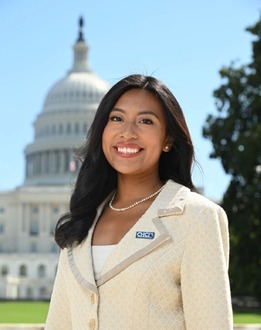
1. From MEP Student to Community Advocate: Alejandra Lopez Nestor
Leadership rooted in lived experience came into focus on February 18, when former Migrant Education Program (MEP) student Alejandra Lopez Nestor joined our TIC Graduation Specialist Webinar to share her journey growing up on the Oregon Coast in a migrant family and the experiences that shaped her path.
Alejandra reflected on her parents’ sacrifices and their commitment to education, which shaped her understanding of opportunity and responsibility. A defining moment came in 10th grade when she organized a protest for her community, an experience that ignited her interest in civic engagement and the power of policy. As she noted,
“Sophomore year of high school I decided to organize a protest on the streets, and that was the moment I learned about political advocacy and the potential that policy has to affect the lives of people around me.”
Now a first-generation college student at Mount Holyoke College, she is majoring in Critical Race and Political Economy. Alejandra continues to uplift Latino communities through her academic pursuits and documentary storytelling. Through her creation of Raíces Clatsop, one of the various projects she has fostered, she helps center and preserve Latino stories from Oregon’s Coast with authenticity, dignity, and heart.
Alejandra’s journey is a powerful reminder of the strength within our migrant communities and the lasting impact of investing in student voice and leadership. We were honored to learn from her and to celebrate her contributions during Women’s History Month.
|
 Classrooms and community spaces come alive through Alejandra’s work, from supporting hands‑on learning activities to uplifting cultural exhibits for families.
Contact Alejandra Lopez Nestor by email and on LinkedIn.
2. ODE Team Participates in OABE Conference – February 21, 2026
Once again, the Oregon Association of Bilingual Educators has put on an outstanding conference centering multilingual learners this year. With the theme, “Raices y Alas: Cultivating Justice through Multilingualism,” the conference helped us all grow our understanding of our sphere of control. Keynote Jeff Zwiers offered instructional strategies that are accessible, rigorous, and engaging to help us stretch into pedagogical justice while Deborah Palmer offered a historical perspective around the justice our students are needing now. The sessions were in action toward justice by focusing on all the practices and ideas that help us center our students and allow them to own their own education.
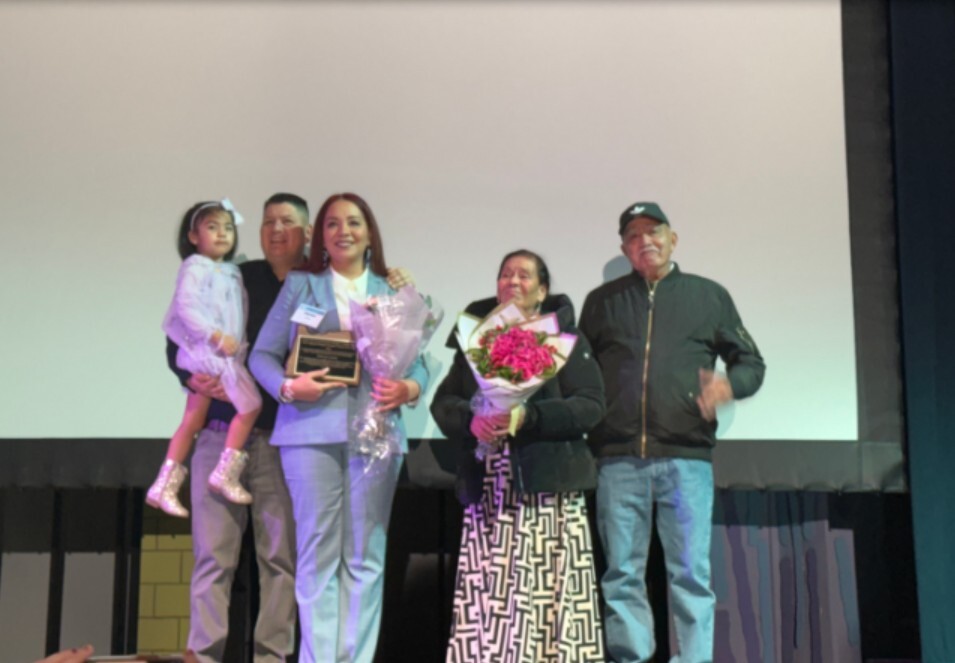 Patricia Lerma Martinez accepting OABE's Teacher of the Year award.
The Teacher of the Year, Patricia Lerma Martinez, shared an inspirational speech that we look forward to highlighting in our next newsletter. Student scholarship recipients made us proud of their hard work and determination and centered on the importance of caring for families as a unit to move outcomes forward. All in all, an outstanding conference complete with Mariachi, opportunities to connect with others passionate about multilingualism, and rigor towards a better tomorrow for those we serve!
Some district personnel recently expressed concerns to ODE regarding “item skipping” on the in-person fixed form ELPA Summative. ODE has investigated the concern.
Summary
In the 2025-26 testing year, Oregon moved from a semi-adaptive English Language Proficiency Assessment (ELPA) Summative to a fixed form version of the test that is delivered as four individual domain tests. On the fixed form, students are able to leave items unanswered and submit tests with unanswered items. Unanswered items are scored incorrect.
In January 2026, educators from three districts expressed concern to ODE about potential undesired consequences of item skipping. After investigating testing data from 1/13 through 2/16/26, ODE has concluded the following:
- No change to the test is warranted at present.
- It may be possible to address some causes of item skipping locally.
- ODE should continue to track and analyze item skipping data.
Context
Tests in the Oregon Statewide Assessment System (OSAS) can be classified into two groups: tests with adaptive components and tests without adaptive components.
Tests with adaptive components (general English Language Arts, Math, and Science summative tests) require students to respond to items before the test can advance. This requirement ensures the test has sufficient data to select the next item. It is not intended to guarantee a given minimum effort on the student’s behalf.
Tests without adaptive components (all Oregon Extended tests, ELPA Screener, Alt ELPA, remote ELPA Summative, and now the in-person fixed form ELPA Summative) do not need student responses to choose the next item. They permit students to advance past (i.e., “skip”) unanswered items. This is intended behavior that has been in place on all the aforementioned tests since their incorporation into OSAS.
The ability to skip items on the ELPA Summative has been present since 2015-16 in all ELPA21 states other than Oregon. No other ELPA21 state has yet reported an issue with item skipping.
Data Analysis
ODE examined data for tests taken from 1/13/26 to 2/16/26. Analysis revealed patterns such as the following (abbreviating Reading, Writing, Listening, and Speaking with RWLS):
- Most students skipped 0 items.
- Even in the domain with the most skipping (GK R), 84.27% of students completed the entire domain test (skipped 0 items).
- In GK L, G1 R, and G2-3 R, 87-88% of students completed the entire domain test (skipped 0 items).
- In all other grade band/domain test combinations 91%+ of students completed the entire domain test (skipped 0 items), with eight combinations exceeding 95% “entirely complete”.
-
Item skipping was significantly present only in Grades K (RWS) and 9-12 (WS).
-
Very few students are skipping all or most of the ELPA Summative.
-
Item skipping varies across districts and domains.
-
The rate of item skipping is not proportional to the number of students tested across districts. Some districts tested many students and saw little skipping. Other districts saw more skipping even though they tested comparatively fewer students.
-
Students skip at different rates in different domains. Only 21 students statewide skipped at least half their Listening items (the least skipped domain). 103 students skipped at least half their Writing items (the most skipped domain).
-
Item skipping will not reduce most students’ scores as compared to 24-25 testing.
-
Of the 306 students who skipped 50% or more items on at least one domain test in 2025-26, 41 had a domain score of 2 or higher in a corresponding 2024-25 domain test.
-
All other students who skipped 50% or more of the items on the 25-26 ELPA Summative were either taking ELPA for the first time or had a domain score of 1 in the corresponding domain in 24-25.
Conclusions
Caution should be observed when drawing conclusions from just a single month of testing data, including the conclusions listed below. ODE will revisit item skipping data in 2025-26. Based on data analysis and district reports, ODE currently believes:
- The test is functioning as intended.
- Item skipping is an allowable and designed test behavior (and has been present on the remote ELPA Summative for three years).
- It is not clear that item skipping is higher in 25-26 than random guessing was in 24-25 and prior years.
-
If current item skipping trends continue, item skipping will likely have little measurable impact on On Track to ELP (OTELP) rates.
- Local variance of item skipping rates suggest that the issue can be addressed via local measures, such as:
- Exposing students to the Sample Test to increase familiarity with the test platform and item selection processes.
- Familiarizing staff with the intended behavior and function of the test (including the possibility of item skipping).
- Item skipping likely has different causes. For example:
- It is possible that lack of familiarity with testing equipment or the testing platform may explain some item skipping in Grade K or with some students new to the Oregon school system.
- Low skipping rates in Listening and higher skipping rates in Writing and Speaking may suggest the influence of a high affective filter (cf. this article by Stephen Krashen).
On Track to ELP
The most important aspect of ELP testing is accurately measuring what a student knows and can do. This equips districts to provide effective instruction and ensures that students who need language services receive those services, while students who no longer need language services exit EL status.
That being said, a student’s OTELP baseline is established by their first ELPA Summative test. For item skipping to negatively affect OTELP, the student needs to be taking at least their second ELPA Summative test and would need to demonstrate a significantly different testing behavior from the prior year.
Analysis of testing data from 1/13 to 2/16/26 show that of students who engaged in significant item skipping (i.e., leaving 50% or more items unanswered on at least one domain test), only 41 students statewide can possibly see a reduced ELPA domain proficiency rating in 2025-26 as compared to 2024-25 due to skipping, and only in one domain. Of those 41 students, 23 had a domain score of 2 in 2024-25.
For more information about On Track to ELP, contact Stephanie Evers.
In Closing
ODE appreciates districts’ desire for students with EL status to have a fair opportunity to demonstrate what they know and can do on state tests. Accurate results on the ELPA Summative help inform instruction, evaluate English language development programs, and correctly identify which students need English language development services. ODE encourages efforts to help students do their best on all statewide tests, including ELPA. ODE will analyze item skipping data again later in the ELPA Summative test window to confirm whether the conclusions above remain accurate.

4. ELPA Read Aloud Guidelines Updated
Language in the ELPA Read Aloud and Scribe Guidelines (found in the General Accessibility Resources accordion of the Assessment Resources page) has been updated to more clearly indicate what can and cannot be read aloud should the Human read aloud support be activated on the English Language Proficient Assessment (ELPA) Summative or Alt ELPA. This update is for clarity only; the policy itself has not changed.
Contact Ben Wolcott, ELPA Specialist, with questions regarding ELPA testing.
|
5. ODE State Summer Learning Grant RFA Announcement for Sharing
The Oregon Department of Education (ODE) has announced the opening of the 2026-28 State Summer Learning Grant Request for Applications (RFA). These competitive grants will support high‑quality, research‑aligned summer learning programs that accelerate academic literacy growth and holistic youth development.
We encourage all eligible entities to review the full State Summer Learning Grant RFA, view the materials from the Pre-Application Conference on OregonBuys, and submit questions via the Q&A Smartsheet to support successful application development.
Key Dates
- March 18: Questions/Requests for Clarification Due
- March 5, 12, and 19: Answers to Questions/Requests for Clarification Issued on Oregon Buys
- March 20, 5:00 pm: Closing (Applications Due)
- April: Issuance of Notice of Awards
Eligible Applicants
To be eligible for a Grant under this RFA, Applicants must be one of the following entity types and meet the criteria below:
- A School District organized under ORS 332;
- An Education Service District (“ESD”) organized under ORS 334;
- A Public Charter School as defined in ORS 338.005; or
- A Consortium of the above entities; and
- Demonstrate capacity to operate an in-person Summer Learning Program that uses Research-Aligned Strategies, meets Grant requirements, and aligns with Grant goals (Section 2.3.3 and 2.4.1 of the RFA).
Contact Us

1. Webinar Recap: Supporting Refugee Youth Mental Health
On February 25, 2026, U.S. Committee for Refugees and Immigrants (USCRI) provided a training on "Addressing the Mental Health of Refugee Children and Youth Part II - Facilitating Effective Conversations with Youth and Families".
- Simple ways to support your child's well-being
- Supporting your child's well-being through connection and open communication
- Facilitating effective conversations about mental health with newcomer youth and families (for service providers)
The handouts are currently available only in English, with translated versions in progress. You can access the training recording, slides, and handouts here, and materials from Part 1 are available here.
USCRI’s next training, “Identifying, Assessing, and Responding to Trafficking Concerns Involving Refugee & Newcomer Youth,” will be held on March 25 at 11 a.m. To join, register here.
Additional trainings, resources, and Oregon‑specific services can be found on the USCRI Refugee Youth Resource Center site, including their Community Resource Directory.
|
2. Article: Indigenous Parents from Mexico Call for More Interpretation
What happens when a parent can’t speak the language their child’s school relies on and the school doesn’t speak theirs? This article uncovers a rarely discussed challenge faced by Indigenous Mexican families in California, revealing how gaps in interpretation services can leave students vulnerable and parents unheard. Read the full story here.
 |
|
3. Article: It’s Never Too Late to Learn a Language
Research shows that while age influences how people learn a language, the ability to acquire new vocabulary, grammar, and fluency never disappears. Adults and children simply bring different strengths to the process. Learn more here.
|
4. Article: Educators Warn Flat English Learner Funding Falls Short of Growing Demand
Congress approved funding dedicated to English learners for the 2026 fiscal year, but left allocations unchanged despite rising student enrollment and increasing instructional costs. The article highlights growing concerns from educators about the sustainability of support for multilingual learners under stagnant Title III funding.Learn more here.

1. Webinar: Upholding the Education Civil Rights of Multilingual Learners, March 10, 2026
The Center for Applied Linguistics invites educators and leaders to join the webinar “Upholding the Educational Civil Rights of Multilingual Learners and Families” on March 10, 2026. This session brings together policy experts and practitioners to demystify the civil rights protections that support multilingual learners and to highlight real-world strategies and state-level insights that help schools create truly equitable learning environments. A valuable opportunity for anyone committed to meaningful access and inclusion. Click here to register.
Back to top
|
2. PODER Statewide Town Hall, March 18, 2026
The PODER Coalition will host a statewide town hall on Wednesday, March 18, from 12–1 p.m. via Zoom. The session features Jessica Ventura, Director of the Oregon Office of Immigrant and Refugee Advancement, who leads statewide policy coordination to support immigrant and refugee Oregonians. A first‑generation immigrant raised in Oregon, she brings over a decade of experience in equity‑focused policy and legislative strategy. Click here to join the conversation online.
Back to top

3. Center for Applied Linguistics Literacy Institute, April 2026
The Center for Applied Linguistics is launching a new four‑day virtual institute, CAL Literacy: Comprehensive Approach to Literacy Instruction, held on April 8, 15, 22, and 29, 2026. This professional learning series responds to national priorities around literacy and equity and is aligned with the U.S. Department of Education’s Comprehensive Literacy State Development efforts.
Grounded in National Committee for Effective Literacy research, the institute helps educators connect evidence‑based literacy practices with the needs of multilingual classrooms. Participants will explore strategies that integrate oral language, foundational skills, vocabulary, comprehension, and writing within culturally and linguistically sustaining instruction.
Attendees will gain practical classroom strategies, a ready‑to‑use literacy lesson plan, and a 22‑hour digital badge in CAL Literacy for Multilingual Learners. Early registration is encouraged due to limited space. Click here to learn more and register.
|

5. Registration Now Open: National 2026 Title I, Part C Convocation, April 27-30, 2026
NASDME invites you to attend the National 2026 Title I, Part C Convocation, April 27–30, 2026. This reimagined national event will offer high-quality professional development, dynamic general sessions with national leaders, and practical workshops on key migrant education topics. Participants will also have opportunities to connect with colleagues nationwide and engage in collaborative, interactive experiences. Click here to learn more and to register.
|

If you have content or stories you’d like featured in our newsletter, we want to hear from you! Whether it’s an article, event, or an inspiring story, your contributions add depth to our discussions. Please send your submissions and ideas to Estephany Membreno, Administrative Specialist, and you may see your content in an upcoming publication.
|

For questions or assistance, the Multilingual and Migrant (MME) team is available to support you. Please contact us via email for further information.
|
|
Hector Aguirre, Migrant Education Title IC Specialist
|
|
Diego Contreras-Medrano, Migrant Education Research Analyst
|
|
Jennifer Fontana, Multilingual Education Specialist
|
|
Kelly Kalkofen, English Learner Outcomes Program Education Specialist
|
|
Yuliana Kenfield, Migrant Education Title IC Specialist
|
|
Mary Martinez-Wenzl, Director of Multilingual & Migrant Education Team
|
|
Estephany Membreño, Administrative Specialist II
|
|
Kim Miller, Title III Education Specialist
|
|
Myrna Muñoz, English Learner Outcomes Program Education Specialist
|
|
Reza Norouzian, Multilingual Education Research Analyst
|
|
Natalia Piar, Multilingual & Migrant Education Team Coordinator
|
|
Marisol Rodriguez, Administrative Specialist II
|
You were added to this newsletter if you are part of the Migrant Education Program and/or the Title III English Learner listserv. Migrant Ed and Title III leaders, staff, and interested members of the public may subscribe to this newsletter through ODE's QuickSubscribe portal at any time. We thank you for serving Oregon's multilingual and migrant students.
|