In This Message
- Federal Actions Update
- ESSA Quick Reference Brief: Determining Allowability
- It’s Consultation Time!
- Equitable Services Consultation
- Introducing the ESEA Modules!
- Plan for the 2026 EVE Workforce Survey
- CIP Budget Narrative Submission Reminder
- Reading Corner
Earlier this month Congress passed, and the President signed, a budget to fund the U.S. Department of Education and the programs for the 2026-27 school year. This budget includes slight increases in Title I-A, special education, rural education, and Impact Aid from FY25. Most other K-12 programs are level funded at FY25 levels.
The bill also requires ED to make formula grants available to states by July 1, the date identified in ESEA when funds can begin being obligated.
Now that a budget has been passed, ED staff are working to calculate preliminary state allocations, which usually takes 2-3 weeks. The Federal Systems as well as the Multilingual Migrant Education Teams at ODE then need 1-2 weeks to calculate district allocations. The ODE will provide allocations to districts as soon as possible and will continue to share updates as we learn more about Congressional action. Once available, allocations will be posted on the ODE’s ESEA Allocations webpage.
Each program within ESEA is authorized for a specific purpose, intended to support improved outcomes for identified groups of students. While allowable activities are often articulated in the authorizing statute, states and districts must also look to regulations from the U.S. Department of Education (ED) for direction on how to spend federal funds in allowable ways. In ESSA Quick Reference Brief: Determining Allowability, learn more about the Education Department General Administrative Regulations (EDGAR), the Uniform Grant Guidance (UGG) and key questions to ask when determining allowability.
Check out other ESSA Quick Reference Briefs here!
|
Consultation is a requirement of many ESEA programs and is a core aspect of district efforts to support students. While the content of consultation and the partners involved vary by program, the process should be timely, meaningful and ongoing.
As spring approaches, there are three areas of consultation and engagement to highlight:
-
Equitable Services to Private Schools - ESEA sections 1117(b)(5) and 8501(c)(5) require each school district to conduct consultation with every private school in their district and submit documentation that consultation occurred, or that attempts were made to contact the private schools. Consultation must occur for every Title program that is eligible for equitable services and for which a district receives an allocation. The goal of consultation is to reach agreement between the LEA and private school officials on how to provide equitable and effective programs for eligible private school children. While the final decisions concerning equitable services rest with the district, serious and due consideration must be given to the private school’s views. Resources for consultation can be found in the Equitable Services Toolkit.
-
Tribal Consultation - Consultation requirements under section 8538 of ESEA, require “affected” local education agencies (LEAs) to consult with Indian tribes, or those tribal organizations approved by the tribes located in the area served by the LEA, prior to submitting a plan or application for covered programs. Covered programs include all federal title programs that are administered by the ODE. The consultation must be done “in a manner and in such a time that provides the opportunity for such appropriate officials from Indian tribes or tribal organizations to meaningfully and substantively contribute” to plans under covered programs. Resources for Tribal Consultation can be found in the Tribal Consultation Toolkit.
-
Title II-A and Title IV-A – Sections 2102(b)(3) and 4106(c) of ESEA require LEAs to consult with a variety of individuals including district staff, families, community partners, and other education partners when making determinations on how to spend funds. However, this does not have to be a separate process for each program. The district’s comprehensive needs assessment, data review, and engagement efforts as part of the Integrated Programs process can be expanded to include discussion of these two programs and used to receive input and feedback on how best to use these funds to benefit students, staff, and families.
For districts who are consulting with private schools, it is recommended that they use the ODE’s 2026-2027 school year Affirmation of Consultation (available in Word or PDF). When completing the Affirmation, the district and private school will complete the first page and then each program page in which the private school is participating. Language was added to address inventory in the Private School Affirms section at the bottom of the first page.
For school year 2026-2027 consultation with private schools:
- Each District must, at a minimum, contact all of the private schools physically located in their district (districts may use the Private School by District List as a resource to help identify private schools). Additionally, if an out-of-district private school is known to enroll students living in your district, the district must also contact these private schools but only for Title I-A equitable services.
- If the private schools listed for your district need updating, please contact the ESEA Private School Ombuds.
- The Intent to Participate Letter is a template school districts can use to inform private schools of their opportunity to participate in equitable services.
- Evidence that the district invited private schools to consultation must be uploaded to the Evidence of Consultation form.
- For private schools that are non-responsive, upload evidence that the private school was invited to consultation.
- For private schools that decline services, upload evidence that the private school declined services.
- For private schools that are participating in services, upload a signed Affirmation.
Questions? Comments? Concerns? Contact Janette Newton, the Private School Ombuds, at Janette.Newton@ODE.Oregon.Gov or Call/Text 503-551-9405.

Join us on Tuesday, February 17th, from 10:00 to 11:00 a.m. Pacific Time, on Zoom for “Puzzled by Federal Programs?” This webinar will showcase the new ESEA modules that are now available!
The 10 self-paced modules are under 30 minutes each, free to anyone in your district, and cover all ESEA Title programs, along with cross-program topics such as Equitable Services, Rank and Serve and Supplement not Supplant.
The webinar will walk through the five Ws of the modules:
-
Why the modules were created and the challenge they are designed to address
-
What is included and how the pieces fit together
-
Who the modules are designed for
-
When to use them as part of your overall strategy
-
Where to access them
After reviewing these basics, we will explore the modules together and show how the pieces come together in practice. We hope to see you on February 17th.
|
Oregon’s 2026 Elevating Voices in Education (EVE) Workforce Survey will open on Monday, February 2 and close on Tuesday, March 31.
The EVE Workforce Survey is a free, anonymous and confidential survey designed to gather insights from the public education workforce about their workplace experiences in order to provide actionable information to the state and districts.
What is Required?
ORS 342.676 requires public education providers (districts, charter schools, ESDs, YCEP/JDEP, Oregon School for the Deaf, and long-term care or treatment facilities) to provide staff with an opportunity to participate in the EVE Workforce Survey.
Who Should Take the Survey?
Licensed, classified, and contracted staff. The law requires staff members to be informed of and provided an opportunity to complete the EVE Workplace Survey, but staff participation in the survey is voluntary.
What’s New in the 2026 Survey?
The EVE Workforce Survey has 25% fewer questions and includes four optional opportunities for educators to share more about their sense of belonging, workplace stress and other critical survey domains.
Please share this Save the Date Flyer with your staff electronically. We also recommend sharing it in person (e.g., at a staff meeting or posting where it can be easily accessed). If you have any questions about accessing or completing the EVE Workforce Survey please visit the EVE Workforce Survey website or contact ODE.edstaffsurvey@ode.oregon.gov.
|
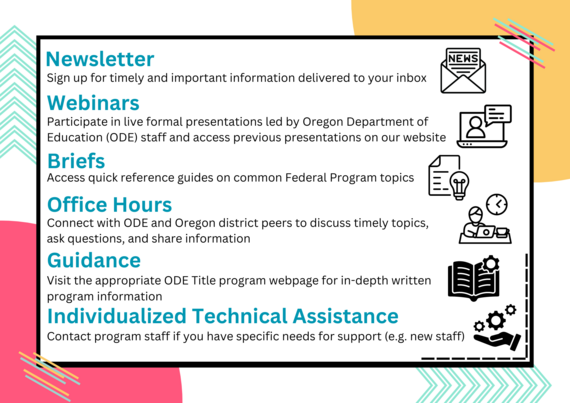
Federal System Team's "Framework of Support"
Our goal is to provide differentiated support and strengthen the partnership between districts and ODE federal program staff. Check out the resources and support below and reach out to let us know how we can support you!
|