
-
Webinar: Teachers, Paraprofessionals, and ESSA –January 20th, 10-11 AM
-
Formula Grants Office Hours (Titles I-A, II-A, IV-A, and V-B) – February 10th, 10-11 AM
-
CIP Budget Narrative Carryover Application (2024-25 Funds): Opened November 20th, Due January 15th
In This Message
- Federal Actions Update
- ESSA Quick Reference Brief: Family Engagement
- Join us for our monthly ESEA webinar!
- CIP Budget Narrative Submission Reminder
- ‘Tis the Season (To Document Time and Effort)
- Division 22 Professional Learning Series
- Reading Corner
On November 12th, the U.S. House of Representatives passed a Continuing Resolution (CR) to reopen and fund the government. This CR funds most of the government – including the U.S. Department of Education – at last year’s fiscal year (FY) 2025 funding levels through January 30. Congress will need to pass additional legislation by January 30th, to fund the rest of the federal government and avoid another shutdown in February. Congress has not introduced a bill that will fund the 2026-27 school year. In addition to funding the government past January 30, 2026, Congress will also need to pass a budget to fund the ESEA Title programs for next school year.
Families are their children’s first and most important teachers, and engaging families in partnership is a critical component to student success. ESEA requires districts and schools that receive Title I-A funds to communicate, collaborate, and work as partners with families, with the goal of improving student achievement and promoting academic success. In ESSA Quick Reference Brief: Family Engagement under Title I-A learn more about these requirements as well as recommendations for practice to ensure all families feel welcome and able to participate as partners.
|

Join us on Tuesday, January 20, from 10:00 to 11:00 a.m. Pacific Time, on Zoom for “Teachers, Paraprofessionals, and ESSA: Requirements under Title I-A.”
The webinar will cover key changes in requirements from No Child Left Behind (NCLB) to the Every Student Succeeds Act (ESSA), as well as:
- Which paraprofessionals must meet requirements and the methods available to meet those requirements,
- A review of applicable certification and endorsement requirements for teachers, and
- Required district notifications to families.
We know these requirements can raise questions, and our team looks forward to supporting you navigate them. We hope to see you on January 20.
|

The 2025-26 CIP Budget Narratives opened on August 14th and were due November 7th.
The Federal Systems Team recognizes the multiple demands districts are currently experiencing and is committed to working in partnership to ensure that they receive all funds for which they are eligible. Some additional dates to track are included below:
- Carryover narratives opened November 20th, and are due Thursday, January 15, 2026.
- Funds will be frozen for any district that has not submitted the 2025-26 CIP Budget Narrative by February 2, 2026.
- Funds will be liquidated for any district that has declined or has not applied for federal grants through the 2025-26 CIP Budget Narrative on June 1, 2026.
If your district has questions about submitting a particular narrative, please reach out to your regional specialist with questions or support.
-
Jen Engberg: Clackamas, Columbia Gorge, Linn-Benton-Lincoln, Multnomah and Northwest Regional
-
Sarah Martin: Douglas, Lake, Lane, Malheur, South Coast and Southern Oregon
-
Amy Tidwell: Grant, Harney, High Desert, InterMountain, Jefferson, North Central, Region 18 and Willamette
|
Is your district using Federal Funds to pay the salary and benefits of staff? If so, please remember that all employees whose salary is paid with federal funds (in whole or part) must track and formally document their time and effort.
Charges to federal awards for salaries and wages must be based on accurate records systems. Time and Effort systems must meet the requirements outlined in 2 C.F.R. Part 200.430(i) of the Uniform Grants Guidance (UGG), including:
- Maintaining an internal system of controls;
- Developing written policies and procedures;
- Ensuring 100% of staff time is documented;
- Documenting actual time spent on federal program activities (rather than projections);
- Following established accounting activities and procedures; and
- Tracking time by cost objective.
More information on the requirements for Time and Effort can be found in the ESSA Quick Reference Brief: Time and Effort.
The Oregon Department of Education (ODE) is hosting quarterly professional learning sessions to support district leaders in implementing Division 22 standards and requirements. Find dates and registration information for all dates in the series on the Division 22 Professional Learning Series flier.
Join us virtually on Friday, January 23rd from 9:00 -10:15 AM, as we focus on the following topics:
- Division 22 Hot Topics/Updates from ODE Staff
- Bite-Sized Brief
- Waivers, Extensions, and Postponements: Decoding the Details
- Instructional Materials Adoption Engagement
- Provide input on the effectiveness and challenges of the current instructional materials adoption schedule.
- Your experience and perspective are essential to ensuring the redesigned program reflects the realities and needs of Oregon districts.
Register via zoom to get the meeting link and add the January session to your calendar.
Recorded content and materials will be posted on the Division 22 Standards Professional Learning webpage following each meeting.
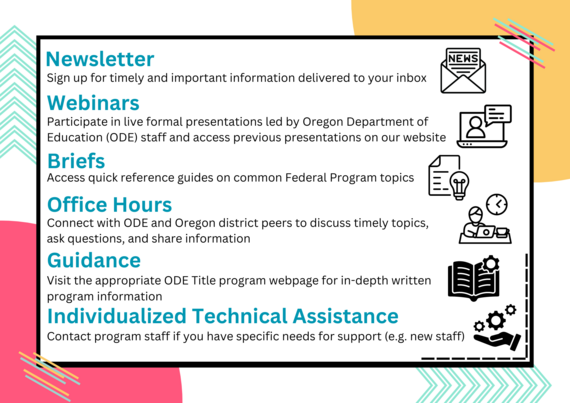
Federal System Team's "Framework of Support"
Our goal is to provide differentiated support and strengthen the partnership between districts and ODE federal program staff. Check out the resources and support below and reach out to let us know how we can support you!
|