|
|

Hello Everyone!
We are hoping your summer was a blend of rest and fun, and you find yourself in a space of balance as we begin our 2025 - 2026 school year. In this newsletter, you will find a number of ODE updates, resources, and other pertinent information for the start of the school year. We have the opportunity to acknowledge, celebrate and educate our students about National Dance Day, Substance Use Prevention Month, Suicide Prevention Month, and National Hispanic Heritage Month to name just a few.
Please take some time to read about the new Physical Education Standards, look for opportunities to participate on our Instructional Materials Criteria Review Committee, sign up for the Oregon SHAPE conference, and review other resources that you can use with your students. Please also feel free to reach out with any questions, requests or suggestions to help us help your new year off to a good start.
Best wishes for a great new school year!
Suzanne Hidde, Health and Physical Education Specialist & Alanna Russell, Substance Use Prevention Education Coordinator
|
ODE Updates
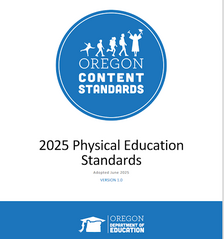
Introducing Oregon's 2025 Physical Education Standards
Oregon has taken a step forward in reinforcing the critical role of physical education within its K–12 required content areas . The State Board of Education has officially adopted the standards based on SHAPE America’s National Physical Education Standards (2024), and infused it to fit the needs and values of Oregon.
The newly updated 2025 standards focus on four foundational domains:
-
Developing a variety of motor skills (DMS) — Supporting physical literacy through diverse movement experiences.
-
Applying movement and fitness knowledge (AMF) — Encouraging students to use fitness concepts and strategies to enhance efficiency and well-being.
-
Cultivating social skills through movement (SSM) — Building empathy, communication, leadership, and cultural awareness during physical activities.
-
Fostering personal skills and motivation (SMC) — Guiding students toward understanding and choosing physical activity that is personally meaningful, while setting and reflecting on goals.
The new Oregon PE Standards are organized by grade bands - K–2, 3–5, 6–8, and 9–12—instead of specifying standards for each individual grade. This approach:
- Supports developmentally appropriate motor progressions, allowing younger students to focus on foundational skills and older students on refining competence and applying knowledge.
- Offers instructional flexibility and differentiated learning opportunities, giving educators room to tailor lessons based on class needs while maintaining consistent expectations across similar developmental stages.
Transformative Social and Emotional Learning (TSEL) Standards are deeply integrated into Oregon’s PE Standards, with domains specifically linked to TSEL Self‑Management & Agency and Social‑Awareness & Belonging—helping students navigate emotional, mental, and relational challenges in active settings. Together, these design choices ensure Oregon’s PE Standards promote not only physical literacy, but also the social and emotional skills students need for lifelong wellbeing.
These standards are designed not just to help students stay active, but also to empower them with the lifelong knowledge, attitudes, and behaviors needed to lead healthy, confident, and socially engaged lives.
*Additional guidance will be developed to assist school districts to implement the new standards by the 2027-28 school year.
|
Physical Education Instructional Materials Criteria Development Committee
The Oregon Department of Education is accepting applications for the 2025 Physical Education (PE) Instructional Materials Criteria Development Committee.
Members will review and provide input on the draft K–12 PE instructional materials adoption criteria. These criteria will guide the review of PE instructional materials to ensure alignment with the 2025 Oregon Physical Education Standards. Final criteria will be presented to the Oregon State Board of Education for approval.
District administrators and supervisors are highly encouraged to share the application with teachers, curriculum specialists, or other experienced professionals with expertise in physical education for grades K-12.
The application is open through noon, September 26, 2025 For more information or questions, contact ODE.InstructionalMaterials@ode.oregon.gov or call 503-551-3123.
|
ODE requesting your input
The ODE 2023 Health Education Standards include Substance Use, Misuse, and Abuse (SUB) as a Topic Area. Within this topic area, specific standards also utilize the terminology “substance abuse.” Since the standards were published, prevention education specialists have shifted away from using “substance abuse” and instead recommend using “substance use disorder.” According to NIDA, this shift helps reduce stigma associated with substance use and helps learners develop an understanding of substance use disorder as a medical condition and not a moral failing.
The Health Education team at ODE is proposing the following updates to the language in the 2023 Health Standards:
- Change the Topic Area title from "Substance Use, Misuse, and Abuse" to “Substance Use Prevention”
- Replace the phrase “substance abuse” with “substance use disorder (SUD)” throughout the document
- Eliminate the word “abuse” throughout the document as it relates to substance use. This word could be replaced with “misuse”, “SUD”, or simply deleted as grammatically appropriate.
The team would like to keep the acronym “SUB” to refer to the Topic Area in order to minimize confusion and workload.
Please take this brief survey to help our team identify how this change may impact your work as well as identify other factors that we should consider when making this change.
If you have additional questions or feedback, please contact ode.substance-prevention@ode.oregon.gov
|

As the school year begins, educators continue the critical work of creating safe and supportive classroom environments that promote healthy decision-making. To strengthen these efforts, new substance use prevention and intervention resources are available on the ODE Substance Use Prevention and Intervention webpage. Through strengths-based education, inclusive environments, and supportive intervention systems, K-12 classrooms and buildings provide daily opportunities for students to access the foundational skills and resources they need for life-long wellness.
ODE is offering drop-in office hours for school staff supporting student mental health, well-being, and safety. Please see details and registration information here.
August 31st is Opioid Overdose Awareness Day
Educators leading overdose prevention awareness efforts have an opportunity to share resources, engage in critical conversations with students and families, and remember those who have lost their lives to overdose. Below are resources that schools can use to share prevention-oriented messages with their communities. When doing so, schools are encouraged to remember that for the many individuals in our state who have been impacted by substance use, Opioid Overdose Awareness often comes with feelings of loss and grief. Please be thoughtful of the language that is used when sharing information about resources and events.
Overdose Prevention and Awareness Resources:
|

Oregon SHAPE Conference
Save the Date- October 11, 2025
Join Health and Physical Education teachers from around the state at the Annual Oregon SHAPE Conference on October 11, 2025 at Milwaukie High School from 8:00 am-4:00 pm. Attendance includes membership in the organization, lunch, and a chance to learn from past and present Oregon Teachers of the Year, featured speakers from Oregon and around the country, and representatives from Health and PE curriculum and equipment companies.
|
Oregon Student Health Survey Data
The 2024 Oregon Student Health Survey (SHS) offers valuable insights into the experiences and challenges faced by Oregon students. These findings help bridge the gap between youth and the adults and communities who support them — guiding efforts to create a safer, more supportive, and more equitable environment for all. As you explore topics in your classroom, consider using the SHS data to spark meaningful conversations with students and deepen their understanding of the issues that impact their well-being.
|
Teaching about Organ and Tissue Donation
This school year, Oregon high school health education standards need to include teaching about organ and tissue donation (HS.WHP.6). Cascade Life Alliance and Donate Life Northwest provide multiple ways to bring thoughtful and factual information on organ, eye, and tissue donation to meet this standard. Educators can:
- Request an in-person or virtual program presented by our staff or highly-trained volunteers, or
- Download materials for your class—we have presentations, lesson plans, videos, activities, and homework assignments ready to go for you to teach it yourself.
Best of all, this is all completely free and will meet the standard!
Ready to give your students the information needed to make an educated decision about organ, eye, and tissue donation? Find out more and request presentations and materials here.
|
International Walk+Roll Day
October 8 is International Walk+Roll Day! We encourage schools to plan events to encourage walking and rolling during the month of October. Need help planning your Walk+Roll day? Head to the SRTS websitefor toolkits and resources to help plan and promote your event.
Walk+Roll Day Incentive Ordering is Open Order your Walk+Roll incentives today! Strider + Viv stickers, comics, shoelaces, shoe wings and so much more is offered this fall! Make sure you get your orders in by October 1 to ensure until they get there by Walk+Roll day on October 8.
Adaptive Bicycle Guide Have you checked out our new Adaptive Bicycle Guide? It was created to help coordinators plan and adapt bike safety lessons for students of all abilities. Cycle Oregon presented the guide and the adaptive bikes that are available through the Jump Start program. If you missed the webinar you can find it here.
|
Support Line Available
The State of Oregon recently launched the 988 Oregon: Connect to Hope campaign, aimed at making sure everyone knows they can call or text 988 for free, confidential mental health or substance use support. We want people to know it’s never too early to reach out for support. Reach out when you’re stressed, worried or just feeling really down. If you’re having suicidal thoughts or worried about someone else, 988 is here for you.
Partners can help spread the word about 988 Oregon in their community at https://988oregon.org/partners/.
Have questions? Read more on https://988oregon.org/partners/ or reach out to Dean Carson, 988 Communications Officer at Oregon Health Authority and Claire Coffey, Senior Account Manager at Coates Kokes.
|
New Resources from Song for Charlie
Song for Charlie and New Drug Talk Oregon are offering free resources, grounded in evidence-based prevention best practices, to educate students and communities about today’s drug landscape. Their free Educator Package includes education materials, curriculum guides, discussion tools, and parent resources. To further support local efforts, they are also offering $500 community investment grants to help Oregon-based organizations raise awareness and educate their communities about fentanyl. Questions? Contact Kristin MacRostie, New Drug Talk Oregon Program Director, at kmacrostie@songforcharlie.org.
For their next Collaboration Forum on September 11th, Song for Charlie is walking through their Educator Package. Sign up here.
|
|
|
|
|
|
|
|